Palantir just delivered the fastest growth in its history as a public company. Revenue grew 96% year-over-year to US $ 2.31 billion in a single quarter. Management also raised full-year guidance again.
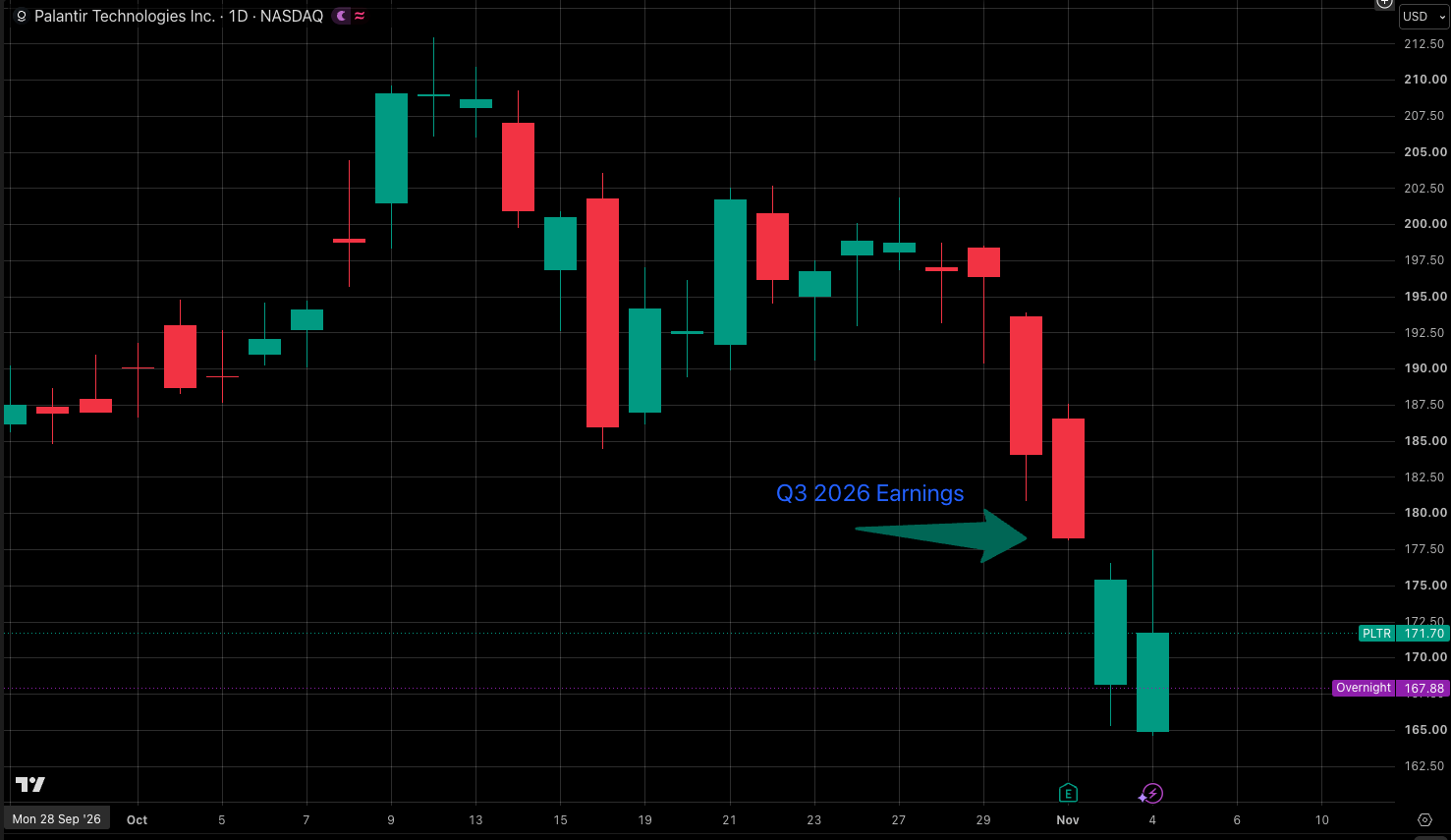
And the stock still fell.
If that feels familiar, it should. Palantir has dropped after strong reports several times over the past two years. The pattern may frustrate a lot of retail investors, but that’s just how the market reacts to events like earnings.
In this breakdown, we walk through what Palantir reported, the less obvious numbers that explain the market's reaction, and the questions worth asking before the next report.
Palantir Q3 2026 earnings at a glance
Palantir reported results for the quarter ended 30 September 2026 after the US market closed on 2 November 2026. It beat Wall Street estimates on both revenue and earnings.
|
Metric |
Q3 2026 |
Q3 2025 |
Change |
|
Revenue |
US$2.31B |
US$1.18B |
+96% |
|
US revenue |
US$1.94B |
US$883M |
+119% |
|
US commercial revenue |
US$984M |
US$397M |
+148% |
|
US government revenue |
US$953M |
US$486M |
+96% |
|
Adjusted operating margin |
62% |
51% |
+11 pts |
|
Adjusted free cash flow |
US$1.22B |
US$540M |
+125% |
Revenue came in at US2.31 billion. Earnings per share of 0.44 beating 0.41 consensus.
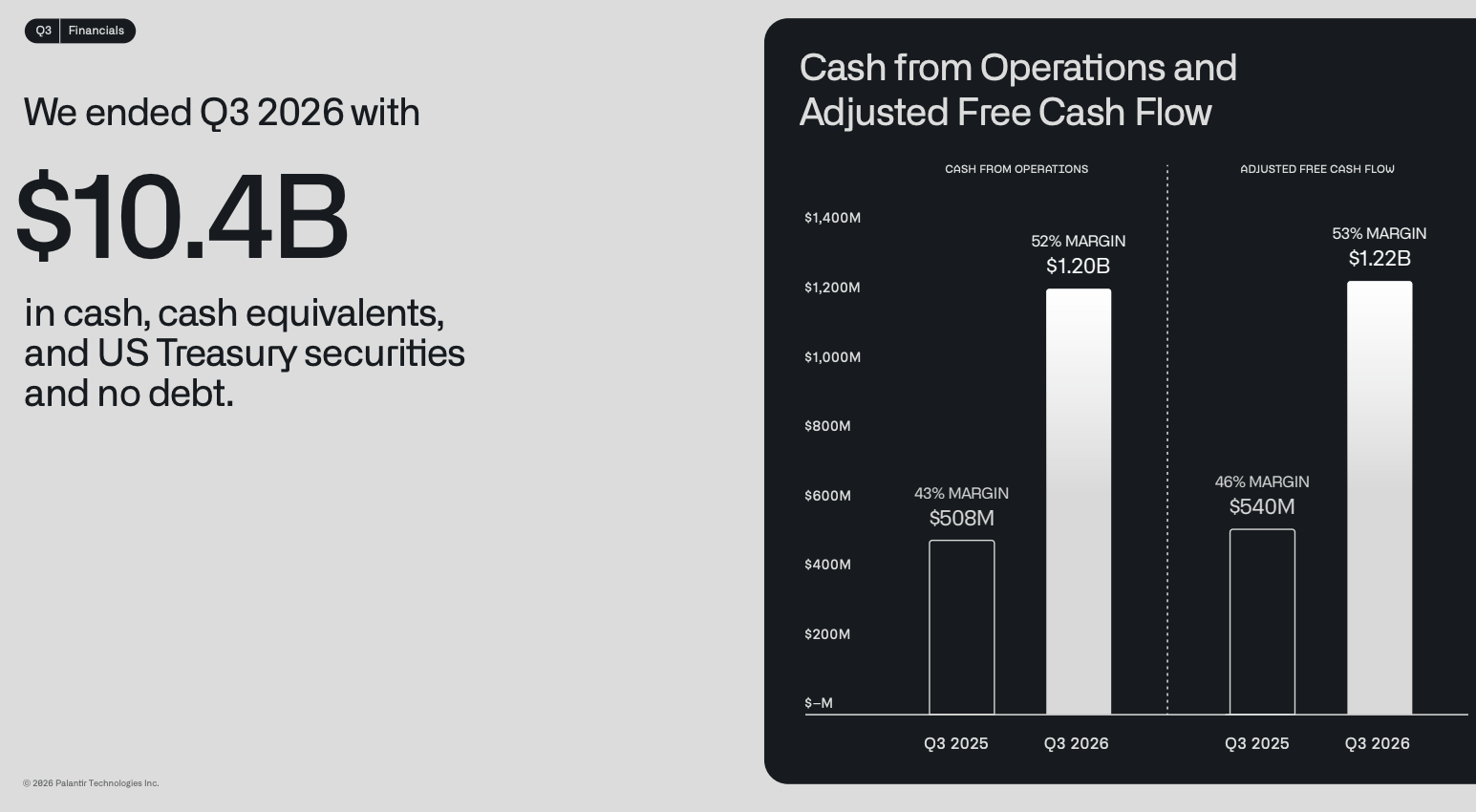
Palantir also ended the quarter with US$10.4 billion in cash, cash equivalents and US Treasury securities, and no debt.
The headline news: US commercial overtakes government for the first time
For most of its history, Palantir was known as a government software company. That changed this quarter. US commercial revenue reached US 984 million for the first time.
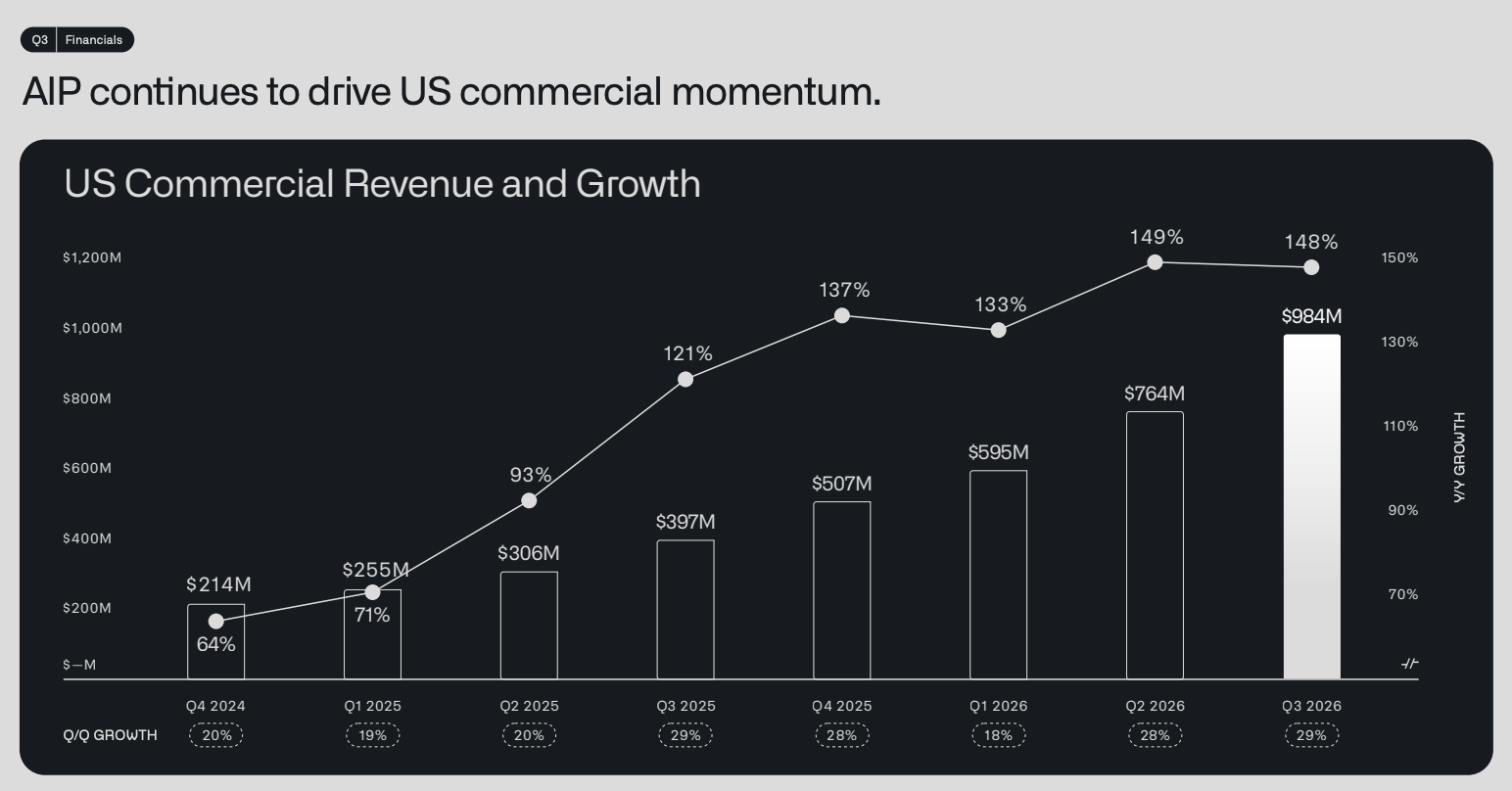
The shift has been building for two years. US commercial growth accelerated from 64% year-over-year in Q4 2024 to 148% in Q3 2026.
The main driver is Palantir's Artificial Intelligence Platform (AIP). AIP sits on top of Foundry, Palantir's data operating system, and lets companies deploy AI agents on their own data. Customer examples in the Q3 deck include NVIDIA (supply chain), Hexion (chemical manufacturing) and the FAA (aviation safety).
Two customer metrics show where the growth is coming from:
- Net dollar retention rose to 165%, up 8 points from the prior quarter. Existing customers spent 65% more over the trailing 12 months than they did a year earlier.
- US commercial customers grew 29% to 686. Revenue is growing much faster than the customer count, which means most of the growth comes from existing customers expanding.
The government side of revenue is also far from slowing. US government revenue still grew 96%, and the US Army awarded Palantir a prime agreement to produce eight TITAN AI-enabled ground stations.

Profitability: growing fast and getting more efficient
Palantir's costs are growing far slower than its revenue. Adjusted expenses rose 53% to US$887 million while revenue grew 96%. That gap is what suggests operating leverage within Palantir.
GAAP operating income reached US$1.08 billion, a 47% margin, up from 33% a year ago. On an adjusted basis, the operating margin was 62%, flat versus Q2 2026 but up from 51% a year ago.
The numbers behind the numbers: bookings slowed sharply
Revenue tells you what a company earned this quarter. Bookings tell you what it has signed for the future. In this earning report, those two stories pulled in different directions.
First, three terms worth knowing:
- Total contract value (TCV): the full value of new contracts signed in the quarter, including options customers haven't exercised yet.
- Remaining deal value (RDV): the total value of signed US commercial contracts not yet recognised as revenue. Think of it as the backlog.
- Remaining performance obligations (RPO): the non-cancellable portion of that contracted backlog, reported under accounting rules.
Here's how they moved over the past three quarters:
|
Metric |
Q1 2026 |
Q2 2026 |
Q3 2026 |
|
Total TCV |
US$2.41B (+61% YoY) |
US$3.37B (+49% YoY) |
US$2.92B (+6% YoY) |
|
US commercial TCV |
|
US$2.13B (+153% YoY) |
US$1.46B (+11% YoY) |
|
US commercial RDV, QoQ change |
+12% |
+27% |
+4% |
|
Total RPO |
US$4.45B |
US$4.90B |
US$4.88B |
|
US commercial customers, QoQ change |
+8% |
+6% |
+5% |
A few things stand out:
- US commercial bookings fell about 31% from Q2's record. Growth slowed from 153% to 11% year-over-year, even as US commercial revenue grew 148%.
- The backlog barely grew. US commercial RDV rose just 4% quarter-over-quarter, and total RPO edged down slightly from Q2
- New customer additions are slowing. Quarterly growth in US commercial customers eased from 8% to 5% over the past three quarters.
- International lagged. Palantir's earnings call highlighted growth of only about 21% year-over-year and 1% quarter-over-quarter outside the US.
While none of this means demand has collapsed. Bookings are lumpy, Q2 was an unusually strong quarter, and billings still doubled year-over-year to US$2.45 billion. But revenue today comes from contracts signed months ago. When bookings slow, the market starts asking how long the current pace can last.
Why did Palantir stock drop after earnings?
The market reaction to earnings depends less on whether results are good and more on whether they beat what the consensus already expected. A good earning report may be punished if investors expected a lot more. Three forces were at work this time for Palantir.
1. Expectations were already sky-high. Palantir has beaten estimates for many quarters running. When a company does that consistently, investors start pricing in the beat before it happens. Clearing consensus by roughly 6% on revenue was strong, but it may not have been the blowout some had positioned for.
2. The bookings slowdown gave bears a talking point. Media coverage the next day focused on slower US commercial bookings rather than the record revenue. For a stock priced on future growth, a soft leading indicator matters more than a strong trailing one.
3. Valuation leaves little room for error. When a stock trades at a high multiple of its earnings, more of its price depends on growth years into the future. Any hint that growth might slow can trigger a sharp repricing, even if the business itself is performing well.

This is the core lesson from Palantir's post-earnings history. A great business and a great stock at today's price are two separate questions. The market answers the second one every quarter.
Palantir's guidance for Q4 and full-year 2026
Palantir raised its full-year outlook for the third time this year.
|
Metric |
Q4 2026 guidance |
FY2026 guidance |
|
Revenue |
US$2.649B–US$2.653B |
US$8.530B–US$8.534B |
|
Adjusted operating income |
US$1.640B–US$1.644B |
US$5.245B–US$5.249B |
|
US commercial revenue |
— |
Above US$3.559B (≥143% growth) |
|
Adjusted free cash flow |
— |
US$4.8B–US$5.0B |
At the midpoint, Q4 guidance implies about 88% year-over-year revenue growth, ahead of the roughly US$2.46 billion analysts expected.
Management also expects GAAP operating income and net income in every quarter of 2026. These are company forecasts and can change.
What Investors should be watching next quarter
The Q3 report raises one central question: is the bookings slowdown a one-quarter blip after a record Q2, or the start of a trend? These are the numbers that will help answer it.
US commercial TCV. A rebound towards Q2 levels would ease concerns. Another quarter of low growth could make the slowdown harder to dismiss for investors.
RDV and RPO. The backlog has to keep growing for projected revenue growth near 90% to be sustainable. Net dollar retention. At 165%, existing customers are doing the heavy lifting. We'll watch whether that holds as new customer additions slow.
Stock-based compensation. Rising SBC dilutes shareholders, so we track it against revenue growth.










submit your comment