A trader who likes a stock and expects it to stay above a certain level for the next few weeks often faces a choice. A cash-secured put ties up significant capital. Directional calls decay with time. Outright shares require even more capital.
The put credit spread occupies a different corner of the strategy map: be bullish on a level, define the risk, collect a credit, let time decay work. While not owning the stock.
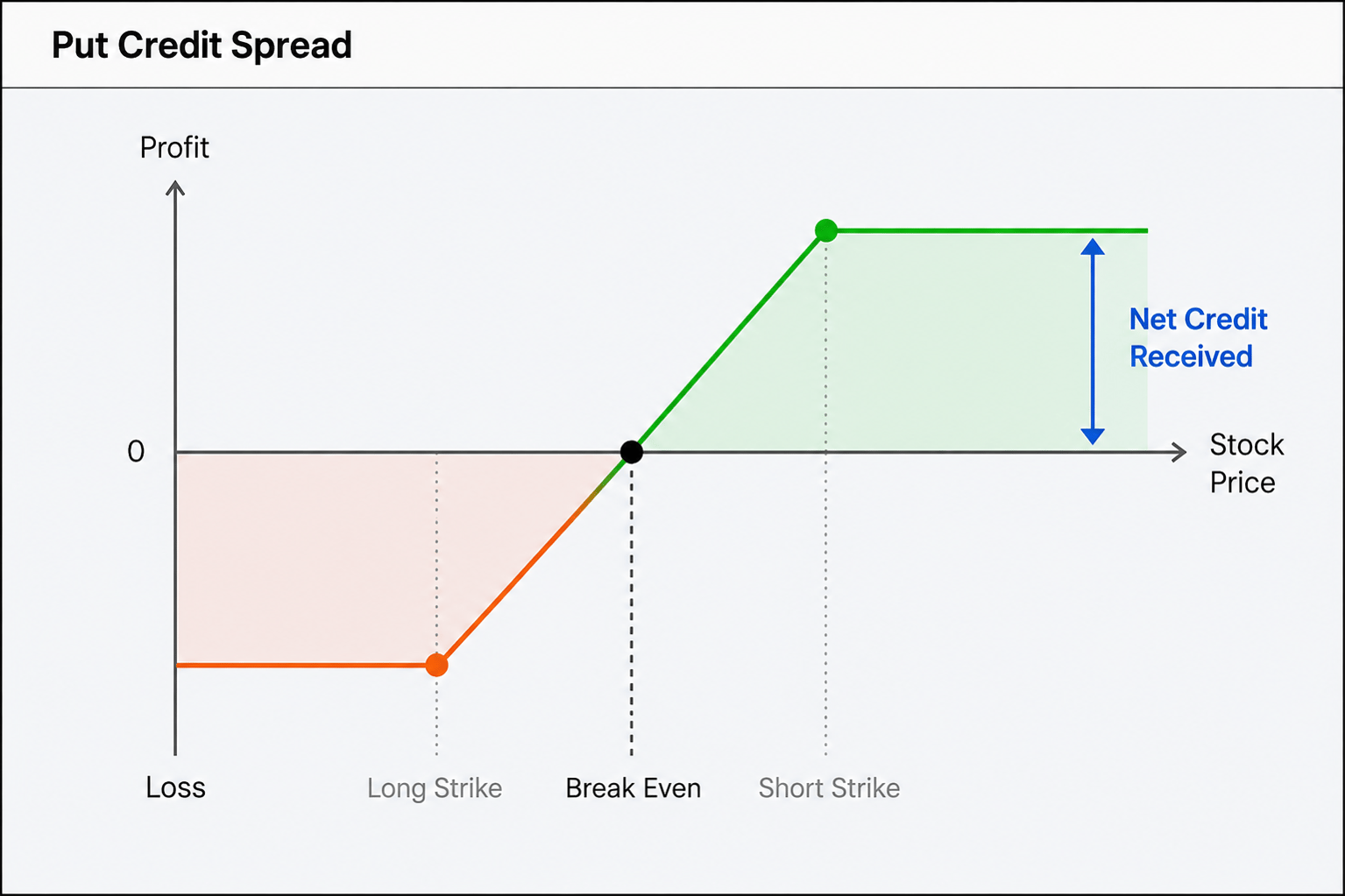
The strategy is also known as the bull put credit spread, credit put spread, or vertical put credit spread. Whatever it is, it is the same trade: short one put, long a cheaper put further down, collect a net credit, and the position tends to profit when the underlying stays above the short strike.
How the Bull Put Credit Spread Strategy Works
The bull put credit spread strategy performs when three forces line up: time decay, range-bound or rising price action, and (often) falling implied volatility.
The Two Legs
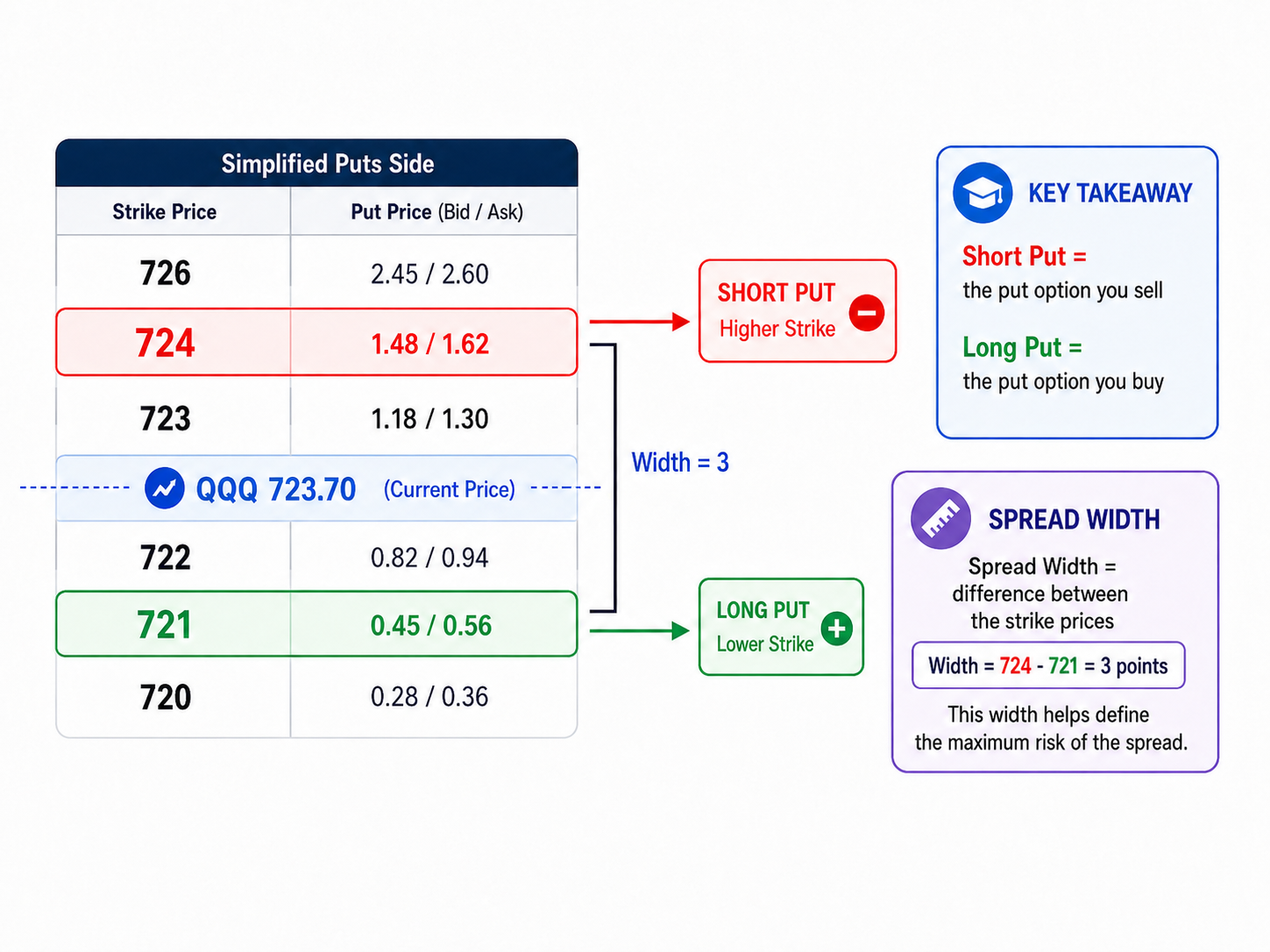
1. The short put: Sold at a strike near current stock price. Many traders place this around the 20 to 30 delta region, though approach varies. This is where the premium and risk live.
2. The long put: Bought at a strike below the short put. Cheaper, defensive, defines the max loss. The width between the two strikes (commonly $1, $2.50, or $5 on individual stocks; $1 on indices) determines the buying power required and the max loss.
The difference will be the credits received when running this strategy.
The Greeks Behind a Put Credit Spread
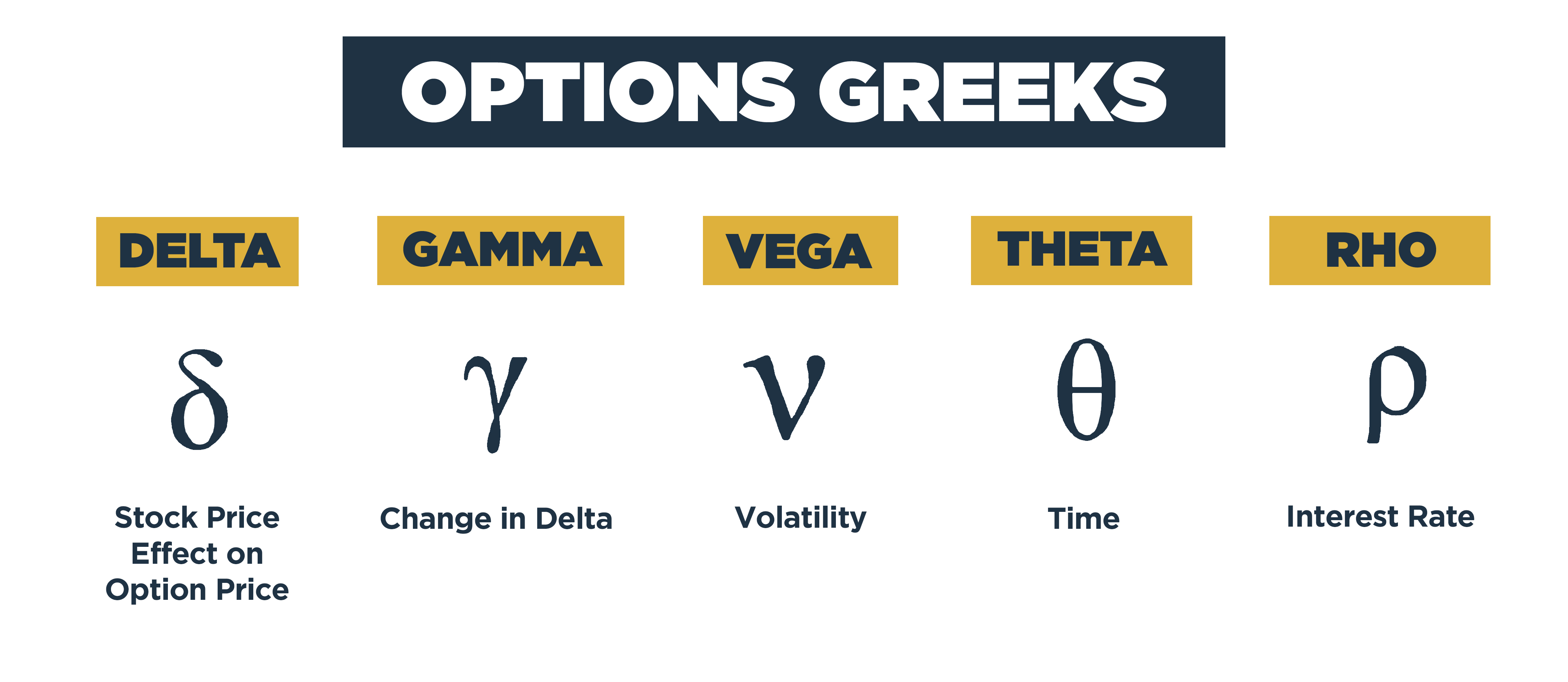
- Theta is positive: Time tends to work in favour of the position. Each passing day, the spread loses extrinsic value, which tends to be favourable for a short position.
- Delta is positive: A slightly bullish bias because the trader is short puts.
- Vega is negative: Rising implied volatility tends to hurt the position (the short put gains more vega than the long put). Falling IV tends to help.
- Gamma is negative around the short strike: As price approaches the short put, the position becomes more sensitive to further moves, which is often where trades go wrong fast.
A Concrete Put Credit Spread Example
Consider a credit put spread example using a stock at $100 (call it XYZ), with 35 days to expiration, where the view is that XYZ will stay above $90 over the next month.
The bull put credit spread example:
- Sell 1 XYZ $95 put for $2.10
- Buy 1 XYZ $90 put for $0.70
- Net credit: $1.40 per share, $140 total
- Width: $5
- Maximum profit: $140
- Maximum loss (credit put spread max loss): $500 minus $140 = $360
- Breakeven: $95 minus $1.40 = $93.60
The numbers stay the same regardless of how high XYZ runs. The position does not benefit from XYZ rocketing to $130. The job is for XYZ to stay above $95 by expiration.
Scenario A: XYZ Closes at $97
Both puts expire worthless. The full $140 credit is kept.
But most traders tend not to hold it till expiration which we will cover that later on in the article.
Scenario B: XYZ Closes at $92
The $95 short put is in the money by $3.00, worth $300.
The $90 long put is out of the money, worth $0.
The spread is worth $300 to close.
The $140 collected upfront offsets some of that, leaving a realised loss of $160. Even though the stock is below the breakeven of $93.60, you’re not in max loss territory because it has not crossed below the long strike.
Scenario C: XYZ Crashes to $85
Short $95 put now worth $1,000 (intrinsic).
Long $90 put worth $500 (intrinsic).
Spread worth $500.
The $140 collected offsets some of that, realising the full $360 max loss.
From here, XYZ can fall to $50 or $5, and the loss does not grow because the long put offsets the short put dollar-for-dollar below $90.
That cap is the structural reason bull put credit spread strategies exist as a defined-risk strategy.
Conditions That Tend to Favour Put Credit Spreads
There is no fixed list of best put credit spread stocks, but there is a set of attributes many traders look for. The best put credit spread strategy generally lives in finding underlying that share these characteristics:
1. Liquid options chains. Tight bid-ask spreads matter. SPY, QQQ, IWM, and the largest mega-cap stocks (AAPL, MSFT, NVDA, AMZN, GOOGL, META, TSLA, JPM) tend to have deep open interest.
2. Multiple strike intervals near current price. ETFs and high-priced stocks usually offer $1 and $5 wide options, giving flexibility on width.
3. Reasonable implied volatility. Traders tend to consider IV rank between the range of 30 to 60, where premiums are richer without the extreme tail risk that very high IV can suggest.
4. Stable, trending or range-bound price action. The strategy underperforms in parabolic moves and crashes. Mega-cap index ETFs and slow-moving blue chips tend to fit.
5. Major earnings or catalysts are avoided within the expiration window. Earnings introduce gap risk that a defined-risk spread usually can't absorb.
6. Support level beneath the short strike. Many traders look for technical floors that have been held multiple times to give the strategy a better edge.
Specific tickers come and go with market regimes, but liquid index ETFs and the top 20 to 30 stocks by option volume tend to feature in consistent setups. Newer traders often start with SPY, QQQ, or IWM, where markets are deep, moves are dampened, and the strategy behaves predictably.
Closing a Put Credit Spread
Closing tends to be where many traders make their biggest mistakes. Knowing how and when to close a put credit spread is one of the bigger differentiators between a disciplined trader and hopeful gambler.
Why Letting it Expire Might Underperforms Closing Early
A spread at 50% of max profit with 14 days left has a marginal reward for the remaining 14 days that is small relative to the unchanged risk. Most experienced credit spread traders close at around 50% to 70% of max profit and redeploy capital.
The Mechanic of Closing a Credit Spread
To close, a "buy to close" order on the entire spread is submitted.
The short put is bought back and the long put is sold as a single order.
Most brokers allow both in one ticket. And the cost to close equals the current value of the spread. If the spread was opened for a $1.40 credit, closing at $0.50 means $0.90 is kept (or $90 per spread). You will then pocket the difference as profit or loss.
Closing Put Credit Spread Specifics
On most brokers, closing a put credit spread is relatively straightforward. From your position screen, "Close Position" should be available, an order type (market or limit) is chosen, and both legs are treated as one order.
Two specifics worth noting:
1. Limit orders tend to be a better practice than market orders. Spread fills can be wide, especially after hours or on less liquid names. A market order can fill at the worst price in the bid-ask range.
2. Partial closes are possible. If multiple contracts of the same spread were sold, a portion can be closed first. This is useful for scaling out at different profit thresholds.
When closing a put credit spread becomes difficult because the long leg's bid is zero, legging out (closing the short put first, then selling the long put separately) is possible, but not recommended. Awareness of the temporary unlimited downside exposure during that gap is important; many traders tend not to do that.
Rolling a Put Credit Spread
Rolling comes up often because rolling can rescue trades that would otherwise approach max loss. Or continue on a trade if the thesis still holds and the trader wants to readjust the strike price.
Rolling means closing the current spread and opening a new spread further out in time for an additional credit, or sometimes for a debit. The aim is to extend duration, give the underlying more time to recover, and/or potentially collect additional credit to improve the P&L of the trade.
A Roll Example
A $95/$90 put credit spread was sold for $1.40 with 35 days to expiration. Two weeks later, XYZ is at $92, and the spread is now worth $3.00. The options:
1. Close for a $160 loss.
2. Roll: close the current spread for $3.00 and simultaneously open a new $90/$85 spread 35 days further out for a $1.60 credit.
Result: realised loss on the original = $1.60. New credit collected = $1.60. Net cash impact close to zero, with a new spread further out of the money and more time to recover.
Conditions Where Rolling Tends to Help
- The underlying still looks fundamentally fine and the bullish thesis remains intact
- Enough credit can be collected on the new spread to meaningfully improve the breakeven or offset the loss
- The position has not already been rolled multiple times (more than one or two rolls often suggests the loss should just be taken)
Conditions Where Rolling Tends to Hurt
- The thesis has broken; the stock is in a real downtrend
- The new spread would have to be opened deep in the money to collect any credit
- The roll is emotionally driven rather than analytically driven
A common principle taught at Piranha Profits: rolling for credit tends to be more sustainable than rolling for hope.
The Psychology Behind Put Credit Spreads
The harder part of trading put credit spreads is often not the math. It tends to be the emotional weight of asymmetric payoffs.
Say a credit spread collects $140 on dozens of winning trades. Then an earnings surprise or market gap hits, and you face a $360 max loss. New traders may look at that single number, decide the system is broken, and abandon it after one bad outcome. Risking $140 to get $360 sounds illogical and unprofitable.
A common reframe: this is a probabilistic game. Over 100 trades, with a probability-of-profit range many traders target (often above 70%), a $140 average gain on winners and a $360 average loss on losers can produce a positive expected value ($140 x 75 minus $360 x 25 = $10,500 minus $9,000 = $1,500 over 100 trades). The system could work, but only if the trader keeps showing up after the losses.
A second psychological pattern tends to be overtrading. The strategy can look easy on paper, prompting beginners to stack multiple spreads on the same underlying. One bad day can bring the entire portfolio into max losses.
A third pattern is the urge to fix losing trades by rolling indefinitely. Each roll adds risk and complexity. After a few rolls, the position often becomes a gamble on recovery. Many traders soft cap the number of rolls they allow themselves to do.
Related Strategies to Explore
Traders comfortable with the put credit spread can explore:
- Bear call credit spread: The mirror image. Calls sold above the price for a credit. Running both together forms an iron condor.
- Iron condor: Bull put + bear call to profit from a range.
- Cash-secured put: A higher-capital version that often becomes the wheel if assignment is accepted.
- Bull call debit spread: A debit version of a bullish trade. Lower probability, higher payoff per dollar risked.
- Diagonal put spread: A time-spread cousin that combines short-term short puts with longer-dated long puts.
Final Thoughts
Risk is defined upfront, premium is collected upfront, time and probability work in the trader's favour, and the strategy tends to survive the occasional losing trade if the trader does not overleverage themself.
For traders who internalise the mechanics, it can scale with account size, fit busy lifestyles, and match the way most stocks behave most of the time (drifting sideways, slowly higher, or staying within a defined range).
The strategy itself is simple. The discipline is where many traders find the practical edge.
This article is for educational purposes only and is not financial advice. Options trading involves substantial risk and is not suitable for every investor. Always consult a licensed professional and trade with capital you can afford to lose.










submit your comment