Warren Buffett recently described modern financial markets as "a church with a casino attached," warning that "we've never had people in a more gambling mood than now." When the world's most experienced investor uses the word "casino" to describe today's market, it's worth paying attention.

The market also feels familiar for investors who have been in the markets for at least the last 10 years. In 2020 and 2021, speculative growth stocks with no profits and no moats were doubling, tripling, and ten-bagging. Anyone sticking to fundamentals looked like the slowest kid in the race.
Then 2022 happened. The Fed raised rates, and the same speculative stocks collapsed 50% to 90%. The "boring" disciplined investors recovered first and kept going.
That cycle is why understanding what a market bubble actually is matters and in this guide we share why predicting is not as important as preparing.
Now before we go on, this is not a bubble call. It's a framework for thinking clearly about market cycles.
What is the definition of a market bubble?
A market bubble is a period when the increase of price of an asset exceeds far above its intrinsic value, driven primarily by speculation, narrative, and emotional momentum rather than fundamental performance of the underlying asset.
The defining feature of a bubble is the gap between price and value: price runs ahead, value moves slowly, and the gap eventually closes through a sharp, often violent, correction.
The Price-Value gap
Think of price and value as two runners. In a healthy market, they jog at roughly the same pace. Sometimes price gets a little ahead on optimism, sometimes value gets a little ahead on pessimism.
In a boom stage of a bubble (which we will talk about more later), price sprints. Value walks, sometimes stays still, and sometimes even moves backwards. The gap widens until something dramatic happens. Like a rate hike, an earnings disappointment, or a credit shock reminding the market that the two runners are supposed to be tied together.
Price then doesn't just slow down. It collapses to catch up with value, often overshooting on the way down because of extreme pessimism.
The 5 Stages of a Market Bubble by Hyman Minsky
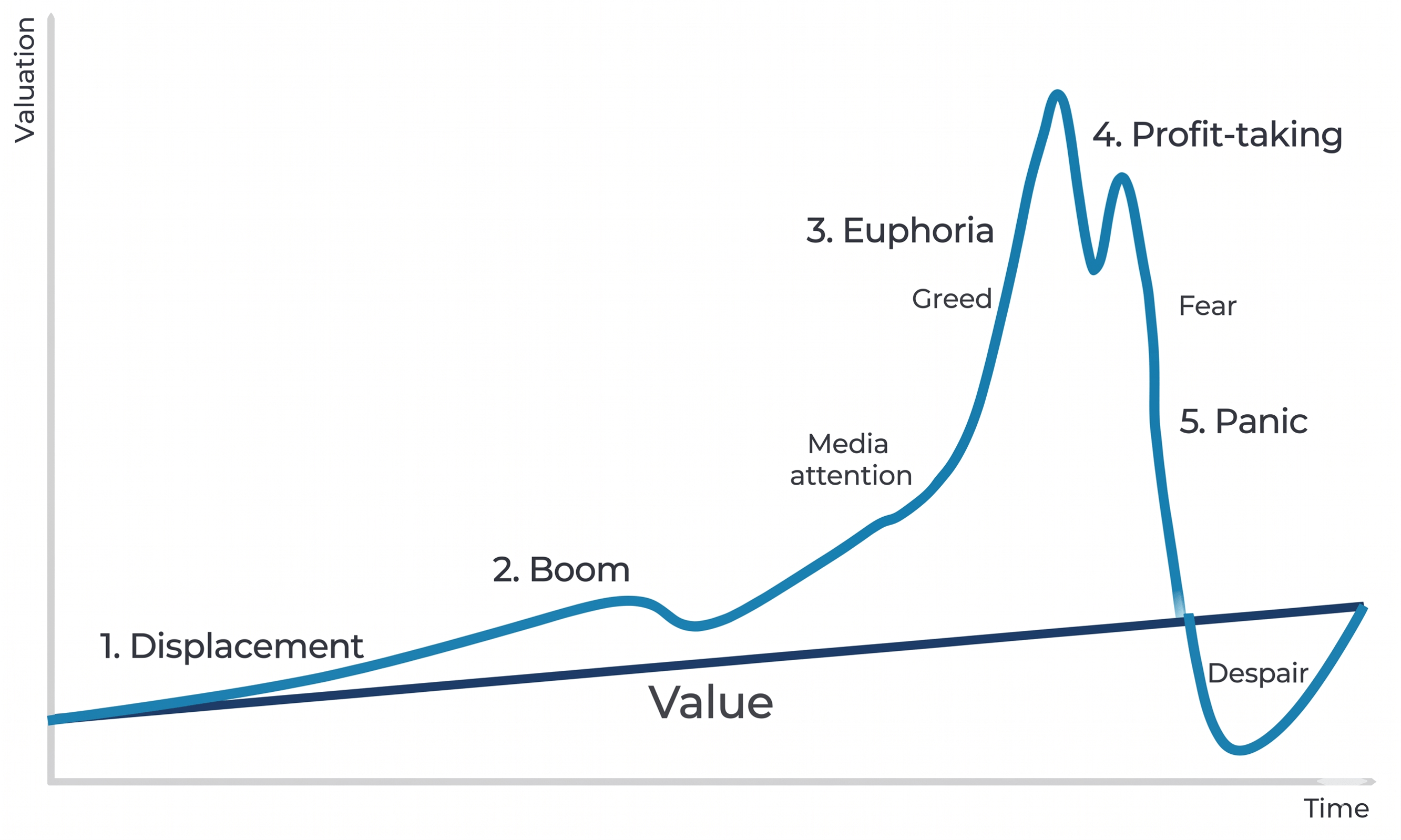
History doesn't repeat itself; but it often rhymes. This chart by all means is not a prediction of where markets are headed. It's a map of how human behaviour has played out
Economist Hyman Minsky mapped the lifecycle of a bubble into five stages. Every major bubble in financial history : Dutch tulips, the South Sea Company, the 1929 crash, the dot-com bust, the 2008 housing crisis, the 2021 growth-stock mania has roughly followed this arc.
Stage 1: Displacement.
A new event captures the market's imagination. A breakthrough technology (the internet, mobile, AI), a policy shift (zero interest rates), or a structural change (commission-free trading apps).
Smart and early investors recognise a genuine opportunity and start accumulating. Valuations stay low to reasonable.
You may have noticed that the displacement technology is usually real. The internet wasn't a hoax. Mobile wasn't a hoax. AI might not be a hoax. The dot-com bubble didn't burst because the underlying technology a.k.a the internet failed to live up to expectations.
It burst because the prices paid for internet stocks ran wildly ahead of even the most optimistic earnings any of those companies could realistically produce in the near term.
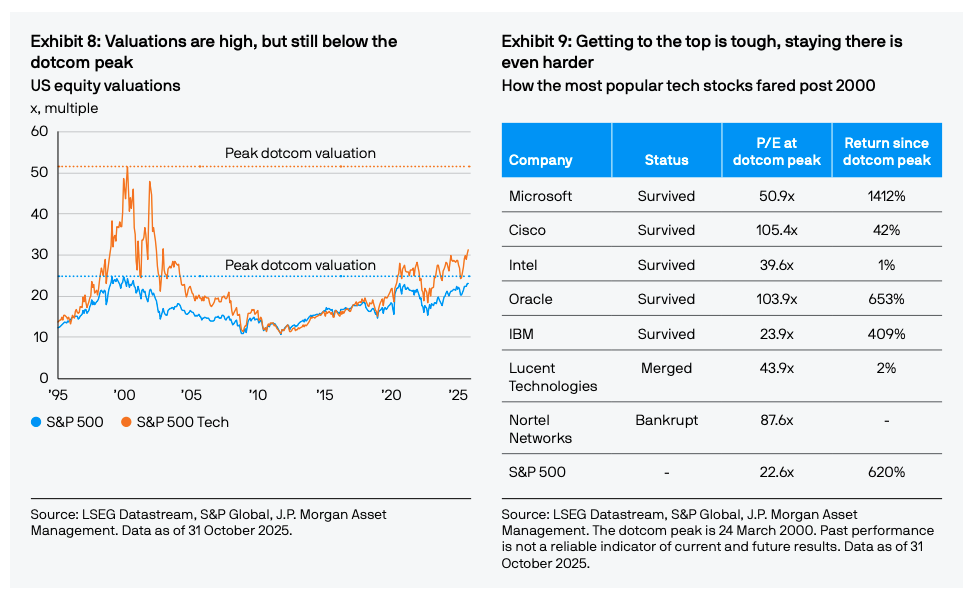
Amazon, Cisco, and Microsoft are still standing today, their stock prices took years to recover from the dot-com peak and some even outperformed the index after it's recovery. A bubble doesn't need a fake story. It only needs the price to outrun the value.
Stage 2: Boom.
Prices begin to rise. Media coverage grows. Early returns attract a wider audience and momentum traders. By this point, the original thesis seems to have been validated, and the price is starting to move faster than the fundamentals.
Stage 3: Euphoria.
This is where it usually starts to go wrong. Caution disappears with the prospect of making profits. Prices go parabolic. Valuation metrics that worked for a century are suddenly declared obsolete because of insane growth projections.
Typically, retail money pours in at the worst possible moment. IPOs and SPACs floods the market to capitalise on investors' appetite.
Stage 4: Profit-taking.
Institutional money usually quietly starts selling here. Price action stalls. Most people in the market may interpret the pause as a healthy "consolidation" and double down at again the worst possible moment.
Stage 5: Panic.
A catalyst hits. Rate hike, credit event, fraud revelation, geopolitical shock and the selling, snowballs.
Forced selling triggers even more forced selling. Prices collapse, often falling further and faster past their fair value range. The same crowd that bought the top now sells the bottom. Suddenly there is no price too low to sell.
This is extreme pessimism in full play. Investors don't just sell, they convince themselves and others that the entire system is broken. The stock market is "rigged." The Fed is incompetent. Capitalism is finished. The same narratives that justified buying at the top now justify selling at the bottom, just inverted.
And because panic doesn't confine itself to the bubble segment, the contagion spreads to the rest of the market.
Fundamentally sound companies often get sold off alongside the speculative ones, simply because everyone needs to raise cash and de-risk at the same time. This is also where the next cycle's biggest opportunities are quietly being created.
The Human Psychology that Fuels Every Bubble
Bubbles are not a market failure. They're a psychological failure.
The two strongest forces are the fear of missing out(FOMO) and herd behaviour.
When you see prices rising and other people getting rich, your brain interprets it as a threat. Sitting on the sidelines starts to feel painful, even when you objectively know the asset is overvalued.
It's one thing to underperform an index. It's another thing entirely to watch someone you know, someone you privately consider less informed than you get rich while you stick to your rules and lag behind.
The temptation to break your own discipline becomes almost unbearable.
Market Bubbles: Historical Examples Worth Studying
The Dutch Tulip Mania (1630s). The original cautionary tale. A single tulip bulb at peak traded for more than a skilled craftsman's annual wage. The price collapse wiped out fortunes in weeks. Centuries later, it's still the cleanest illustration of how detached price can become from value.
The Dot-com Bubble (1999–2000). Internet stocks with no earnings traded at triple-digit price-to-sales multiples. The Nasdaq lost 78% of its value from peak to trough.
Most of the era's high-flyers : pets.com, Webvan, eToys never recovered.
Amazon, a survivor, fell more than 90% before eventually justifying its dot-com-era hype many times over.
The U.S. Housing Bubble (2006–2008). Home prices detached from incomes, fuelled by subprime lending, securitisation, and the assumption that real estate "always goes up." The collapse triggered the 2008 global financial crisis and a decade of slow recovery.
The Speculative Growth Stock Bubble (2020–2022). Stocks like Teladoc (TDOC), Roku (ROKU), Zoom (ZM), Rivian (RIVN), Peloton (PTON), Zillow (Z), Upstart (UPST), Crispr (CRSP), and Coinbase (COIN) rose many-fold during the pandemic on the back of "growth at any price" narratives, near-zero interest rates, and a wave of new retail investors.
Most of them lacked profitability, durable competitive advantages, and consistent cash flows. When the Federal Reserve began raising rates aggressively in 2022, the bubble popped. These same stocks fell 50% to 90% from their peaks.
One example worth noting from that period: in 2021, while the ARK Innovation ETF (ARKK) was being celebrated as the future of investing.
Adam Khoo explained why he removed it from his watchlist. His reasoning was straightforward, many of ARK's holdings were being driven by narrative rather than fundamentals. It was a contrarian call at the time, and not an easy one to make when the fund was still posting headline-grabbing returns. A year later, ARKK had fallen more than 70% from its peak.
Warning Signs of a Bubble Forming
No checklist can call the top with precision. These are red flags and when taken together, are how the prudent investors can attempt to recognise dangerous territory.
Valuations untethered from fundamentals. Price-to-sales ratios, price-to-earnings ratios, or other valuation metrics blowing past historical norms with no underlying earnings growth to justify the expansion.
Loss-making companies leading the rally. When the biggest gainers in a market are companies with no profits, no clear path to profitability, and no durable competitive moat, you are looking at a speculative phase, not an earnings-driven one.
A surge in IPOs and SPACs. Companies rush to go public when investor appetite is irrational. The IPO market is one of the most reliable sentiment indicators we have.
How do Investors Protect Themselves from a Bubble
The defence against bubbles is not prediction. It's a process. You need to build a portfolio that does not result in complete ruin when the tide goes out.
Warren Buffett said it best: "Only when the tide goes out do you discover who's been swimming naked." During a bubble, almost every strategy looks like genius.
When reckless leverage gets rewarded and companies with broken business models trade at premium multiples. The water is high and it hides everything. When the tide eventually goes out the swimmers without bathing suits are the ones left exposed in front of everyone.
The hard part is sticking to your process or a process that works in the long run. There will be long stretches where a prudent approach underperforms. From 2020 to mid-2021, every speculative stock you ignored will have looked like a missed opportunity.
Here's the pattern in numbers. Adam Khoo's portfolio rose roughly 44% in 2020 and 23% in 2021. Solid returns by reasonable standard, but pale compared to ARKK's run during the same period.
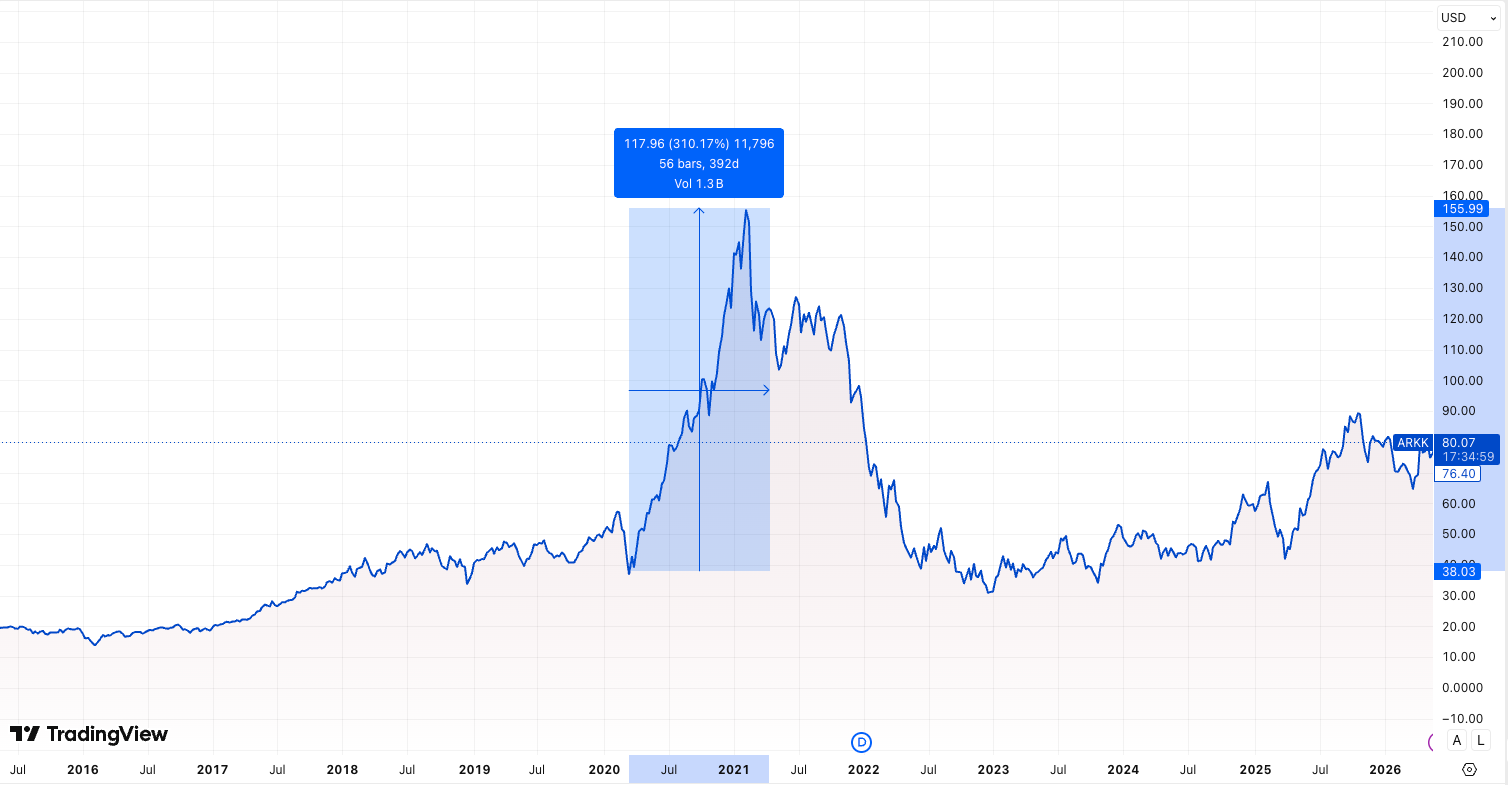
ARKK ETF Performance from 2016 - 2026
In 2022, when the bubble burst, his portfolio also dropped but it recovered faster than both the S&P 500 and ARKK, and eventually outperformed both. That is the pattern. Discipline may costs you upside during the euphoria. It saves you the catastrophe afterward. Compounded over a full cycle, the disciplined investor wins.
Is there a bubble forming right now?
It's a fair question, and worth thinking about. AI-related stocks have surged on a narrative that mirrors several beats of the dot-com playbook, a genuinely transformative technology, optimistic forward projections, and capital flowing in faster than fundamentals can absorb.
Some of these companies will deserve their valuations and grow into them over time. Many might not.
The framework still applies: separate the businesses with durable cash flows, real moats, and reasonable valuations from the stories trading on hope. Whether today's market qualifies as a bubble in the Minsky sense is something only hindsight can confirm.
What we can do, what every prudent investor should consider. Is to apply a warning-sign checklist honestly and let the process decide which stocks make it or out the portfolio.

Final thoughts
Market bubbles are not rare events. They are recurring features of every financial system, because they are products of human psychology, and human psychology has not changed much since tulip bulbs.
The question worth sitting with is not "when will the next bubble pop?" That's unanswerable.
The questions that actually matter are different:
Do you have an investment framework you can stick to when even your neighbours are getting rich?
When everyone around you is calling caution outdated, do you have the conviction to keep applying the rules anyway?
The investors who can answer those questions truthfully to themselves are probably the ones who can outlast a bubble cycle.








submit your comment