The S&P 500 has just posted one of its fastest 30-day rallies in market history surging over 16% to new all-time highs, powered by a Q1 2026 earnings season that printed 27.1% growth against a Wall Street consensus of 15%. Corporate net profit margins hit a 15-year high of 13.2%. Over 81% of S&P 500 companies beat revenue estimates.

And yet, in the same week, Warren Buffett at the Berkshire Hathaway annual meeting said it plainly: stock prices are too high, and he can't find anything to buy. Berkshire's cash pile now sits at over $397 billion. He has been a net seller of stocks for 14 consecutive quarters.
Two things that seem contradictory. Both might be true, depending entirely on which part of the market you're looking at.
The Headline Valuation Number
The first instinct of most investors is almost always the forward price-to-earnings (P/E) ratio of the S&P 500. Basically the index's price, divided by what companies are collectively expected to earn over the next 12 months.
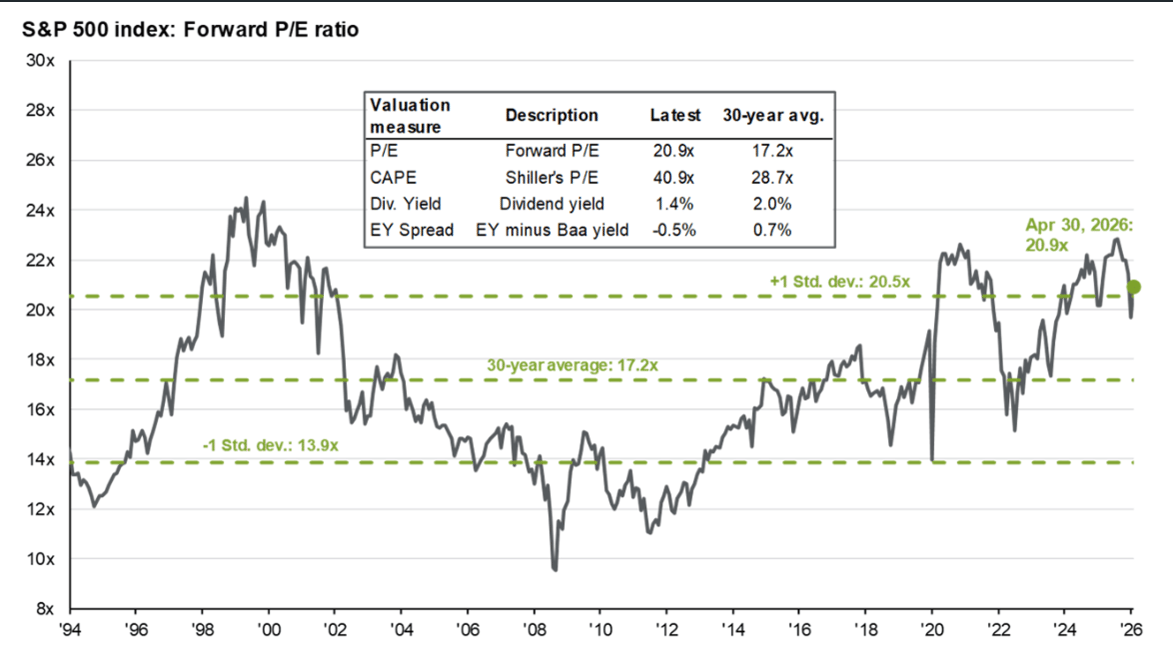
S&P 500 Index: Forward P/E Ratio — J.P. Morgan Guide to the Markets, April 30, 2026
As of April 30, 2026, the S&P 500 forward P/E stands at 20.9x. The 30-year average is 17.2x.
That gap is worth taking seriously. At 20.9x, investors are paying roughly 22% more for each dollar of expected earnings than the historical norm. And notably, 20.9x sits right at the +1 standard deviation band above the 30-year mean (which marks at 20.5x), a level that has historically coincided with periods of more muted forward returns. Before jumping to the conclusion that the markets are too expensive based on the forward P/E we must first understand the underlying 500 companies.
The S&P 500 Index Isn't One Conversation, It's 500
Being in the S&P 500 index doesn’t immediately make the business great. Investors must dig deeper and learn to identify the profit generators to the pretenders.
The index-level P/E of 20.9x is a market-cap-weighted average. It is disproportionately influenced by the largest companies in the index. What it doesn't reveal is the distribution of valuations across all 500 names.
A component-level scan of the S&P 500 using StockOracle™ data as of early May 2026 shows a more varied picture:
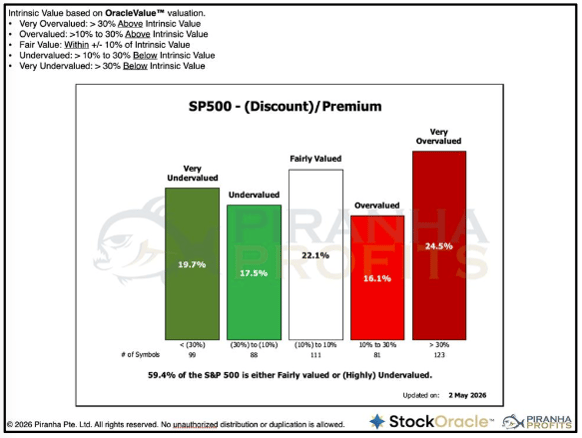
- 24.5% of stocks are very overvalued
- 22% are fairly valued
- 37.2% are undervalued or very undervalued
Roughly 59% of the S&P 500 is either fairly valued or trading below estimated intrinsic value.
When investors say "the market is expensive," they are often making a statement about the index that doesn't apply uniformly to all the companies within it.
It's expensive just like the way a restaurant menu can seem expensive: some items are overpriced, some are fair value, and a few are genuinely good value if you know what to order.

Final Thought
The data points in the same general direction: the S&P 500 at the index level is priced above its historical averages. That observation is not wrong. What it implies, however, depends heavily on what you do with it.
The useful question to think about for investors isn't "is the market expensive?". It's "which part of the market am I buying, and what price am I paying for it?"










submit your comment