The outlook for 2026 is shaped more by long-term structural forces than by any single economic narrative, with artificial intelligence sitting at the center. While attention continues to gravitate toward companies building AI infrastructure and software, meaningful value is also emerging in businesses that benefit from AI-driven efficiency, data leverage, and scale without being explicitly labeled as “AI stocks.”
This includes platforms with entrenched market positions in areas like healthcare innovation, financial data, and global entertainment, where strong moats, pricing power, and recurring demand matter more than hype. Together, these businesses combine exposure to the AI transition with durable competitive advantages in their own fields, making them well positioned for the year ahead even as market leadership broadens beyond pure AI narratives.
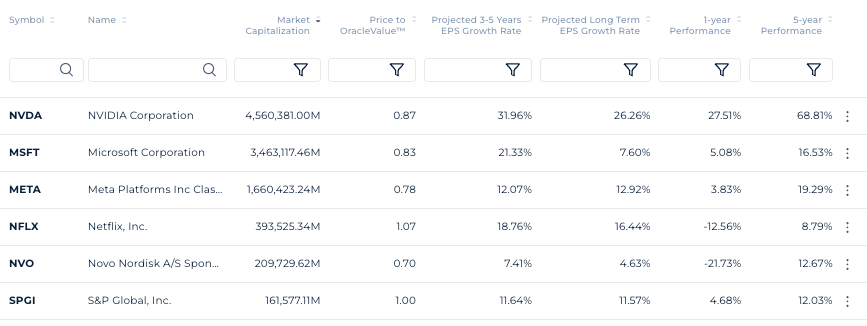
StockOracle™ Comparison Chart 27th January 2026
OracleIQ™ and OracleValue™ are analytical frameworks used for educational comparison, based on historical financial data and forward-looking assumptions. They are not predictions and do not account as buy or sell recommendations .
When compared on StockOracle™, these companies fall within a healthy range based on their Price to OracleValue™. The selected stocks are priced close to their OracleValue™, estimating that their current prices are broadly aligned with, or slightly discounted to, their projected earnings growth.
When comparing OracleIQ™, the stocks selected also all scored highly on predictability. In simple terms, these are companies with existing operating models the market can reasonably understand and forecast. Their revenues, margins, and demand drivers are not dependent on one-off events or speculative breakthroughs.
Novo Nordisk (NVO)
Novo Nordisk is a global leader in GLP-1 therapies, with Ozempic and Wegovy anchoring its dominance in the rapidly expanding obesity and diabetes markets.
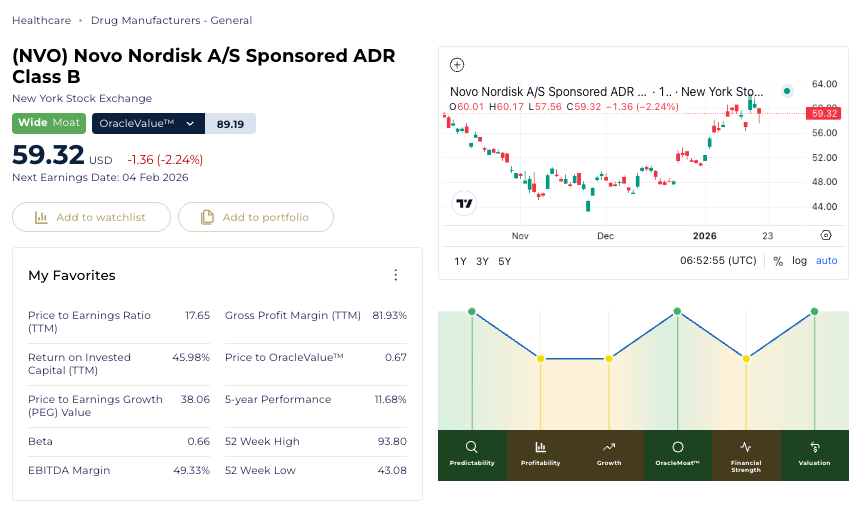
StockOracle™ NVO Metrics 22th January 2026
This leadership, combined with strong pricing power and global scale, supports long-term growth as obesity drug demand increases.
Eli Lilly (LLY) vs Novo Nordisk (NVO)
OracleIQ™ of LLY and NVO key difference lies in financial strength, where LLY appears more stable and resilient with relatively better cash flow dynamics, while NVO remains solid but slightly more sensitive. 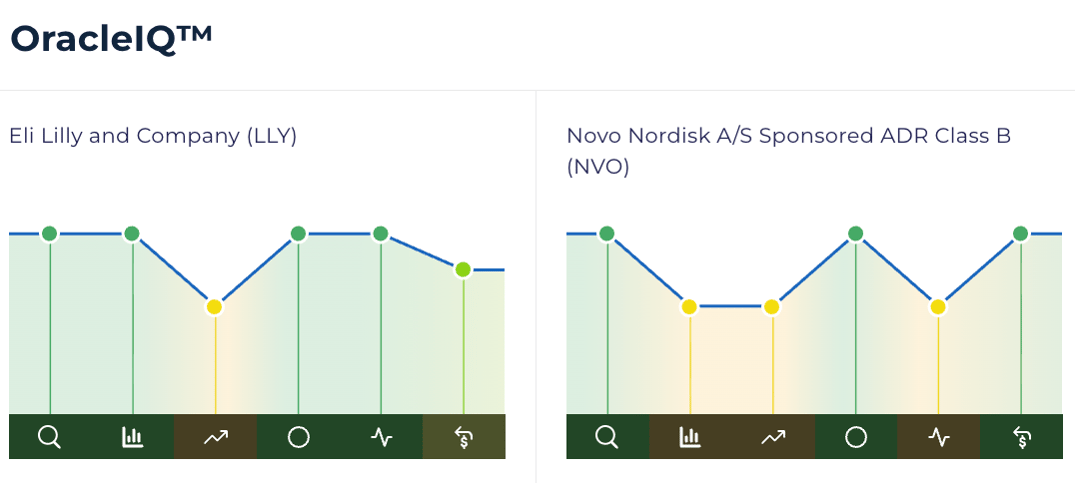
StockOracle™ LLY vs NVO OracleIQ™ 26th January 2026
While competition from Eli Lilly is intensifying, the GLP-1 market faces eventual pricing pressure, patent risk, and slower growth in more mature regions. Each has the scale, pipelines, and manufacturing depth to remain central players over the long term. From an OracleValue™ estimate, however, valuation still tilts in Novo Nordisk’s favor. OracleValue™ estimates Novo Nordisk’s intrinsic value at USD 89 per share.
S&P Global (SPGI)
S&P Global is a toll booth on global finance, and an exceptionally hard one to bypass. Alongside Moody’s, it controls a near-duopoly in global and private debt, giving it entrenched pricing power, recurring demand, and healthy margins. This wide moat is reinforced by long-term tailwinds from emerging markets, which are expected to drive roughly 65 percent of global economic growth through 2035.
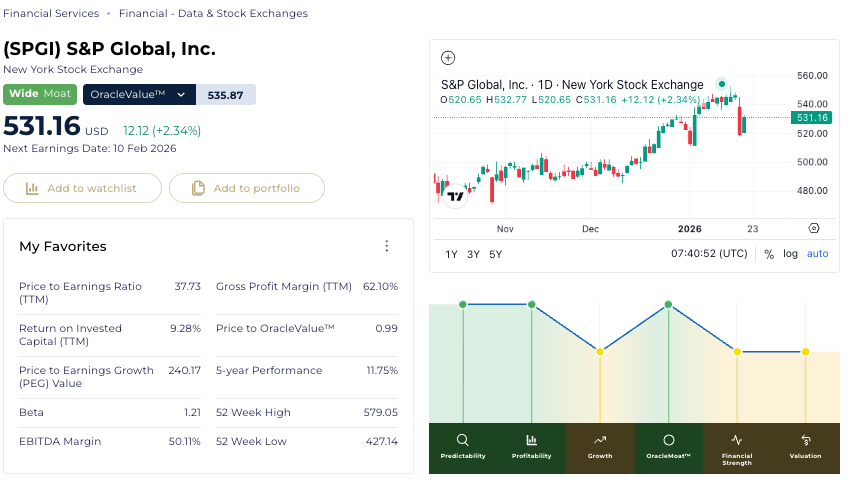
StockOracle™ S&P Global (SPGI) Metrics 22th January 2026
The acquisition of With Intelligence pushes S&P Global deeper into private assets. At the same time, AI is being embedded across products and workflows, improving efficiency and locking clients further into its ecosystem.
S&P Global (SPGI) vs Moody’s Corporation (MCO)
OracleIQ™ shows that both S&P Global (SPGI) and Moody’s (MCO) exhibit similar medium growth, consistent with their mature business models, with both posting estimated EPS growth of around 11% over the next five years. 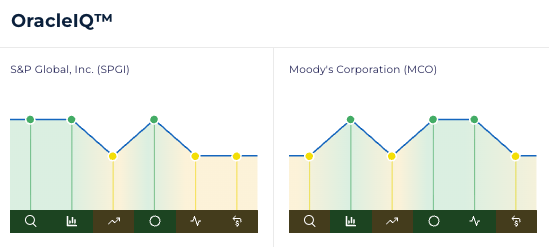
OracleIQ™ S&P Global (SPGI) vs Moody’s (MCO) 27th January 2026
The key difference lies in predictability and financial strength. SPGI ranks higher in predictability likely because of its diversified data and analytics businesses, while MCO demonstrates stronger financial strength, supported by superior cash flow resilience.
There are risks from market cycles. When borrowing money becomes more expensive, fewer people borrow, and the company makes less money.
Even so, S&P Global’s business remains resilient, supported by strong cash flow, steady shareholder returns, and a dominant market position that is hard to replace over the long term.
Nvidia Corporation (NVDA)
NVIDIA needs no introduction. It is the dominant supplier of AI computing infrastructure, designing the GPUs and software platforms that power modern data centers and drive the global build-out of artificial intelligence.
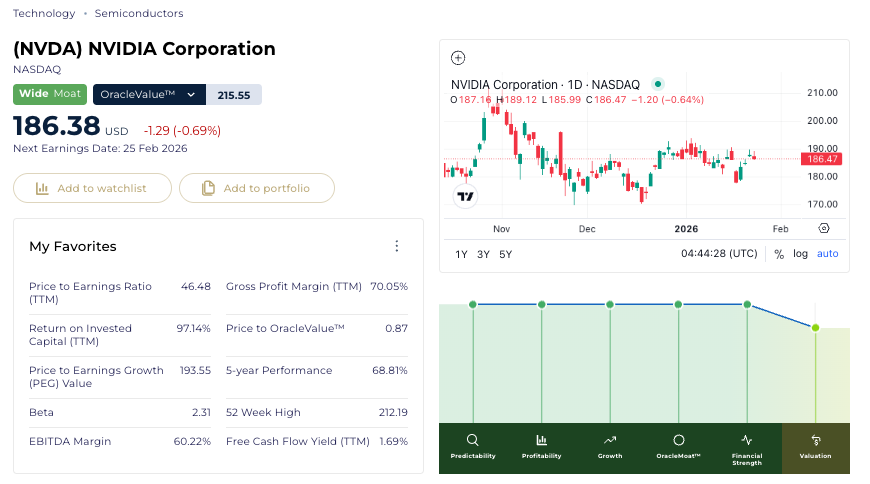
StockOracle™ NVIDIA (NVDA) Metrics 27th January 2026
The bull case is simple: NVIDIA leads AI hardware not just because of its GPUs, but because of CUDA’s ecosystem that most AI developers already rely on. CUDA is the underlying language and toolkit used to build, train, and run AI models, and it is deeply embedded in existing frameworks, workflows, and data center infrastructure. Switching away from NVIDIA does not just mean buying a different chip, it means rewriting code, re-optimizing models, retraining engineers. Which could be costly, slow, and operationally painful.
As AI data center spending ramps up into a multi-trillion-dollar investment cycle over the next decade, NVIDIA is well positioned to capture a large share of that spend. In the near term, the Rubin architecture could deliver a major leap in performance and efficiency.
The risks to NVIDIA’s dominance are starting to become real as hyperscalers push back against the so-called “NVIDIA tax.” Microsoft, Google, and Amazon are deploying custom AI chips to reduce reliance on NVIDIA’s GPUs.
NVIDIA (NVDA) vs Advanced Micro Devices (AMD) vs Intel (INTC)
As custom silicon and alternatives from AMD and Intel gain traction, OracleIQ™ provides a clear comparison of the competitive landscape. OracleIQ™ positions NVIDIA (NVDA) as the clear leader over AMD, with consistently higher scores in predictability, profitability, moat, and financial strength. NVDA’s dominance reflects its leadership in AI accelerators, superior margins, and highly visible revenue streams, supporting strong execution confidence.
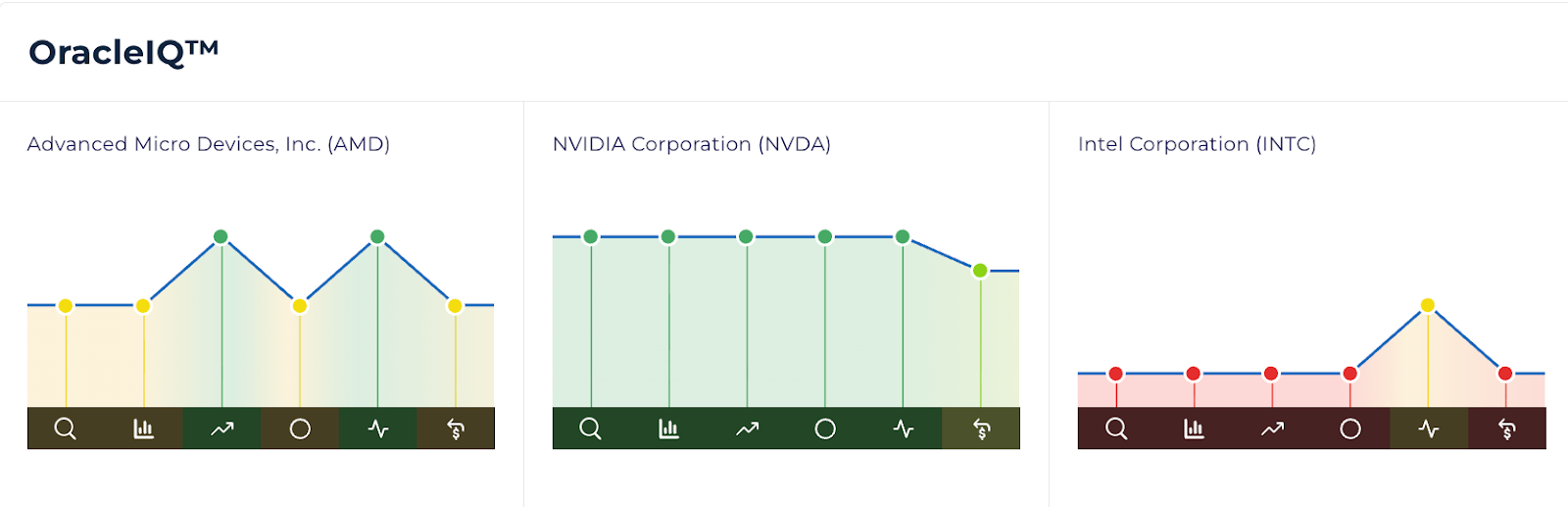
OracleIQ™ NVDA, AMD & INTC 27th January 2026
AMD, while competitive, shows a more uneven OracleIQ profile. Its growth and financial strength remain solid, but lower predictability and profitability point to greater reliance on share gains and precise execution against NVDA’s entrenched ecosystem.
Intel (INTC) could be seen as a turnaround case. The bull thesis centers on AI-PC adoption, improving data-center competitiveness via Xeon 6 and Gaudi accelerators, a potential foundry revival through the 18A process and hyperscaler partnerships, and aggressive cost cuts supporting margin recovery.
The bear case remains execution risk, with early stage yields risk, intense competition, ongoing foundry losses, and restructuring challenges. OracleIQ™ reflects this reality, positioning Intel as a high-execution-risk turnaround rather than a compounder alongside its more established peers.
Microsoft Corporation (MSFT)
Microsoft’s position in AI is anchored by Azure’s role as a foundational cloud platform, where aggressive investment in AI data centers and close partnerships with OpenAI and Anthropic place it in the flow of enterprise AI spending, from raw infrastructure to applications like Copilot.
This advantage compounds through its enterprise software ecosystem, where AI features embedded into Office, Dynamics, and LinkedIn drive higher usage, stronger pricing power, and deep customer lock-in, similar to expanding toll roads that businesses already rely on daily.
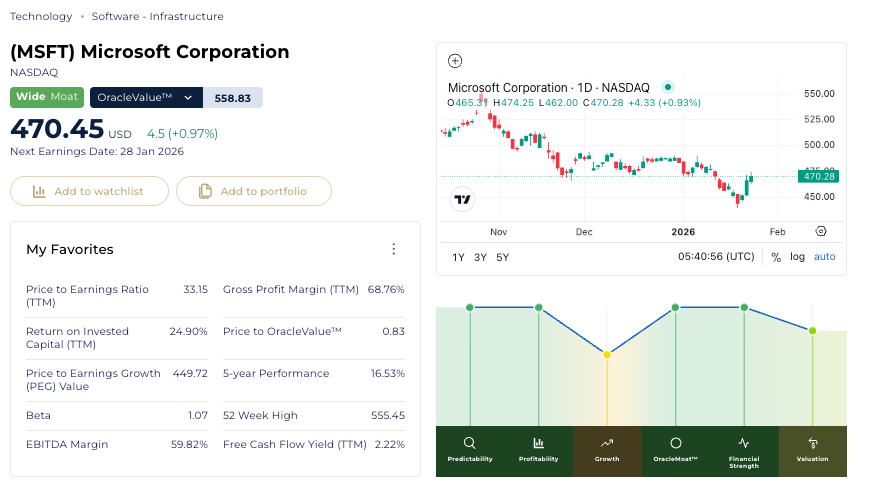 StockOracle™ Microsoft (MSFT) Metrics 27th January 2026
Recurring revenue from gaming and subscriptions adds stability. Microsoft is spending heavily on AI infrastructure, like other hyperscalers, which requires significant upfront investment. This level of spending and regulatory scrutiny can lead to short-term volatility. Even so, Microsoft’s scale, distribution, and control over key platforms position it well to benefit over the long term.
Microsoft Competitors
Microsoft business operates across broad segments that it faces different competitors in each part of its business, from productivity software and cloud infrastructure to gaming, advertising, and devices.
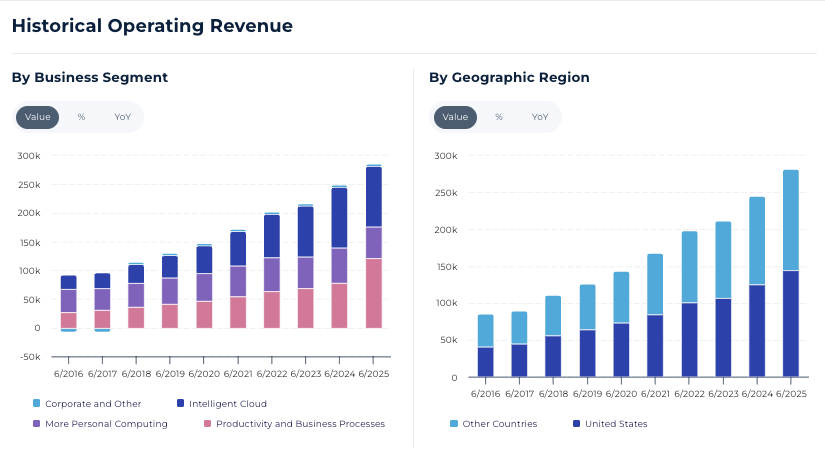
StockOracle™ Microsoft (MSFT) Business Segment Graph 27th January 2026
Microsoft operates across three core segments. Productivity and Business Processes includes Office, Microsoft 365, LinkedIn, and Dynamics. Intelligent Cloud, led by Azure, is its main growth engine as cloud and AI adoption scale. More Personal Computing spans Windows, devices, Xbox, and search, anchoring Microsoft in consumer and hardware-linked revenue.
Competition is most intense in cloud and productivity, where Microsoft goes head-to-head with Amazon and Google. AWS is the largest cloud provider and rivals Azure on scale, pricing, and infrastructure, while Google leverages its strengths in AI, data, and proprietary hardware to challenge Microsoft in cloud and enterprise AI. Other competitors exist across individual segments, such as Salesforce in enterprise software, Sony and Tencent in gaming, and Apple in consumer ecosystems.
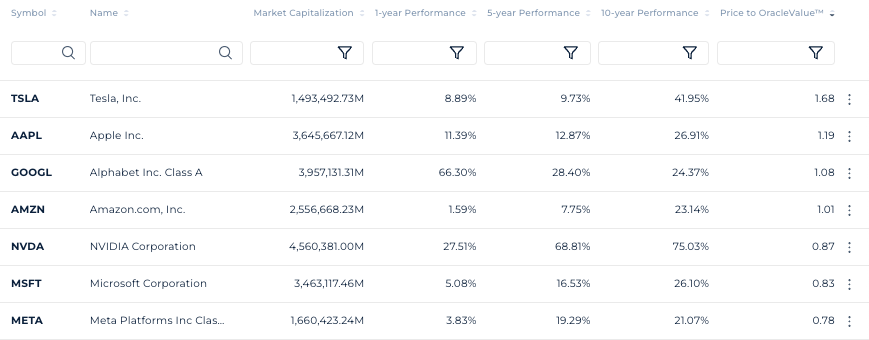
StockOracle™ Magnificent 7 comparison 27th January 2026
Still, within the Magnificent Seven, Microsoft stands out as one of the cheaper stocks estimated by OracleValue™. With a price-to-OracleValue™ around 0.83, it appears more attractively valued than Google and Amazon, suggesting the market is pricing Microsoft more conservatively despite its strong position in AI, cloud, and enterprise software.
Meta Platforms (META)
Meta is one of the largest digital platforms in the world, operating at the intersection of social media, digital advertising, and artificial intelligence. Its Family of Apps, including Facebook, Instagram, WhatsApp, and Messenger, reaches roughly 3.5 billion daily active users, giving Meta unmatched scale in global attention and user data.
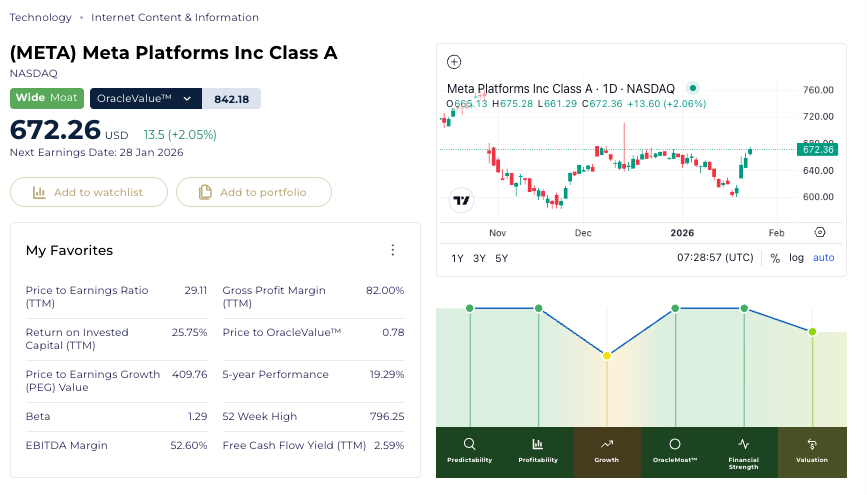
StockOracle™ Meta Platform (META) Metrics 27th January 2026
This scale powers its core advertising business, where AI-driven targeting, automation, and creative tools are increasingly lifting ad efficiency and pricing. Beyond ads, Meta is expanding monetization through WhatsApp business messaging, custom AI infrastructure, and longer-term bets in AR, VR, and the metaverse. In effect, Meta is evolving from a social media company into an AI-driven engagement and monetization platform, with scale as its biggest advantage and its biggest regulatory risk.
Meta’s Competitors
Meta faces competition on several fronts: Google and YouTube dominate digital advertising and video, TikTok challenges user attention in short-form content, Amazon is pulling ad spend through retail media, and Apple pressures Meta through platform control, privacy rules, and AR/VR competition. Smaller but relevant threats come from Snapchat and X in social media, OpenAI in AI capabilities, and emerging AR/VR players that could disrupt Meta’s long-term ambitions in immersive computing.
Among Meta’s key competitors, Google and Amazon, the table highlights a clear valuation and growth contrast. Google has delivered the strongest 1-year performance at about 65%, reflecting renewed confidence in its AI and ad business, while Amazon’s shorter-term performance has been muted despite solid long-term EPS growth expectations.
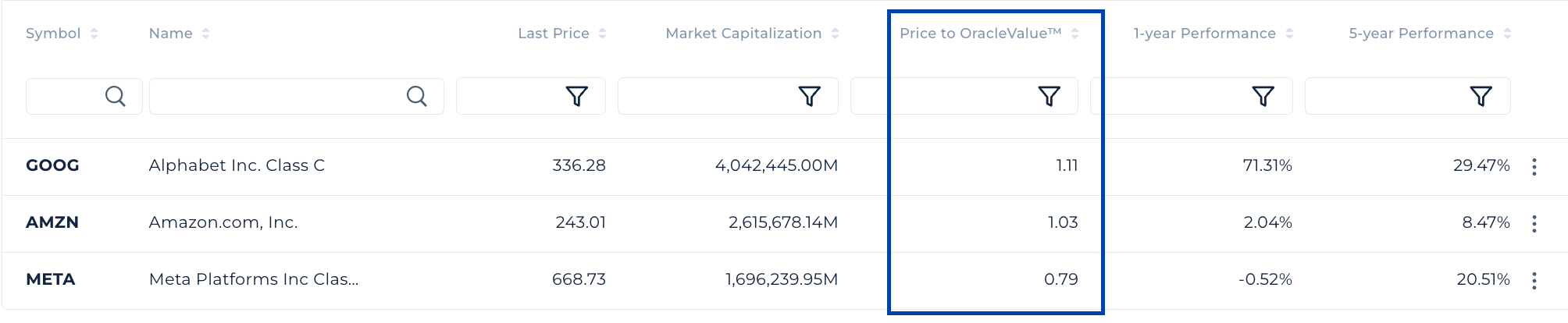
StockOracle™ Comparison of GOOG , AMZN , META 27th January 2026
Meta stands out on estimated valuation: with a price-to-OracleValue™ of 0.79, it screens meaningfully cheaper than Google (1.08) and Amazon (1.01), even though it continues to post healthy earnings growth and strong medium-term performance. Meta appears more conservatively valued than its closest advertising and platform peers.
Netflix(NFLX)
Netflix operates in a highly competitive streaming market but remains the clear leader due to its global scale, technology, and reach.
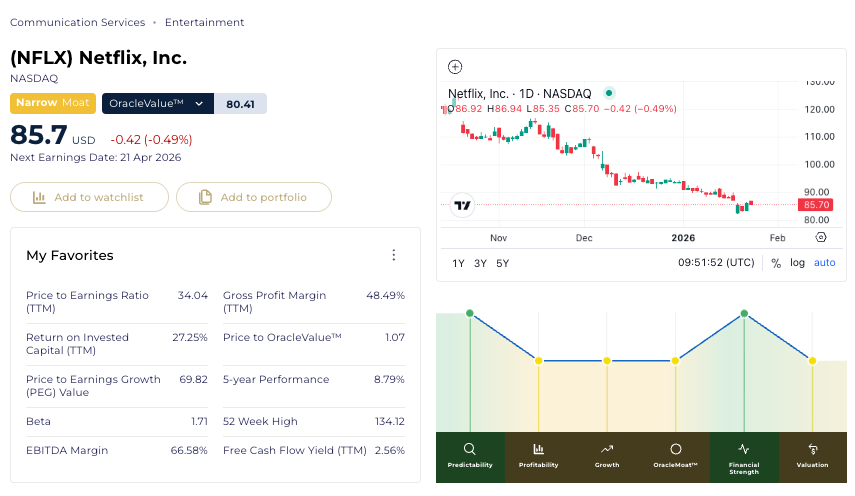
StockOracle™ Netflix (NFLX) Metrics 27th January 2026
Its main rivals are Amazon Prime Video, which benefits from ecosystem bundling, and Disney+ and Max, which rely on strong franchises and aggressive bundles. The landscape would shift materially if Netflix acquired Warner Bros. outright in an all-cash deal, consolidating premium IP and studios under one platform and strengthening its bargaining power. Apple TV+ is a smaller premium competitor, while regional platforms and social video services like YouTube and TikTok mainly compete for attention rather than subscriptions.
Netflix Competitors
Netflix competes in an arena where its biggest rivals are divisions inside much larger empires: Amazon uses Prime Video as part of the Prime bundle (More about keeping users inside the Amazon ecosystem than directly monetizing streaming.), while Disney leans on franchise gravity (Marvel, Star Wars, Pixar) and bundling muscle, including the Disney-Hulu-Max bundle that hit ~80% 3-month retention versus Netflix’s ~74% for comparable new sign-ups.
What keeps Netflix defensible is that it’s the pure-play specialist: global scale and a relentless release cadence.
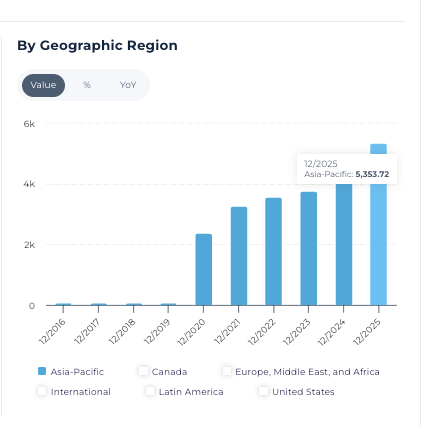
StockOracle™ Netflix (NFLX) Asia-Pacific Geographic Region Value 27th January 2026
Netflix’s expansion into Asia-Pacific has become one of its most important growth engines. Revenue from the region has risen steadily since 2020, reflecting successful localization strategies.
Asia-Pacific combines a massive addressable audience with improving broadband access and rising disposable income, allowing Netflix to grow subscribers while keeping churn relatively low compared to peers. While ARPU is lower than in the U.S. or Europe, the scale and long runway in markets like India, South Korea, and Southeast Asia make the region a key pillar of Netflix’s long-term growth strategy.
Final Thought
This sums up the 6 value stocks. Each operates behind a moat that is already built, already monetised, and proven under real market conditions. These businesses do not rely on perfect macro backdrops to deliver results. Their revenues are recurring, their unit economics are clear, and their growth paths are structurally sustainable.











submit your comment