A neocloud stock is a listed company that rents out AI computing power, mainly racks of high-end GPUs, to the companies building and running AI models. Think of them as the landlords of the AI boom. They don't build the frontier models. They own and operate the data centres that train and run them.
Two years ago, most investors had never heard the term. Today, names like CoreWeave, Nebius and IREN move together as a group, sometimes rallying double digits in a day and falling just as hard the next week.
That volatility is why it matters to understand what you're looking at before forming any decision to trade or invest.
In this guide, we cover what a neocloud is, which kinds of companies fall into the category, the bull and bear arguments, and a practical framework for evaluating any neocloud stock on its own merits.
What is NeoCloud?
A neocloud is a cloud provider built specifically for AI workloads. Instead of offering hundreds of general services, it focuses on one thing: giving customers fast access to large clusters of GPUs. The industry often calls this GPU-as-a-Service (GPUaaS).
The easiest way to understand a neocloud is to compare it with a hyperscaler. Hyperscalers are the big general-purpose clouds: Amazon Web Services, Microsoft Azure and Google Cloud.
|
Neocloud |
Hyperscaler |
|
|
What it sells |
Mainly GPU compute for AI training and inference |
Hundreds of services: storage, databases, software, AI and more |
|
Data centres |
Purpose-built for high-density GPUs |
Mostly general-purpose, retrofitted for AI |
|
Main customers |
AI labs, hyperscalers, AI startups |
Almost every type of business |
|
How growth is funded |
Largely debt and new share issuance |
Mostly cash flow from profitable businesses |
|
Analogy |
A specialist supplier |
A full-service supermarket |
That last row is the one investors should remember. A hyperscaler can absorb a bad year in AI because it has other profitable businesses. A neocloud usually can't.
How a neocloud makes money
At its core, a neocloud is a simple business: buy GPUs, house them, and rent their computing time for more than they cost to own and run.
Revenue comes in two forms:
- Long-term contracts. Most revenue at the larger neoclouds comes from multi-year, take-or-pay agreements. The customer commits to pay for a fixed amount of capacity whether or not it uses it. These contracts build up the "backlog" figures you see in earnings reports.
- On-demand rental. Smaller customers rent GPUs by the hour. This pays higher rates but is less predictable, and prices fall when supply catches up.
Costs fall into these three main buckets:
- The GPUs and servers. This is the biggest upfront cost. It is depreciated over an assumed useful life, usually several years, so profits depend heavily on how long the hardware stays competitive.
- The data centre and power. Neoclouds either build their own facilities or lease space and power from landlords. Power availability is now one of the hardest constraints in the industry.
- The cost of money. Because GPUs are bought before customers pay, most neoclouds borrow heavily. Interest is a major and growing expense.
Put together, the economics work well when contracts are long, customers are creditworthy and borrowing is cheap. They weaken quickly when any of those three change. That is why the way neoclouds are financed matters so much, which we cover in the vendor financing section below.
Why does Neoclouds even exist?
AI demand is outrunning what even the largest tech companies can build on their own. Three things drive the neocloud business model:
- Capacity shortfall. Hyperscalers are spending at record levels, yet still report being short on compute.
- Speed. A neocloud can deliver GPU capacity faster than a hyperscaler can build it, so big tech signs multi-year contracts to rent rather than wait.
- Accounting appeal for customers. Renting turns a huge upfront capital cost into an operating expense spread over the contract.
The result is a group of companies with fast-growing revenue, large contracted backlogs, and heavy borrowing to fund the build-out. All three matter when you evaluate one.
Vendor financing: how neoclouds pay for growth
Many neoclouds are funded partly by the company they buy their chips from. This is called vendor financing. Critics call it "circular financing", because money can flow from the supplier to the neocloud and straight back to the supplier.
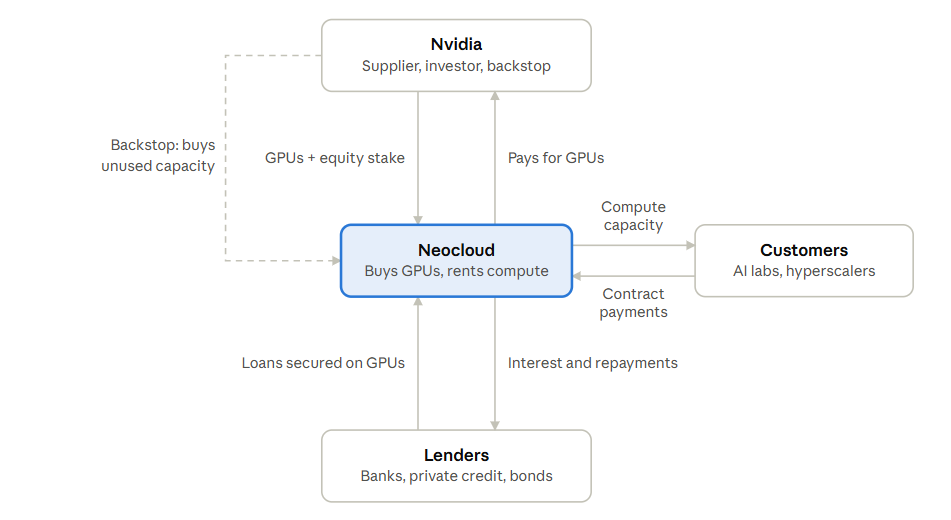
The dashed line is the key piece: a supplier promising to buy unused capacity puts a floor under the neocloud's revenue, which makes lenders more to lend.
How it works in practice, using CoreWeave as the clearest example:
- Equity. Nvidia holds a stake in CoreWeave.
- Debt. CoreWeave borrows heavily, often using its GPUs and customer contracts as collateral, and uses the money to buy more Nvidia GPUs.
- Backstop. Nvidia has agreed to buy CoreWeave's unsold capacity under an agreement initially valued at $6.3 billion, running to April 2032. It is a conditional purchase commitment, not a guarantee of CoreWeave's debt.
- Wider rollout. In 2026, Nvidia reportedly began offering a similar model to other neocloud operators, agreeing to rent back unused GPU capacity at a fixed rate.
Nvidia isn't the only one doing this. Google has provided credit support for some data-centre leases signed by Fluidstack with landlords such as TeraWulf and Cipher, reportedly taking warrants in return.
Why vendor financing matters to investors:
|
What it helps |
What it hides or adds |
|
Lowers borrowing costs, because lenders see a guaranteed buyer |
When a supplier is also a customer, revenue may overstate true end-user demand |
|
Gives a utilisation floor if demand softens |
Risk is linked: stress at the neocloud can travel back to the supplier, and the other way round |
|
Signals the supplier's long-term commitment |
Backstops are conditional and expire, and the supplier can change its stance |
|
Lets young companies grow faster than their own cash flow allows |
Faster growth also means more debt; one report put CoreWeave's liabilities above $72 billion against about $5 billion of equity |
Vendor financing isn't exactly new. It played a large role in the late-1990s telecom build-out, when equipment makers lent to the carriers buying their gear. Some of those loans went bad when demand fell short. That doesn't mean the same will happen here, but it's why investors watch these arrangements closely.
Questions to ask about any neocloud: How much of its revenue or backlog comes from its own suppliers, or from companies they fund? Is any backstop conditional, and when does it expire? Could it still borrow on similar terms without it?
The three types of neocloud companies right now
Not every company called a neocloud does the same thing. We find it useful to sort them into three groups, because each carries a different risk profile.
|
Type |
What they do |
Examples (illustrative) |
Things Investors are watching |
|
Pure-play GPU clouds |
Buy GPUs, run the clusters, and sell compute directly to AI customers |
CoreWeave (CRWV), Nebius (NBIS) |
Backlog quality, customer concentration, debt |
|
Landlords (former bitcoin miners) |
Own power-rich sites and lease data-centre capacity, sometimes also running GPUs |
IREN, TeraWulf (WULF), Cipher (CIFR), Applied Digital (APLD), Hut 8 (HUT) |
Lease length, tenant strength, power delivery timelines |
|
Private bellwethers |
Major neoclouds not yet listed |
Crusoe, Lambda, Nscale |
Their funding rounds and future IPOs can reprice the listed group |
Type 1: Pure-play GPU clouds
Pure-plays are the companies most people mean when they say "neocloud". They buy the GPUs, run the clusters and the software layer, and sell compute directly to AI labs and hyperscalers. They carry the most upside exposure to AI demand, and arguably the most balance-sheet risk.
CoreWeave (CRWV) is the benchmark for the group. It started as a crypto-mining operation before rebranding around GPU cloud services in 2021. Its growth has been anchored by a small number of very large customers. Microsoft has historically made up the majority of revenue, with large agreements since signed with Meta and others. It is also the clearest example of vendor financing: Nvidia is a shareholder, a supplier and a buyer of last resort for unused capacity.
Nebius (NBIS) is headquartered in Amsterdam. It emerged from the international operations of Yandex after the Russian group sold its domestic business. It has signed large multi-year commitments with hyperscalers including Microsoft and Meta. Beyond raw compute, it offers storage and AI developer tools, which it hopes will make customers less likely to switch.
What to watch in pure-plays: how much of the backlog converts into revenue on schedule, the share of revenue from the top customer, interest costs relative to operating cash flow, and delivery delays from data-centre partners.
Type 2: Landlords (former bitcoin miners)
Landlords own the scarcest input in AI: large, reliable, affordable power connections. Many began as bitcoin miners, an industry that also needs cheap electricity, large sites and serious cooling. As AI demand surged, they began converting capacity to high-performance computing (HPC).
They generally follow one of two models:
- Lease the shell. The landlord builds the data hall and power infrastructure, then leases it on a long-term contract to a neocloud or hyperscaler, which installs its own GPUs. This is closer to real estate: lower margins, but longer contracts and less GPU depreciation risk.
- Run the GPUs too. The company buys GPUs and sells compute directly, becoming a pure-play in part. Higher potential returns, but the full balance-sheet risk of a pure-play.
What to watch in landlords: lease length and tenant credit quality, whether a large tech company guarantees the tenant's payments, how quickly new megawatts are energised on schedule, and how much revenue still depends on bitcoin prices.
Type 3: Private bellwethers
Some of the neoclouds are still privately held. Retail investors can't buy them directly on a stock exchange, but they still matter to listed neocloud stocks in two ways:
- Valuation benchmarks. Their private funding rounds set reference prices for what the market is willing to pay for neocloud capacity.
- Future IPOs. A large neocloud listing can reprice the whole group, either by drawing investor money away from existing names or by confirming high valuations.
New entrants also count here. Large players such as Google with Blackstone, and SoftBank, have announced their own neocloud ventures, adding competition from well-funded rivals

The bull case vs the bear case
Neocloud stocks divide opinion sharply, and both sides make serious arguments. We think understanding both is more useful than picking a side early.
|
The bull case |
The bear case |
|
AI compute demand is outrunning supply, and hyperscalers are signing multi-year contracts to fill the gap |
Growth is funded heavily by debt, so a slowdown in demand could hit hard |
|
Large contracted backlogs give visibility into future revenue |
A few customers often make up most of the revenue, and those customers are also competitors |
|
Purpose-built data centres can deliver GPU compute more cheaply than general-purpose clouds |
GPUs lose value quickly as newer chips arrive, creating heavy depreciation |
|
Hyperscalers keep raising capex guidance |
Hyperscalers are building their own capacity and launching rival offerings, such as Google's neocloud joint venture with Blackstone |
Some analysts have openly bet against the group. BCA Research, for example, proposed favouring hyperscalers over a basket of neocloud stocks, arguing that neocloud capex would earn much lower returns on invested capital. Others remain positive on growth. The disagreement itself is a reminder of how uncertain the outcome is.
Key takeaways
- Neocloud stocks are companies that rent AI computing power, mainly GPU capacity, to AI labs and tech giants.
- They fall into three broad groups: pure-play GPU clouds, landlords (often former bitcoin miners), and private players not yet listed.
- Growth has been rapid, but it is funded heavily by debt and depends on a small number of large customers.
- Before forming a view on any neocloud stock, look at backlog quality, customer concentration, funding, contract length, depreciation and competitive advantage.
Themes like this move fast, and the headlines rarely tell you whether the business underneath is strong.









submit your comment