SpaceX shares closed at $147.79 on 20 October 2026, roughly flat for the day, ahead of the Q3 report. After the release, the stock climbed as much as 5% in early after-hours trading, to around $155.
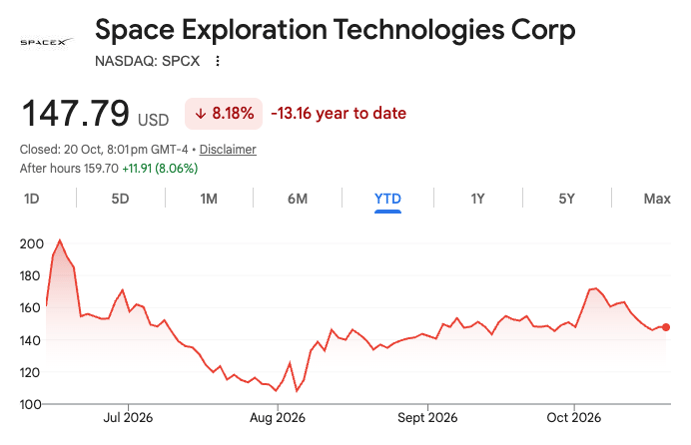
The beat on revenue and earnings and the first profit since listing gave investors something to cheer about. For context, the stock trades above its $135 IPO price but well below its June high of about $226.
Read more about "How to Invest in Space 2026"
The short answer
Yes, for the latest quarter. In Q3 2026 (July to September), SpaceX reported net income of $4.4 billion on revenue of $14.6 billion. That's its first profitable quarter since listing on Nasdaq (ticker: SPCX) in June 2026.
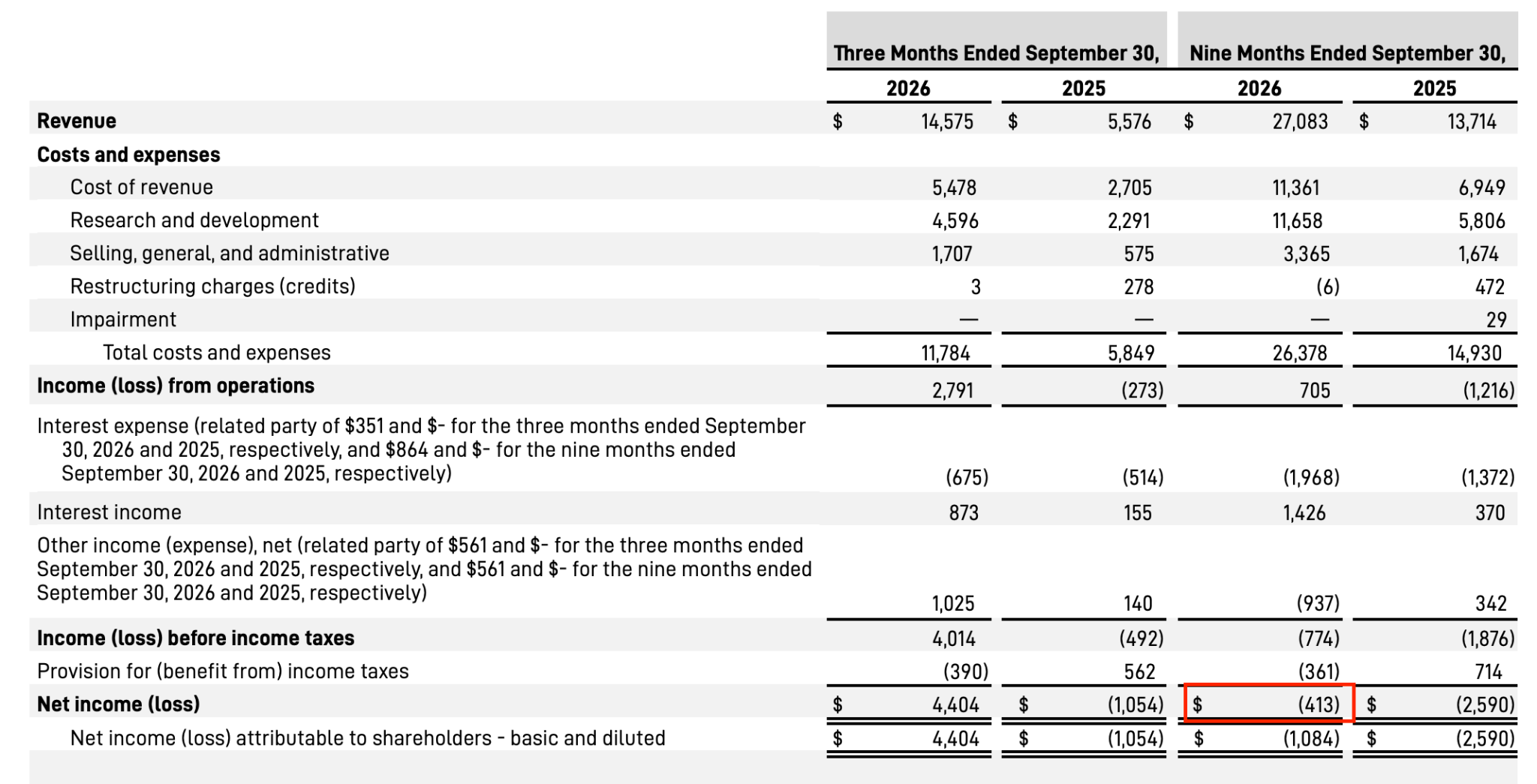
But zoom out and the picture changes. Across the first nine months of 2026, SpaceX still shows a net loss of $413 million.
SpaceX's business has started to earn money, but the headline numbers might flatter it. The rest of this article explains why, using the company's own Q3 2026 earnings release, and asks the second-level questions most skips.
All figures are as reported by SpaceX, in US dollars. This article is for education only and is not a recommendation to buy or sell any security.
SpaceX profitability timeline: 2024 to Q3 2026
|
Period |
Revenue |
Income from operations |
Net income (loss) |
|
Q3 2026 |
$14.58B |
$2.79B |
$4.40B |
|
Q2 2026 |
$7.81B |
−$0.14B |
−$0.54B |
|
Q1 2026 |
$4.69B |
−$1.95B |
−$4.28B |
A single quarter can be lifted or dragged by one-off items. Q1 2026 carried around a $4.3B loss. Q3 then carried a $4.4B profit. Investors who judge a company on one quarter may reach opposite conclusions. The nine-month figure is a slightly conservative read, and it's still negative.
SpaceX Q3 2026 earnings at a glance
Revenue grew 161% year on year, and every profit line turned positive. Here are the five numbers that matter, and what each one measures.
|
Q3 2026 |
Q3 2025 |
What it tells you |
|
|
Revenue |
$14.6B |
$5.6B |
Total sales across all three business segments |
|
Income from operations |
$2.8B |
−$0.3B |
Profit from running the business, before interest, investments and tax |
|
Net income |
$4.4B |
−$1.1B |
The bottom line, after everything |
|
Adjusted EBITDA |
$8.8B |
$2.2B |
Company-defined profit that strips out depreciation, stock pay and other items |
|
Capex |
$19.6B |
$6.9B |
Cash spent on data centres, rockets and satellites |
One thing should jump out. Capex is larger than revenue. SpaceX spent more on building future capacity in one quarter than it earned in sales.
SpaceX generally reports three business segments:
- Connectivity: Starlink satellite internet for consumers, enterprises and governments
- Space: rocket launches (Falcon 9, Starship) and spacecraft like Dragon
- Super Intelligence (SI): the AI business (formerly called "AI"), including the Grok models, X advertising, Cursor, and renting out data-centre computing power to other companies
Is SpaceX's Q3 profit real? Three ways to measure it
The operating business earned $2.8B. The other $1.6B of the $4.4B net income came from interest, investments and tax.
Where did the extra $1.6B come from?
- Interest income ($873M). SpaceX held about $89.9B in cash and securities on 30 September, largely from its IPO, which raised about $85.7B after costs. That cash earns interest. But it's also the money funding the data-centre build-out. As capex spends it down, this income shrinks.
- Other income ($1,025M). This includes $561M from related parties. The release doesn't explain the rest in detail. Over nine months, this line is actually a $937M loss, largely from a $1.5B charge for paying off debt early. One good quarter here doesn't make a trend.
- Tax benefit ($390M). SpaceX booked a tax credit instead of paying tax. That's an accounting result, not cash from customers.
Then there's Adjusted EBITDA: $8.8B. This is the number management leads with.
So what does EBITDA leave out, and does it matter here? Depreciation is the cost of assets wearing out. For SpaceX, a growing share of assets are AI chips and servers, which age far faster than a rocket factory. Q3 depreciation doubled year on year, to $3.6B. Adding it back makes the business look more profitable than the cash it will eventually need to replace that hardware. Stock-based pay is a real cost too. It's paid in shares instead of cash, which dilutes existing shareholders.
Are there one-off boosts inside operating income too? Yes. On the earnings call, the CFO said Connectivity margins got a one-time lift of about 3 percentage points, mostly from tariff refunds. Management also said it expects Q4 gross margins to be closer to Q2 levels. In other words, part of Q3's strength is not expected to repeat.
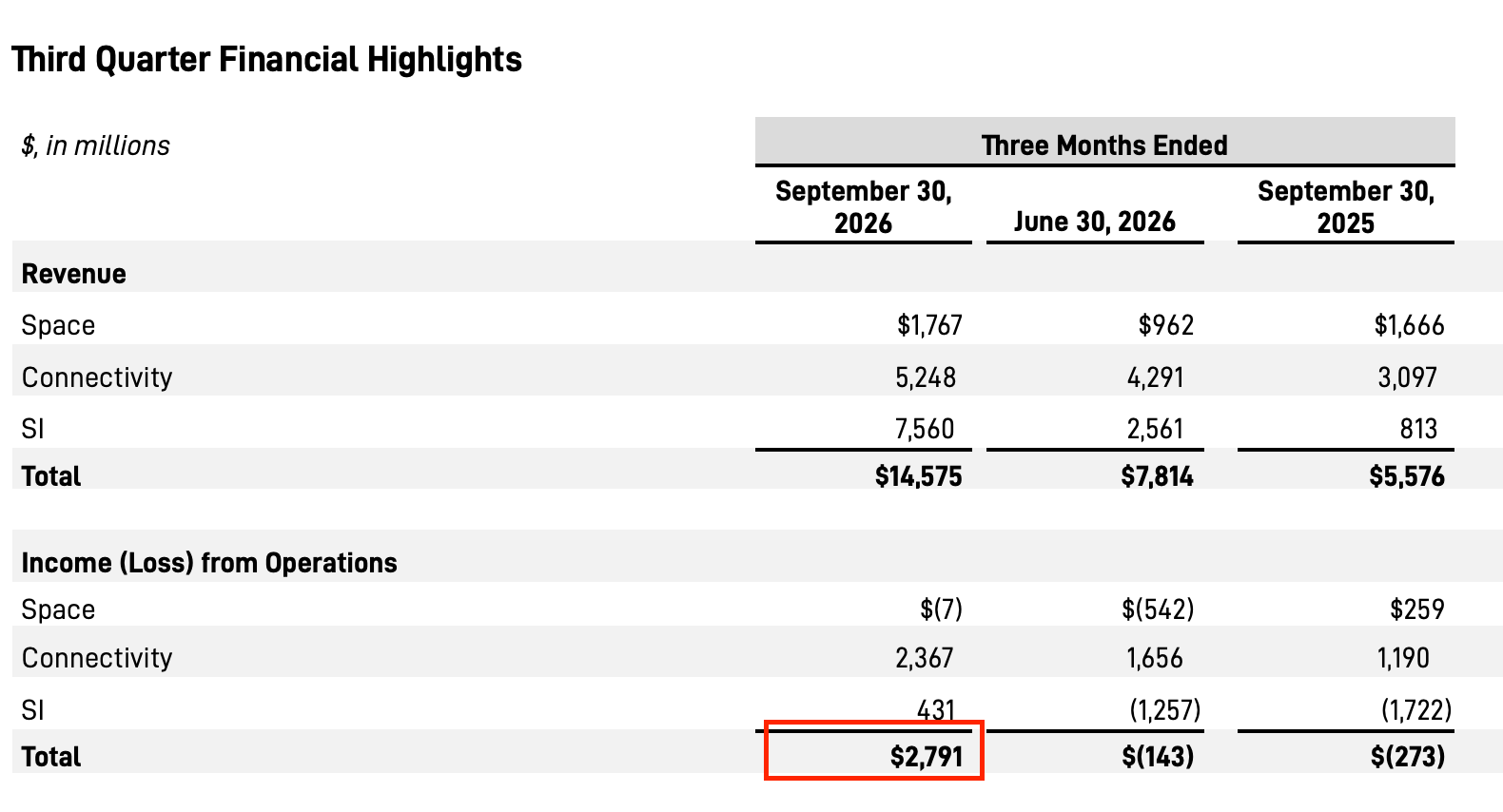
So which number should you trust? Operating income ($2.8B) is the cleanest read on whether the businesses themselves make money. Net income tells you what happened to shareholders this quarter. Adjusted EBITDA is useful for comparing periods, but it's the most flattering of the three.
Segment by segment: where SpaceX makes and loses money
SpaceX is now three very different businesses under one ticker. Each one tells a different story, and the headline numbers only make sense once you see how they feed each other.
|
Segment |
Q3 2026 revenue |
YoY growth |
Operating income |
Operating margin (Q3 2025) |
Capex |
|
Super Intelligence |
$7.56B |
+830% |
$0.43B |
5.7% (−212%) |
$16.44B |
|
Connectivity |
$5.25B |
+69% |
$2.37B |
45.1% (38.4%) |
$1.54B |
|
Space |
$1.77B |
+6% |
−$0.01B |
−0.4% (15.5%) |
$1.61B |
Connectivity (Starlink): the profit engine
Revenue rose 69% to $5.25B, and operating income almost doubled to $2.37B. Starlink consumer subscribers reached 13.6 million, up from 7.2 million a year ago.

Connectivity is the only segment that has made money consistently since its first public filing. Its operating income in Q3 was more than five times the SI segment's. It's the cash engine that helped fund Starship and the AI build-out through the loss-making years.
Revenue grew 69%, but subscribers grew 89%. Average revenue per user (ARPU) fell from $83 a month to $69 over the year. Starlink has been adding customers on cheaper plans and in lower-priced markets.
That's a trade-off worth watching. Growth bought with lower prices is still growth, but each new customer is worth less than the last. The encouraging sign: ARPU rose 5% from Q2, which management put down to a better customer mix.
Enterprise and government revenue grew 91%, faster than consumer (57%). Airlines, shipping firms and governments tend to sign multi-year contracts and churn less than households. Over 3,800 aircraft now carry Starlink. A rising enterprise share makes revenue more predictable.
Is the 45% margin sustainable? Partly. Margin rose from 38.4% to 45.1%, which shows operating leverage: the satellites are already in orbit, so each extra subscriber costs relatively little to serve. But management said about 3 percentage points came from one-time tariff refunds. Strip that out and the underlying margin is closer to 42%, which is still an improvement.
Space: a loss-maker that isn't quite what it seems
Space revenue rose just 6% to $1.77B, and the segment slipped to a $7M operating loss from a $259M profit. On paper, this is SpaceX's weakest business.
Research and development jumped 44% to $1.23B, mostly for Starship. Total launches also fell from 44 to 35.
So is the Space segment really losing money? Look at who it launches for. Of the 35 launches in Q3, 23 carried SpaceX's own payloads, mainly Starlink satellites. That's 75% of the mass sent to orbit. Those internal launches earn the Space segment no revenue, yet they are what makes Starlink possible. The value Space creates shows up in Connectivity's profits, not its own.
The same goes for Starship. Q3 saw Flight 14, Starship's first orbital, revenue-generating mission. It carried 26 Starlink V3 satellites, adding roughly 10 times the downlink capacity of a Falcon 9 Starlink launch. If Starship becomes routine, Starlink can add capacity far more cheaply. That benefit would appear in Connectivity's margins, while Space carries the R&D bill.
The lesson for reading any conglomerate: a segment that loses money on its own may be the reason another segment makes money. Judge the system, not just the parts in silo.
Super Intelligence: the expected growth engine, and the biggest question mark
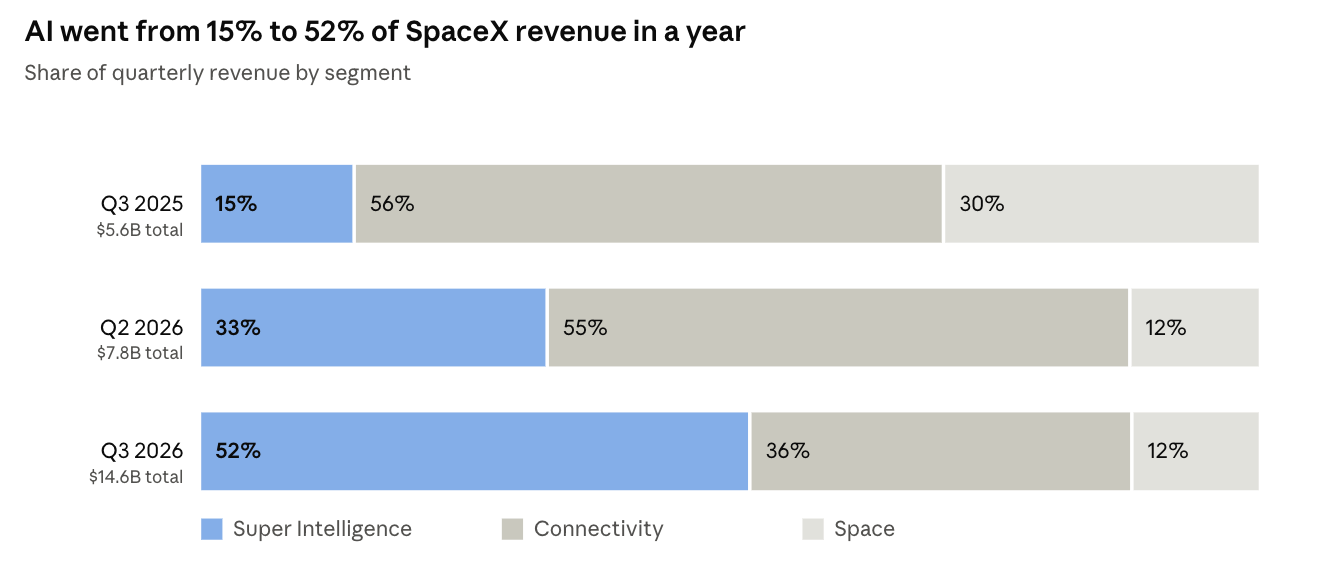
SI revenue rose from $813M to $7.56B in a year. It's now 52% of SpaceX's total revenue, up from 15% a year ago. By sales numbers, SpaceX is now more an AI infrastructure company than a rocket company.
Where did $5B of new revenue in one quarter come from? SI revenue rose $5.0B from Q2. Cursor contributed $608M of that (about 12%). Advertising on X added $171M. Most of the rest came from cloud services agreements: renting out SpaceX's data-centre computing power to other AI companies. On the earnings call, Elon Musk said SpaceX rents compute at close to spot-market rates, not on long-term contracts.
Right now, AI computing power is scarce, so renewals are coming in at higher prices. But spot pricing cuts both ways. If supply catches up with demand, rental prices can fall just as quickly. Long-term contracts would make this revenue more durable.
SI posted $431M of operating income versus a $1.72B loss a year ago. That figure already absorbs a $1.2B stock-based charge from the Cursor deal. Without it, SI's operating income would be about $1.65B. But the segment also spent $16.4B on capex in one quarter, 84% of the company total. Basically, SI is profitable on paper, but it's consuming far more cash than it generates.
What's the hidden cost? Musk said the aim is to split compute roughly 50/50 between internal use (training Grok and other models) and renting to outside customers. Internal compute earns no revenue but still wears out and must be replaced. So only part of every dollar of capex directly produces sales.
The Cursor acquisition: bought growth vs. built growth
SpaceX closed its purchase of Cursor on 14 August 2026, at an implied equity value of $60B. Cursor added $608M of revenue in its first six and a half weeks inside SpaceX. That's a big boost to SI, but bought revenue needs to be read differently from revenue a company builds itself.
What is Cursor?
Cursor is an AI coding tool made by Anysphere, a San Francisco start-up founded in 2022 by four MIT students. Developers type what they want in plain English, and Cursor's AI agents write, edit and review the code.
It grew unusually fast. Annual recurring revenue (ARR) reportedly passed $100M in January 2025, $1B in November 2025 and $3B by May 2026. Its private valuation climbed from $400M to $29.3B in about two years.
Why did SpaceX buy it?
SpaceX's release says the deal advances its strategy to "vertically integrate compute infrastructure, SI models, and applications". In plain terms, SpaceX wants to own every layer of the AI stack:
- The infrastructure: data centres and computing power (Colossus)
- The models: Grok
- The applications people pay for: Cursor, Grok Bot
President Gwynne Shotwell also pointed to Cursor's "scaled enterprise sales force". Selling AI to large companies takes sales teams and existing customer relationships, which take years to build. Buying Cursor gave SpaceX both overnight.
Why acquired growth can flatter a business
Would SI have beaten expectations without Cursor? Yes. Analysts expected SI revenue of about $6.47B, according to Fortune. Excluding Cursor's $608M, SI still delivered about $6.95B. That's an important check. The underlying compute business beat on its own.
But acquisitions can create distortions investors should watch for:
- Growth rates get inflated for a year. Cursor wasn't in last year's numbers, so its revenue counts as pure growth. Q4 will include a full quarter of Cursor, which mechanically lifts SI's growth rate again. Some of that growth might have been purchased, not earned.
- The price sets a high bar. $60B for roughly $3B of ARR is about 20 times revenue. To earn a good return on that, Cursor has to keep growing very fast in a crowded market.
How to read acquired growth in any company: separate organic growth (what the existing business grew on its own) from inorganic growth (what was bought). Then ask what the acquisition cost, how it was paid for, and how many years of growth the price assumes.
A company buying revenue isn't automatically bad. It just tells you less about how strong the core business is.

What to watch in SpaceX's next earnings report
Q3 answered whether SpaceX can turn a profit. Q4 will start to show whether it can keep one. These are the questions we'd bring to the next earnings report:
- Does SI stay profitable with a full quarter of Cursor costs? Q3 carried $1.2B of Cursor-related stock pay for about half a quarter. A full quarter will likely be larger. Can SI revenue growth outrun it?
- What happens to margins without the one-offs? Management expects Q4 gross margins closer to Q2 levels. How much of Q3's margin gain survives?
- Is SI revenue organic? Strip out Cursor. How fast is the compute-rental business growing on its own, and is pricing holding up?
- Does $40B of capex turn into capacity? Watch nameplate compute against the 2.5–3 GW year-end target. Spending without matching capacity would be a warning sign.
- Can Starlink keep growing ARPU and subscribers together?
- Is the full year profitable?
- How is the cash cushion holding up? Track cash and securities against debt, and whether free cash flow narrows.
Management has also set some large targets: $100B of annualised revenue by December 2026. These are forward-looking statements, not guarantees. Comparing them with what's delivered is one of the best ways to judge a management team's track record over time.










submit your comment