Technology trends come and go but very few stick around long enough to reshape industries. Long-lasting structural shifts are known as megatrends.
Unlike short-term technology hype cycles like the Metaverse or NFTs which may or may not have yet to work out, AI is driving deep structural change across multiple industries simultaneously. From healthcare to finance to manufacturing, AI is embedding itself into core systems of businesses.
The scale of investment, adoption, and infrastructure required suggests that AI is not just another technological wave. It could possibly be a multi-decade megatrend.
Why AI Is Considered a Megatrend
1. Multi-Decade Structural Adoption Across Industries
A defining trait of a megatrend is broad, long-term adoption across sectors just like the internet. With the introduction of the internet, companies shifted operations to the internet such as transitioning marketing efforts from print and broadcast media to digital platforms, building e-commerce capabilities to facilitate direct online sales, and leveraging email and instant messaging for internal and external communication. Its impact was seen across all sectors.
Similarly, large language models and agentic AI systems are now being integrated into major industries, including Healthcare, Finance, Defence, Manufacturing & Logistics.
Businesses are embedding AI into their operational workflows to improve productivity, automate decision-making, and reduce costs.
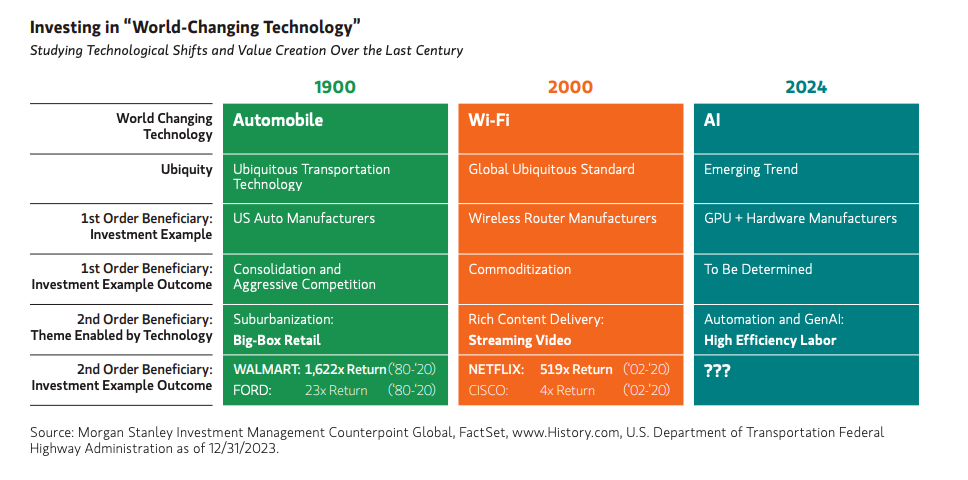
Investors can also think of AI like the electricity revolution of the early 20th century. Electricity did not simply improve one industry; it transformed factories, homes, transportation, and communications simultaneously. AI is following a similar pattern.
Once companies adopt AI systems, they also face very high switching costs. Rebuilding operational infrastructure without AI would mean losing efficiency, automation capabilities, and competitive advantage. This creates a strong incentive for businesses to keep investing in AI once integration begins.
2. Massive and Sustained Market Growth
Another hallmark of mega-trends is long-term market expansion, and AI’s growth trajectory demonstrates this.
Analysts have projected AI to grow at a compound annual growth rate (CAGR) of 26% to 30% through at least 2033. Should growth keep up with expectations, this magnitude over a decade indicates a strong structural shift in global technology spending and not just a temporary surge in interest.
Corporate investment already reflects this shift. For example:
Companies adopting AI-driven software platforms are seeing massive financial gains, such as Palantir delivering over 100% returns in 2025. Simply put, businesses are not just experimenting with AI. They are rebuilding operations around it.
3. Massive Enterprise Automation and Robotics Deployment
AI is expected to move beyond software and enter the physical world applications.
Large companies like Amazon are increasingly deploying AI-powered robotics to automate operations which spans across its warehouses and logistics facilities.
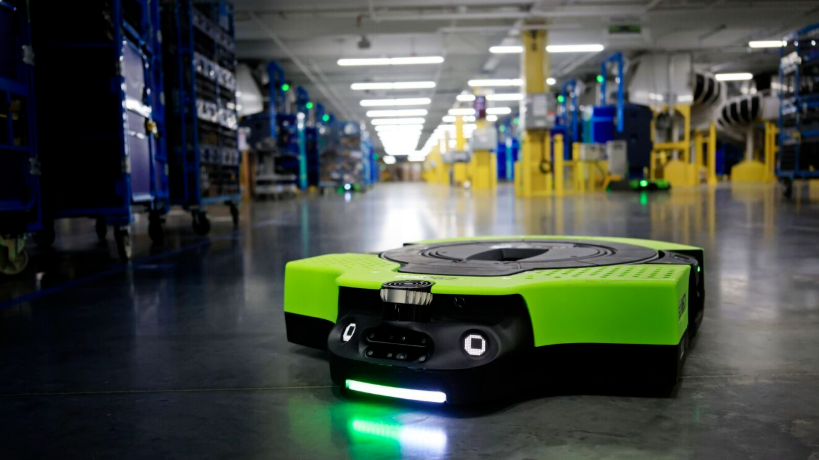
Proteus , Amazon’s first autonomous mobile robot
Automation allows companies to:
- Reduce labor costs
- Increase operational efficiency
- Scale production faster
The long-term driver behind this shift is the global labor shortages caused by aging populations. As workforces shrink in many developed economies, companies will rely more heavily on automation and robotics to maintain productivity. Businesses are not adopting AI because it is trendy. They are adopting it because they have little alternative if they want to remain competitive in a shrinking labour market.
4. A $25 Trillion Surge in Physical AI
As AI becomes embedded into physical systems, the robotics industry itself is expected to grow at a fast pace. According to Morgan Stanley's reports, the robotics market is projected to experience a 250-fold expansion, eventually reaching an estimated $25 trillion industry.
This shift is often referred to as Physical AI, where artificial intelligence controls machines operating in the real world. Some early signals are already emerging. For instance, Singapore has begun trials for autonomous robo-taxis in the early 2026s.
5. The Decade-Long Growth of AI Hardware Infrastructure
Another reason AI could qualify as a megatrend is the massive investment required in hardware infrastructure. AI models require specialised chips, cooling systems, and computing facilities to operate at scale. This has created enormous growth projections for companies building AI infrastructure.
Taking estimated growth rates:
Nvidia: projected annual growth of 31.96% over the next 3 to 5 years, and 26.26% beyond that
Broadcom: expected growth of 20.88% over the next five years, rising to 24% afterward
Taiwan Semiconductor (TSM): projected 22% to 23% growth over the next 5 to 10 years
These projections demonstrate that AI development is not seen as a short-term hype cycle. Instead, the ecosystem supporting AI from semiconductor manufacturing to data center infrastructure is expected to expand for at least the next decade.
6. AI’s Explosive Energy Demands
Lastly, AI systems require enormous amounts of electricity to operate.
Running large-scale AI models and data centers consumes significant power. As AI adoption increases, global electricity demand is expected to surge.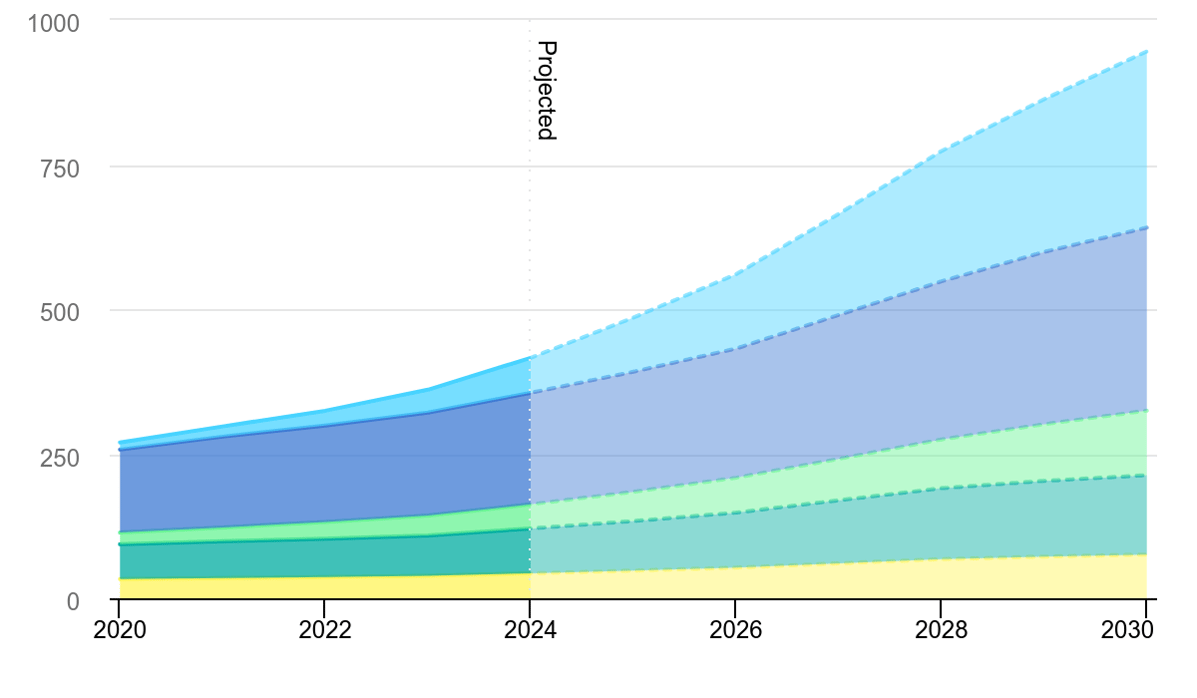
IEA (2025), Global data centre electricity consumption, by equipment, Base Case, 2020-2030, IEA, Paris https://www.iea.org/data-and-statistics/charts/global-data-centre-electricity-consumption-by-equipment-base-case-2020-2030, Licence: CC BY 4.0
The IEA's special report Energy and AI projects that electricity demand from data centres is set to double by 2030.
This demand is so significant that it may create a 44-gigawatt global power deficit by 2028. To put that into perspective, 44 gigawatts is roughly equivalent to the output of dozens of large power plants.
This surge in electricity demand is creating a new investment wave in:
- Nuclear and uranium energy
- Independent power producers
- Power grid infrastructure
And the fact that AI is already affecting the global energy sector further highlights its scale and impact.
Other Emerging Mega-trends Around 2026
While AI might be the megatrend shaping markets today, several other structural shifts are unfolding alongside it. For a smart investor, it is important to view the market holistically rather than focusing solely on AI-driven hype. Opportunities often emerge in adjacent or overlooked sectors, and a disciplined approach means examining the broader landscape instead of chasing a single narrative.
Healthcare and Longevity
Another possible powerful megatrend is the global aging population, often referred to as the “silver tsunami.” The World Health Organization has reported that the number of people aged 60 and older is expected to double by 2050.
This demographic shift would drive long-term demand for healthcare services and innovation, including:
AI-driven drug discovery, Precision surgery robots, Medical devices and Healthcare IT platforms. Healthcare is also generally considered relatively recession-resistant, making it a durable sector for long-term growth.
Final Thoughts
Artificial Intelligence meets many criteria of a megatrend. It spans multiple industries globally, requires massive infrastructure investments, projected decade long technological changes and creating entirely new industries and markets.
From robotics and automation to energy infrastructure and healthcare innovation, AI is very quickly reshaping the foundation of the global economy.
It is a structural transformation that could define the next several decades of economic growth.











submit your comment