An uncovered call (or naked call) is selling a call option without owning the underlying stock.
The seller receives a premium for granting the buyer the right to purchase 100 shares at the strike price before expiration.
If the stock stays below the strike price, the option expires worthless, and the seller keeps the premium.
The unlimited risk that comes with a naked call occurs when the stock rises significantly above the strike price. If exercised, the seller must buy the shares on the open market at the high current price and sell them to the buyer at the lower strike price.
Because a stock price technically doesn’t have an upper limit, the potential loss for an uncovered call is unlimited, making it an extremely dangerous strategy. In this article, we will explain why naked calls is dangerous for beginner options traders and what are other strategy that one can consider.
Payoff Structure of a Naked Call
The profit and loss profile of an uncovered call is very straight forward but highly asymmetric.
Maximum Profit
The maximum profit is limited to the premium received when the option is sold.
This occurs if the stock remains below the strike price and the option expires worthless.
Breakeven Price
Breakeven at expiration is calculated as:
Breakeven = Strike Price + Premium Received
Above this level, the position begins losing money.
Maximum Loss
The maximum loss is theoretically unlimited because the stock price can keep rising indefinitely.
Example Uncovered Call Risk Reward Profile
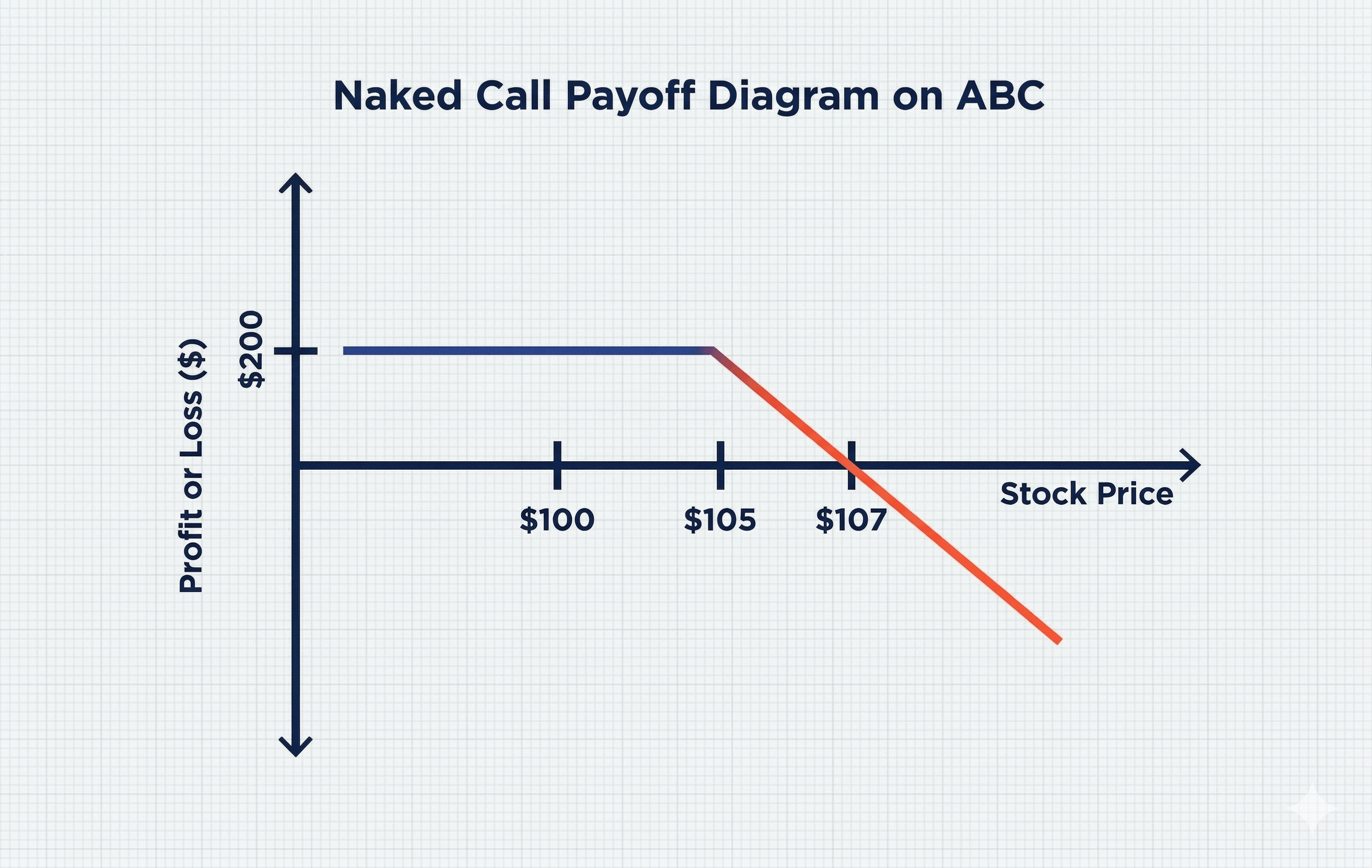
Let’s assume:
- Stock price = $100
- Call strike = $105
- Premium received = $2
If the stock finishes below $105, the option expires worthless and the trader keeps the $2 premium. ($200.)
If the stock rises to $110, the option has $5 intrinsic value.
Loss calculation:
($110 − $105) − $2 = $3 loss per share
Total loss = $300
If the stock rises to $200:
($200 − $105) − $2 = $93 loss per share
Total loss = $9,300
If the stock keeps rising, the loss continues increasing.
This is why uncovered calls are considered a high risk strategy in options trading, especially for beginner options trader who just started.
Covered Calls vs Uncovered Calls
A covered call uses the same structure but includes ownership of the underlying shares. Just a simple difference makes the strategy risk defined as compared to an uncovered call.
With a covered call, the seller already owns at least 100 shares of the stock before selling the call option.
If the option buyer exercises the call, the trader simply delivers the shares already held in the portfolio.
This difference dramatically changes the risk profile.
- Covered Call: Risk is capped to the underlying stock falling in value because you are still a holder of the stock. And when the stock rises rapidly but you are unable to participate in the upside because you sold the call.
Owning the shares also means the trader is not forced to buy stock at extreme prices during a short term rally.
- Uncovered Call: Unlimited Risk comes from the stock rising sharply.
Assignment and "Negative Shares"
If the option holder exercises the call, the seller becomes assigned. As the seller, you might see a new negative shares position in your portfolio depending on how the broker does it.
That’s because if you do not own the shares, the brokerage account usually creates a short stock position (negative shares). This means you are essentially shorting the underlying stock. Losses can pile up if the stock continues it's upward trajectory.
Also, American-style options can be exercised at any time before expiration, so a naked call or uncovered call is not a ‘set and forget’ kind of strategy that many beginners option traders prefer.
Margin Requirements and Forced Liquidation of Uncovered Calls
Uncovered calls are dangerous for beginners because it carry open-ended risk, brokers usually require margin to protect against large losses.
If the stock rises sharply, margin requirements can increase quickly.
If an account cannot meet a margin call, the broker may automatically liquidate positions, usually without notice. Brokers such as Interactive Brokers forego margin calls, opting for real-time liquidations upon margin deficiency. Due to fast markets, accounts typically won't have time to deposit funds to resolve a deficiency.
This can lock in losses and remove the trader's ability to control the exit timing.
The Psychological Aspect of Selling Options For Premium
Selling options appears attractive because the premium is received immediately, and the strategy benefits from time decay working in the seller’s favor. As a matter of fact, options sellers usually make better profits in the long run compared to options buyers. However, understanding the risk involved is crucial.
Sellers can collect small premiums repeatedly, it may create the impression that the strategy is consistently profitable. In reality, the risk remains open for as long as the position exists, only ending when the option expires or the position is closed.
This structure closely resembles an insurance business model:
- Small premiums are collected regularly
- Rare events can produce large losses
Especially with large naked or uncovered positions, the resulting loss can wipe out many previously collected premiums and even accounts.
Other Strategies for Collecting Option Premium
With a loop-sided P&L like uncovered calls/naked calls, many traders prefer risk-defined strategies that give them better control over their positions.
1. Covered Calls
Covered calls generate income from stocks already owned.
How Does Covered Calls Work
- Buy 100 shares of a stock
- Sell out-of-the-money call options against the shares
Benefits of Covered Calls
- Collect option premium
- Reduce cost basis of the stock
- Risk remains tied to the stock you already own
If the stock rises above the strike price, the shares are simply sold at that price.
2. Bear Call Spread
A bear call spread is used when a trader expects the stock to stay flat or fall.
How does a bear call spread works
- Sell an out-of-the-money call
- Buy a higher strike call with the same expiration
Benefits of a bear call spread
- Generates a net credit
- The purchased call caps the maximum loss
- Risk becomes clearly defined
3. Diagonal Spread (Poor Man's Covered Call)
A diagonal spread replicates a covered call using options instead of stock.
How Does PMCC Works
- Buy a deep in-the-money call with long expiration
- Sell short-dated out-of-the-money calls against it
Benefits of PMCC
- Requires far less capital than buying 100 shares
- Maintains defined risk
- Allows repeated premium collection
Key Takeaway
Uncovered calls generate income from selling options but expose traders to theoretically unlimited losses if the stock rises sharply.
Covered calls, bear call spreads, and diagonal spreads allow traders to collect option premium while keeping risk controlled. Understanding and reacting to the risk involved in a naked call requires deep understanding of options mechanics, if you are only just starting to trade options, explore lower risks strategy to train your trading muscle.










submit your comment