Quick answer: A stock split means a company divides each of its existing shares into a larger number of smaller shares. The number of shares you own goes up, the price per share goes down by the same proportion, and the total value of your position doesn't change at all.
Nothing about the underlying business changes, only how its ownership is sliced up.
If you've ever seen a headline like "Company X announces 10-for-1 stock split" and wondered whether that's something to get excited about, let's walk through exactly what's happening, why companies do it, and what it should mean for you as an investor.
The Simplest Way to Picture It
Think of a company's total value as one large pizza. A stock split doesn't add a single extra slice of pizza to the pie. It just cuts the existing pizza into more, smaller pieces. Slice a large pizza into 8 pieces instead of 4, and you have more pieces, but the same amount of food. Is that necessarily good for investors? That depends.
Here's the same idea with real numbers. Say a company is worth $10 billion in total (its market capitalisation), and it has 100 million shares outstanding. Each share is worth $100.
If that company announces a 2-for-1 stock split:
- The number of shares outstanding doubles, to 200 million
- The price per share halves, to $50
- The company's total value stays exactly the same, at $10 billion
If you owned 10 shares worth $100 each ($1,000 total) before the split, you'd own 20 shares worth $50 each ($1,000 total) right after it. Your stake in the business, your percentage ownership hasn't moved at all.
Before vs. After: What Actually Changes
This table shows what happens to a hypothetical company completing a 2-for-1 stock split. Notice which numbers move and which don't.
|
Metric |
Before Split |
After 2-for-1 Split |
Changed? |
|
Share price |
$100 |
$50 |
Yes (halved) |
|
Shares outstanding |
100 million |
200 million |
Yes (doubled) |
|
Market capitalisation |
$10 billion |
$10 billion |
No |
|
Earnings per share (EPS) |
$5.00 |
$2.50 |
Yes (halved) |
|
Price-to-earnings (P/E) ratio |
20x |
20x |
No |
|
Dividend per share |
$1.00 |
$0.50 |
Yes (halved) |
|
Dividend yield |
1.0% |
1.0% |
No |
|
Your % ownership of the company |
Unchanged |
Unchanged |
No |
Anything measured per share gets divided along with the share price. Anything measured at the whole-company level such as market cap, P/E ratio, dividend yield, your proportional ownership stays exactly where it was.
A stock split can't make an expensive company cheap on a fundamentals basis, and it can't make a struggling one healthy, because the math cancels itself out.
So.. Why Do Companies Bother Splitting Their Stock At All?
If a split creates zero new value, it's a fair question. Why do the paperwork? And pay the additional cost. A few practical reasons come up:
To keep the stock accessible. When a share price climbs into four figures over years of growth, it becomes harder for smaller investors to buy a full share and build a diversified portfolio without overcommitting to one position. A lower per-share price after a split removes that friction.
To make employee stock compensation easier to manage. Companies that pay staff partly in shares run into an awkward rounding problem when one share costs thousands of dollars. A split creates smaller, more flexible units for that purpose.
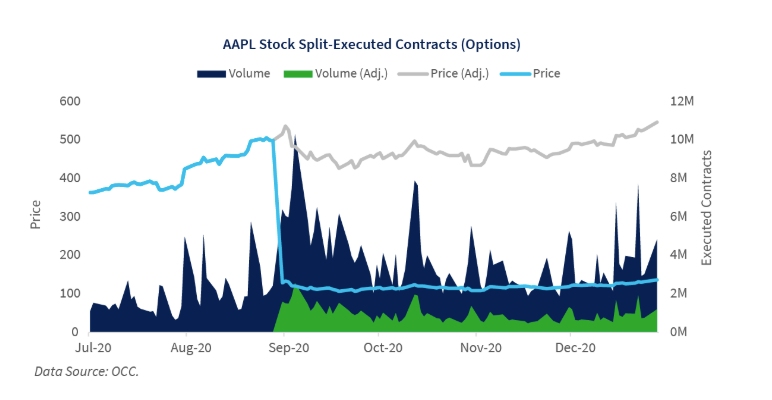
AAPL stock split resulting in increased options contracts being traded (August 2020)
To keep options contracts and index eligibility workable. A standard options contract covers 100 shares, so a very high share price can make a single contract prohibitively expensive, thinning out liquidity. Price-weighted indices can also be reluctant to include ultra-high-priced stocks, since one stock's price swings would distort the whole index.
None of these reasons have anything to do with whether the business itself is a good investment.. They're about keeping the share price in a practical trading range.

Does a Stock Split Affect Your Existing Shares, Orders, or Options?
This is one of the more practical questions for investors who already hold a position when a split is announced.
- Shares you already own: Your brokerage adjusts your share count and cost basis automatically on the effective date. You don't need to do anything.
- Pending limit or stop orders: Most brokers automatically adjust the price on open orders to reflect the new split-adjusted price, but policies vary - it's worth checking your specific broker's handling around the effective date.
- Dividend reinvestment (DRIP) positions: These continue as normal; reinvestment simply uses the new, lower post-split price going forward.
- Options contracts: Existing options are adjusted so the total value of the contract doesn't change. You may end up with a different number of contracts at a different strike price, but the economics stay equivalent.
Nothing about a split requires action from you as a shareholder, the adjustments happen automatically at the brokerage and clearing level.
Is a Stock Split a Signal to Buy?
A stock split, on its own, tells you nothing about whether a company is a good investment as we have said before. It's just a mechanical adjustment to the share count, not a change in earnings power, competitive position, or balance sheet strength. But the headline news can sometimes move stock prices dramatically.
That said, splits don't happen randomly. Companies generally only split their stock after a sustained period of share price appreciation driven by strong business performance. The split follows the good performance, rather than causing it.
Some investors read a split announcement as a signal of management's confidence that the higher price is likely to hold, since a split followed by a sharp decline would be a visible, public reversal for leadership.
Historical studies looking at large samples of past stock splits have generally found that split stocks went on to outperform the broader market in the following year or two. It's worth being clear-eyed about what that evidence actually shows: it reflects that strong companies tend to split, not that the split itself creates the outperformance. A struggling company splitting its stock gets none of that benefit, and a split is never, by itself, a reason to buy or sell.
What About Reverse Stock Splits?
A reverse stock split is the mirror image, a company combines multiple existing shares into fewer, higher-priced ones, again with no change to total value. A 1-for-5 reverse split turns five $2 shares into one $10 share.
Unlike a forward split, a reverse split carries more mixed connotations, mainly because it's most commonly used by companies whose share price has fallen too low to meet stock exchange listing requirements. That said, not every reverse split signals distress. Occasionally healthy companies use one for routine housekeeping, such as aligning their per-share metrics with industry peers. The context behind why a company is doing it matters far more than the mechanic itself.
Final Thoughts
A stock split changes how a company's existing value is divided up on paper. More shares, each worth proportionally less. Without changing the size of the business, its earnings, or your ownership stake.
It's worth understanding so a split announcement doesn't feel like news you need to act on immediately. On its own, it's neither a reason to buy nor a reason to worry. The fundamentals underneath the split are what actually decide whether a company is worth holding.
This article is for general educational purposes and does not constitute financial or investment advice. It is not a recommendation to buy, sell, or hold any security. Past performance is not indicative of future results. Please conduct your own research or consult a licensed financial adviser before making any investment decision.










submit your comment