Valuation lies at the heart of every investment decision, shaping how we identify worthwhile opportunities. Among the many methods, Discounted Cash Flow (DCF) remains a foundational approach for investors to estimate a company's intrinsic worth based on future cash flows.
In this article, you will learn what DCF is and why it's used, how terminal value drives a large part of valuations, the relationship between price and intrinsic value. Step-by-step instructions to calculate DCF, why projected growth rate assumptions move your valuation more than almost any other input.
By the end, you will gain clarity on using DCF as a practical tool to strengthen your investment decisions with confidence and discipline.
What is Discounted Cash Flow (DCF)?
Discounted Cash Flow (DCF) is a valuation method investors use to estimate the value of an investment based on its expected future cash flows.
At its core, discounted cash flow (DCF) involves projecting all future free cash flows a company is expected to generate, then discounting it back to their present value using a chosen discount rate. The discount rate often used is the Weighted Average Cost of Capital (WACC), representing the company's average cost of financing from equity and debt.
Mathematically, the DCF formula is:
DCF = Σ [FCF_t / (1 + r)^t] + TV
where:
- FCF_t = Free Cash Flow in year t
- r = Discount rate (WACC)
- n = Number of forecast periods
- TV = Terminal Value, discounted back to present value
This formula calculates the sum of all projected free cash flows, each discounted back to today's value, plus the terminal value which represents the company's value beyond the forecast period.
However you don’t need to know the formula as you can use platforms like StockOracle™ to calculate it based on your assumptions. What’s more important as retail investors is to understand how each variable in the formula affects the outcome.
Investors frequently rely on Discounted Free Cash Flow (DFCF) which is a DCF model that uses free cash flow because it emphasizes cash generation capability which offers a clearer insight into a company's intrinsic worth, independent of market fluctuations or accounting manipulations.
Free Cash Flow is the remaining cash a company holds after covering operating costs and capital expenditures.
Price vs. Value: Why a Discount Doesn't Mean an Immediate Rally
A DCF model tells you what a business is worth based on the cash it's expected to generate, not what the market is willing to pay for it. In the long term Intrinsic value and price are generally co-related, but they rarely move in lockstep in the short term. Because in the short term, price moves based on emotions and speculations.
And that is important to understand because investors cannot expect prices to move immediately simply because it is undervalued.
When a stock trades below its calculated intrinsic value, that gap reflects a difference between your model's estimate and the market's current pricing. Markets can continue mispricing a business for months, sometimes years, before that gap narrows. In cases, it might only narrow once something changes the market's view of the company: an earnings surprise, a shift in industry sentiment, a change in leadership, or broader macro conditions turning favorable.
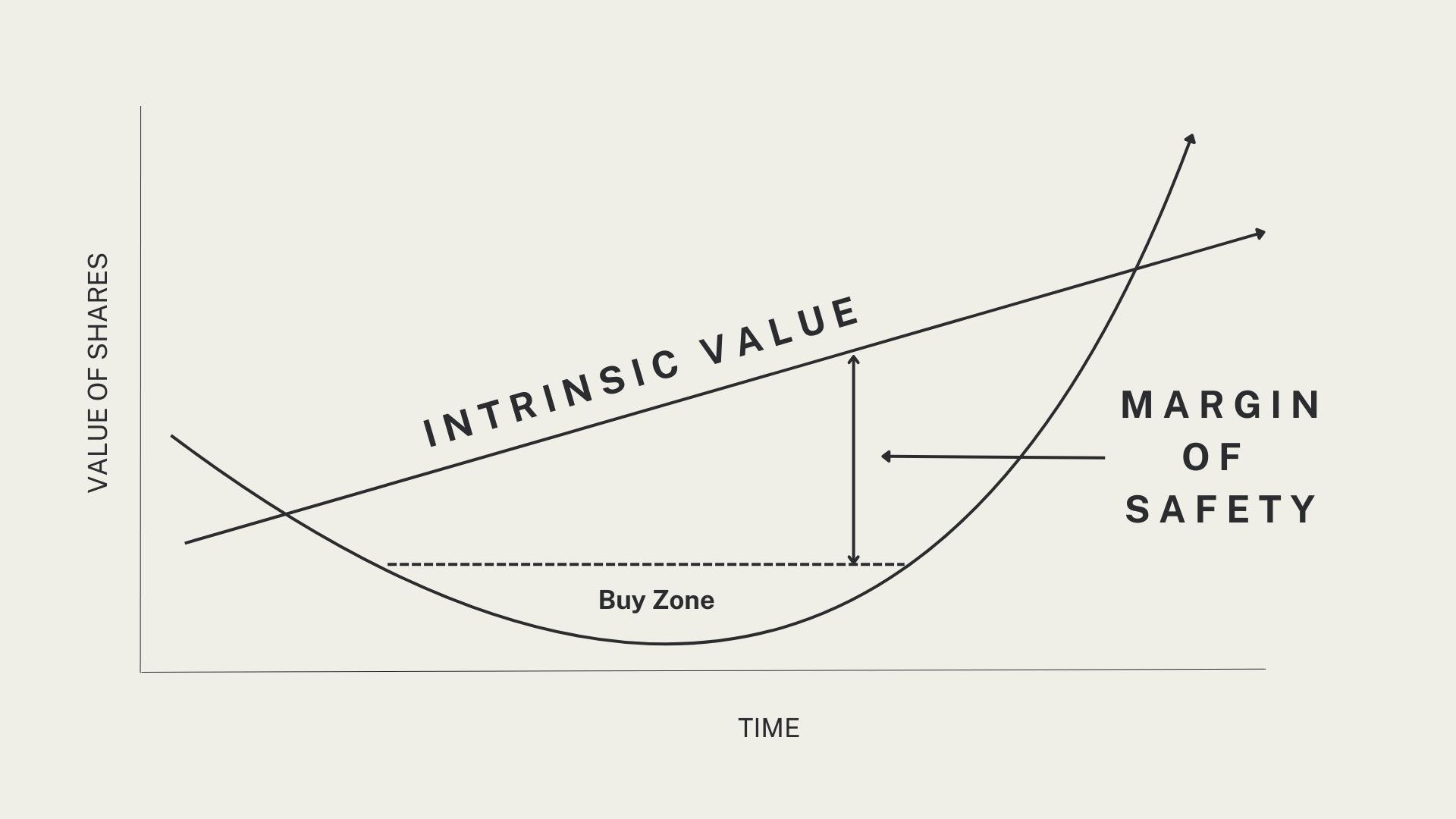
The margin of safety that a valuation gap provides exists to buffer against errors in your own assumptions not to time how quickly the market will re-rate a stock.
Patience has always been part of the investing discipline. A business can be undervalued and stay undervalued for a long stretch of time. Keeping the distinction between price and value front of mind helps investors avoid two common errors: abandoning a thesis too early simply because the price hasn't moved, or expecting a valuation gap to resolve on a specific timeline.
What is Terminal Value in Discounted Cash Flow?
Now, back to the DCF formula. Terminal value in a DCF model is the estimated worth of all future cash flows beyond the forecast period, simplified into a single value today.
Many investors find terminal value challenging due to the assumptions required about long-term growth and market conditions. And no one can predict with certainty what will happen to a business and/or the world. Despite the complexity, estimating terminal value is essential since it often constitutes a significant portion to the outcome. And so valuation models should be used as a framework to make intelligent calculations to estimate the intrinsic value of a business.
Particularly for mature companies with stable cash flow patterns. Here, we aim to simplify this vital concept to help investors navigate valuation with clarity.
There are two primary methods investors utilize to calculate terminal value:
Perpetuity Growth Model: This method assumes the business continues growing at a stable, constant rate for a very long time.
Exit Multiple Approach: Alternatively, investors estimate terminal value using multiples from comparable companies. This could include EBITDA, revenue, or earnings multiples. The selected multiple is applied to the financial metric in the terminal year, capturing market-driven valuation sentiments.
How to Calculate DCF in Excel or Sheets.
Excel offers a straightforward framework to perform a DCF analysis. For investors who deeply value precise valuation methods, having a customised intrinsic value calculator ensures your analysis aligns perfectly with your investment philosophy. Here are what investors tend to do if they want to calculate their own intrinsic value.
- Forecast Free Cash Flows: Project the company's future free cash flows for a defined period (usually 5–10 years). Typically, you could start with historical data and adjust for growth expectations and profitability improvements.
- Determine the Discount Rate: Calculate or obtain the Weighted Average Cost of Capital (WACC), reflecting the cost of financing the company's operations through equity and debt.
- Compute the Present Value of Future Cash Flows:
- Using NPV formula: =NPV(discount rate, cash flow range)
- Make sure your discount rate matches the frequency of your cash flows (annual rate for annual cash flows).
- Calculate Terminal Value:
- Perpetuity growth model: =FCF_final_year * (1+growth rate)/(discount rate-growth rate)
- Exit multiple approach: =Final Year EBITDA or earnings * Exit Multiple
- Discount Terminal Value: Calculate the present value of the terminal value by discounting it back to today: =Terminal Value/(1+discount rate)^number of forecast years
- Sum All Present Values: Add present values of all forecasted cash flows and terminal value to get the intrinsic valuation.
This step-by-step method ensures clarity, precision, and transparency in your DCF valuation. If you're still unsure about company valuations, you may explore our intuitive intrinsic value calculator for further assistance.
The Metric That Moves Your DCF the Most: Projected Growth Rates
Of all the assumptions that go into a DCF model the projected free cash flow growth rate used across your forecast period has the largest impact on the final valuation.
The reason comes down to compounding: a growth assumption doesn't just affect the year it's applied to, it becomes the baseline every subsequent year builds on.
And here's how much that compounding matters in practice. Take a hypothetical company generating $100m in free cash flow today. Model 8% average annual growth over a 10-year forecast, and free cash flow in year 10 reaches roughly $216m.
Raise that same growth assumption to 12%, and year 10 free cash flow climbs to roughly $311m.
Notice a difference of nearly 44%, driven entirely by a 4 percentage-point change in a single input.
(Figures here are illustrative only, used to demonstrate the mechanics of compounding — not projections for any specific company.)
Just like how compounding works on your portfolio of stocks, it works the same way in businesses.
Given this significant sensitivity, the free cash flow growth assumption requires the most rigorous analysis than nearly any other variable. Even minor tweaks can transition your outlook from conservative to aggressive, and vice versa.
Investors should utilise verifiable data as an anchor to ensure growth projections remain realistic. It is also common practice to normalise figures, smoothing out exceptional spikes or dips that don't reflect typical operations. Relying on a single, non-recurring quarter to project future performance is a common error that frequently leads to inflated, unsustainable valuations.
Lastly, it's common practice to model a worst, base, and best case scenario when calculating intrinsic value, giving a range of outcomes rather than a single fixed number.
What is the Impact of Interest Rates on a DCF?
Interest rates influence DCF valuations because the discount rate typically includes a risk-free rate component, usually represented by yields on government bonds. Although this is the variable that will affect almost all companies so dwelling and analysing interest rates might not be very fruitful.
What is “risk-free” rate? In reality, no investment is truly risk-free. However analysts use a proxy: typically the yield on a government bond from a stable, highly-rated country is considered “risk free”.
You can also learn more about equity risk premium and market risk premium here.
How Do Share Buybacks Affect DCF?
In a standard DCF model, share buybacks don't directly factor into the calculation of free cash flows, since those are measured before financing activities. Their impact shows up later, when the equity value is divided by a smaller number of outstanding shares, boosting the intrinsic value per share.
Buybacks also reduce the company's cash reserves, which may slightly lower interest income or constrain future investment capacity, though these effects are typically minor in the overall valuation.
To simply explain, buybacks don't change a DCF's total value, but by reducing share count, they can lift the intrinsic value per share.
Common Investor Mistakes to Avoid
DCF analyses can sometimes be tricky, and it's common for investors to fall into the trap of overly optimistic growth assumptions or not fully capturing risk through the discount rate.
Being too hopeful about future cash flows can unintentionally inflate valuations, potentially leading to misguided investment decisions. Likewise, overlooking adjustments to discount rates that reflect shifting market conditions or specific business risks can skew your valuation significantly.
It helps to regularly compare your assumptions with industry benchmarks, historical data, and market conditions to keep your valuation grounded and sound.
Final Thoughts
Valuing a company is fundamental for informed investing decisions. Mastering valuation methods like DCF enables investors to navigate financial complexities confidently, improving the likelihood of potentially finding undervalued stocks.
Always ensure you understand the underlying assumptions and methods used, as a thoughtful and robust valuation forms the foundation of sound investing.










submit your comment