Options trading may seem complex and intimidating at first, but learning the basics can open up genuine opportunities to profit from stock movements without committing the full cost of buying shares. This guide explains what call options are, how they work, how to profit from them, and the strategies beginners should know before they start.
|
Key Points
|
If you are brand new to options, it also helps to read our options trading beginner guide to build your foundation first.
What Are Call Options?
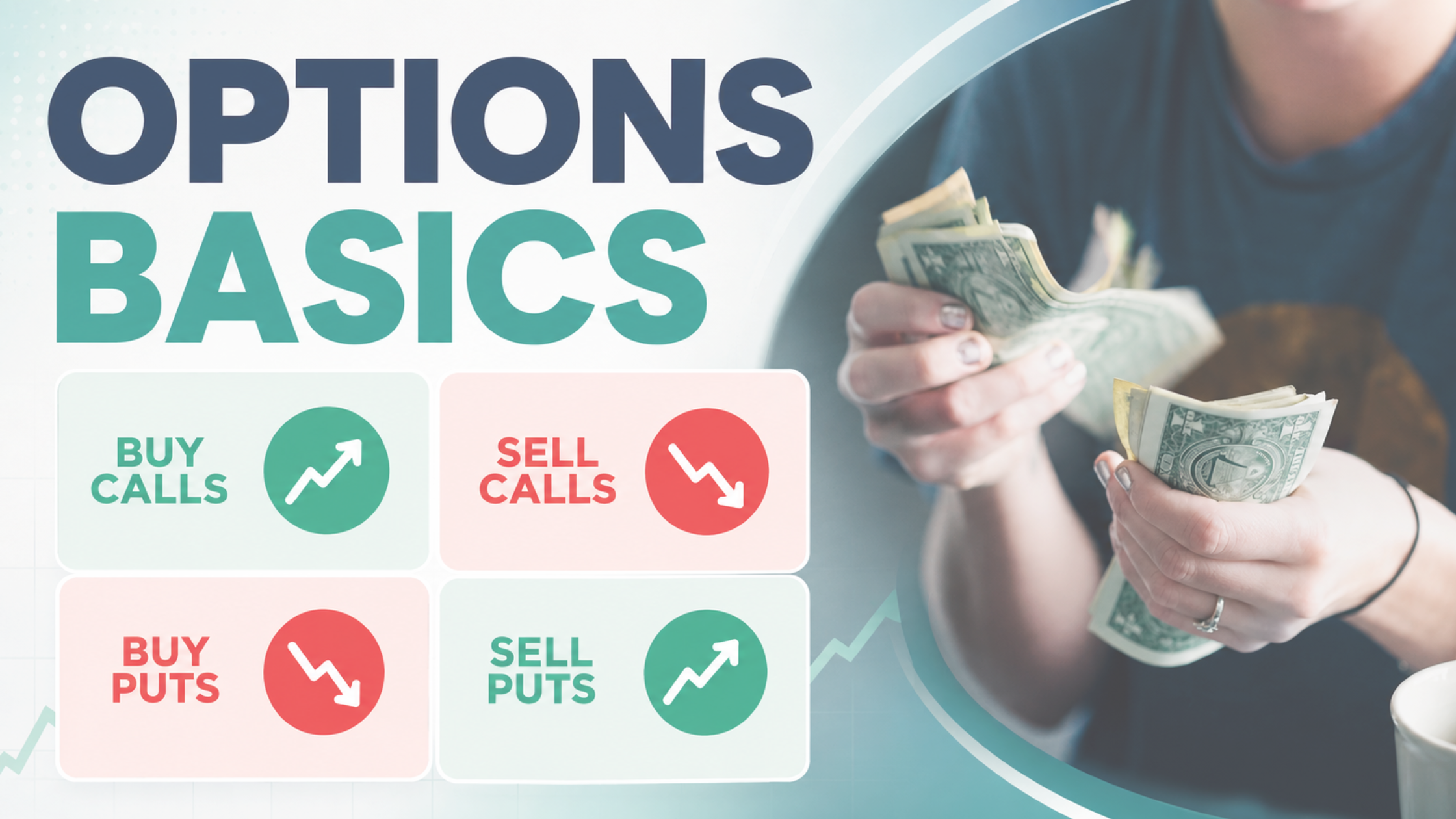
A call option is a contract that gives you the right, but not the obligation, to buy 100 shares of a stock at a specific price, called the strike price, before a set expiration date. Each call option contract covers exactly 100 shares of the underlying stock.
Just like in any contract, there is a buyer and seller. The buyer as mentioned above, pays for the right to buy within the contract period. And the seller earns the premium from the buyer in exchange for the obligation to sell.
|
Call Option |
Buyer
|
Seller
|
|
Strategy |
As a call buyer, you pay a premium for the right to purchase the underlying stock at a set strike price anytime before expiration. |
As a seller, you receive the premium upfront but take on the obligation to sell the underlying stock if the buyer chooses to exercise. If the option expires unexercised, you keep the premium with no further obligation. |
For example, you could buy a call option that allows you to purchase 100 shares of Apple (AAPL) for $190 per share at any time until a specific date three months from now. This is known as a $190 call option on AAPL.
To acquire this right, you pay an upfront fee to the seller of the call option. This fee is called the premium. Premiums are quoted per share, so a $3.50 premium means you pay $350 for one contract (100 shares x $3.50). Premiums are higher for stocks that are more volatile, or for options with more time until expiration.
Think of it like a deposit. You pay a small fee to hold a guaranteed purchase price. If you decide to act on it, the price is locked in. If you walk away, you lose the deposit.
And if you’re the seller you earn the deposit simply by giving the buyer that option.
Why Trade Call Options?
Call options let you profit from upside moves in a stock without paying the full share price. Your maximum buy price is locked in at the strike price, while your profit potential is theoretically unlimited if the stock keeps climbing.
The main reasons traders use call options:
- Less capital required: You can control 100 shares for a fraction of the cost of buying them outright.
- Defined risk: Your maximum loss is capped at the premium you paid. You can never lose more than that.
- Income generation: As a seller of call options, selling covered calls against shares you own, you can collect recurring premiums as income which will be shared a little later in the article.
That said, options have defined expiration dates. If the stock does not move as expected before expiration, your call option can expire worthless and you lose the full premium paid as the buyer.
How Do Call Option Profits Work as Buyer a.k.a Long Call?
There are two primary ways to profit from a long call:
1. Sell to Close your Call Option Contract
This is the most common approach for retail traders. If the stock price rises above your strike price before expiration, the value of your call option increases. You can sell the option back to the market for more than you paid and pocket the difference, without ever actually buying the shares.
For example: you buy a $190 call on Apple (AAPL) when the stock is trading at $185. You pay $350 for the contract. Apple climbs to $205 before expiration and your option is now worth $1,600. You sell it. Your profit is $1,250, a 357% return on a $350 investment, while Apple itself only moved 11%. (figures provided here are based on estimates and examples)
2. Exercise your Right to Buy
If you want to actually own the shares, you can exercise your call option to buy 100 shares at the strike price, regardless of the current market price. If you hold a $190 call and the stock is trading at $205, you can exercise to buy 100 shares at $190 and either hold them or sell immediately at $205, netting $15 per share minus the premium you paid.
Since exercising requires the capital to purchase 100 shares outright, some traders might not actually exercise it and choose the first method of profiting from a long call instead.
The Mindset for Beginner in Options Trading
The fact that options are cheaper compared to buying shares outright, many traders often treat them like lottery tickets: buying speculative contracts with short expirations and strike prices that require massive moves to profit.
The reframe that changes the gambling mindset: treat every call option as paying for a defined-risk position in a stock you have genuinely researched, with a specific thesis and a specific time horizon. You are expressing a measured view with a known maximum loss.
Selling Call Options for Beginners
Everything above explains call options from the buyer's perspective. And there is another side to this trade: the seller. And for many beginners, selling call options is a more consistent path to generating income from options.
When you sell a call option, you collect the premium upfront. The buyer pays you. In return, you take on an obligation: if the stock rises above the strike price, the buyer can exercise their right and you must sell shares at that strike price.
Selling calls without owning the underlying stock, known as selling "naked" calls, carries theoretically unlimited risk. A stock can rise indefinitely, and your losses rise with it. This is not suitable for beginners. The risk defined approach is the covered call.
Covered Call Options Explained for Beginners
A covered call is when you already own 100 shares of a stock and you sell a call option against those shares. Because you own the shares, your risk is managed.
Here is how it works with an example step by step:
- You own 100 shares of Apple (AAPL) trading at $185 per share.
- You sell 1 call option contract with a $195 strike price expiring in 30 days for a premium of $2.50 per share, collecting $250 total.
- For the next 30 days, the buyer of that call has the right to purchase your 100 shares for $195 each.
- If Apple stays below $195, the option expires worthless and you pocket the $250 premium as profit on top of any stock gains you already hold.
- If Apple rises above $195, your shares get called away at $195, but you still keep the $250 premium. Your effective sell price becomes $197.50 ($195 + $2.50).
Covered calls limit your upside if the stock runs strongly, but they provide consistent income and modest downside protection equal to the premium received.
For a deeper walkthrough of setup and management, read our full guide on covered calls.
Related Options Strategies to Explore
Once you are comfortable with buying call options, the next logical step is covered calls: selling calls against shares you already own to generate monthly income. It flips your perspective from buyer to seller and is one of the most widely used income strategies among retail investors.
From there, the wheel strategy combines selling cash-secured puts (to acquire stock at a target price) with covered calls (to generate income from those shares). Together they create a repeatable premium income cycle that many traders use as a core portfolio strategy.

Final Thoughts
Call Options let you profit from a stock's upside with capped downside, control large positions with limited capital, and as a seller generates income from shares you already own.
Note: This information is educational and should not be considered financial advice. Options trading involves significant risk and is not suitable for all investors.
Is it better to buy put or call options?
Neither is universally better. Call options profit when a stock rises; put options profit when it falls. The right choice depends on your view of the stock. If you are bullish, a call makes sense. If you expect a decline, a put is the right tool. Many traders use both depending on the setup. Find out more in our call vs puts guide.








submit your comment