A market correction is typically explained as a decline of 10%+ in a stock index from its most recent high. It is less severe than a bear market (which requires a 20%+ decline)
|
Key Points
|
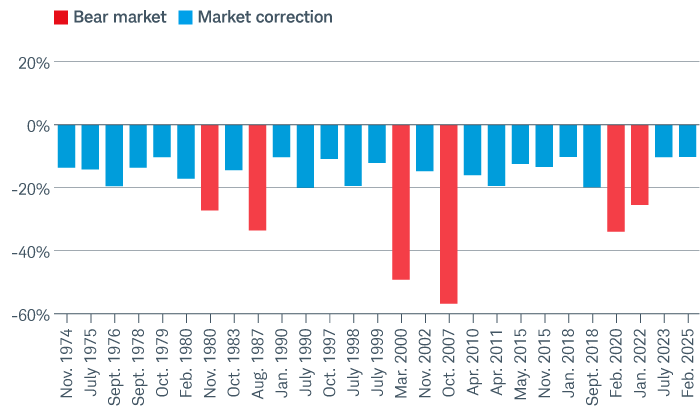
Source: Schwab Center for Financial Research with data provided by Morningstar, Inc.
Most corrections also don’t turn into bear markets. In fact, around 4 out of 5 corrections doesn’t become a bear market since November 1974 as depicted from the chart above. And because of this statistic, most investors who try to time them could end up worse off than those who simply hold.
If you want to know how to identify a correction as it's happening, why acting on it is riskier than it sounds. Read on.
Pullback, Market Correction, Bear Market, Crash
One reason investors panic during corrections is that they don't know what they're actually looking at. A 5% dip feels like the beginning of a crash. A 12% decline feels like the end of the world.
Here's a framework:
|
Market Event |
Decline from Peak |
Typical Duration |
Estimated Frequency |
|
Pullback |
5 - 9% |
Days to Weeks |
Several times per year |
|
Market Correction |
10 - 19% |
Months |
Every 1-2 years |
|
Bear Market |
20%+ |
Months to years |
Every 3 - 6 Years |
|
Crash |
20%+ in a short period |
Months to years |
Rare |
All data presented is based on historical figures and does not guarantee future performance.
A market pullback is normal noise almost like the market breathing. A market correction is a meaningful but temporary decline. A bear market is a prolonged downturn, usually tied to economic contraction that drops more than 20%. A crash is a sudden, severe collapse, often accompanied by a recession that extends the recovery.
Here's the context that almost never gets mentioned: since 1980, the S&P 500 has experienced a pullback of 5% or more in 93% of all years.
Corrections of 10%+ have occurred in roughly half of all years since World War II. These are not bugs of the market, they are just features of how markets work.
What Usually Causes a Market Correction ?
Market corrections typically don't have a single cause.
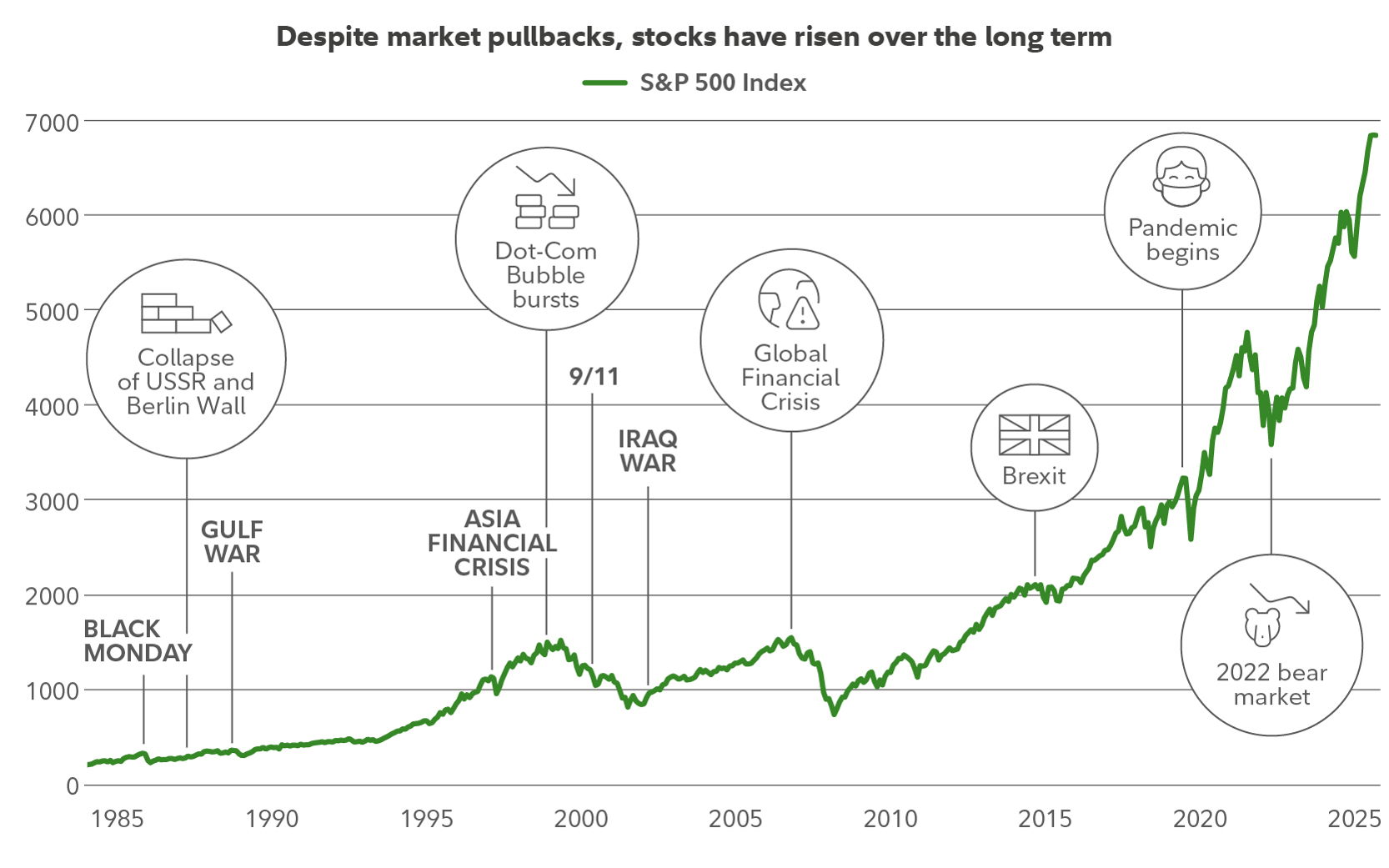
Past performance is no guarantee of future returns. Source: FMRCo, Bloomberg, Haver Analytics, FactSet. Data as of December 31, 2025.
They happen when some combination of factors tips the balance from buying pressure to selling pressure.
Common triggers historically includes:
Rising interest rates. When central banks raise rates to fight inflation, borrowing costs increase, corporate earnings expectations fall, and investors reprice risk assets downward.
Disappointing economic data. A weak jobs report, GDP revision, or poor retail sales numbers can trigger a rapid reassessment of market valuations.
Geopolitical shocks. Wars, trade disputes, sanctions, or political instability can spike uncertainty.
Overvaluation. When valuations stretch beyond what earnings can justify, the market is vulnerable. An otherwise ordinary piece of bad news can set off a sell-off that looks dramatic but is really just valuations drawing closer to price.
Sudden macro shocks. COVID-19 in 2020, the banking stress of 2023, and the rate-driven correction of 2022 are recent examples. These can be fast and violent.
The common thread in all corrections: they feel catastrophic while they're happening, and obvious in hindsight.
Can you Identify a Market Correction using Charts?
Most investors learn about a correction through headlines or when their portfolio screams red. By then, the decline is already well underway, and the emotional pressure to act is at its peak.
A sense of market sentiment can be gained by using price action to identify the market's current position as it unfolds, rather than relying on delayed news reports. Although this is not a guaranteed method, it offers insight into what the market is experiencing.
One technical tool is the 10-week and 30-week Simple Moving Average (SMA) crossover, which is mathematically equivalent to watching the 50-day and 150-day SMAs on a daily chart. For a better visual representation, do refer to our video above.
Here's how to read it:
- The 10-week SMA tracks the market's shorter-term price trend.
- The 30-week SMA tracks the longer-term price trend.
A possible downturn signal appears when the 10-week SMA crosses below the 30-week SMA and both lines are sloping downward.
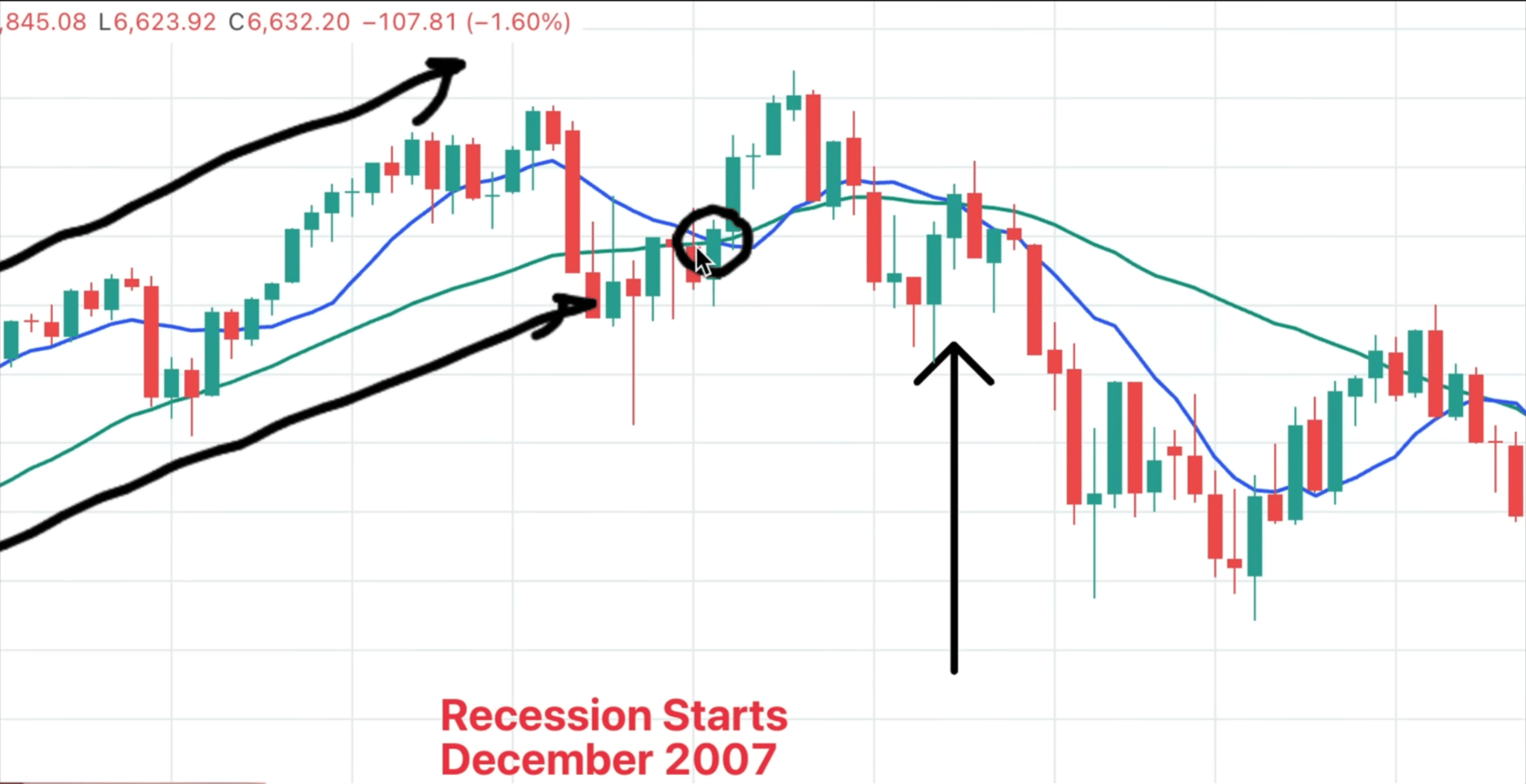
This crossover, combined with downward slope on both lines, indicates that the short-term trend has broken through the long-term trend and momentum is now on the downside.
This is a more objective signal than trying to interpret economic news, which is always backward-looking. Price action reflects what market participants are collectively doing right now, not what they were doing three months ago when the data was collected.

The Whipsaw Problem: Why Acting on the Signal Can Backfire
With this understanding, you might think that short-term trading can help navigate corrections. However, it is a fact that no one can predict the market; signals indicate your current position, not the future direction of the market.
It is crucial to emphasize again that the vast majority of market corrections do not escalate into a full bear market. This statistic is hugely significant, particularly if you are considering selling assets every time the 10-week Simple Moving Average (SMA) falls below the 30-week SMA.
Sometimes market corrections can be as brief as a few weeks. The market can recover before you have time to act on your sell decision, find somewhere to park your cash, and plan your re-entry. What tends to happen instead is the "whipsaw" effect:
- The market drops 10–12%. You see the SMA crossover and sell.
- The market reverses sharply and recovers.
- You're now holding cash, watching the market climb back above your exit price.
- To get back in, you have to buy at a higher price than you sold.
The problem is that you never know in real-time whether a correction will become a bear market or reverse within weeks.
This is why the signal is most valuable as a monitoring tool, a way of understanding where the market stands rather than an automatic trigger to sell or buy.
The Case for Buy-and-Hold Through Corrections
Over a long investing horizon of 10 to 30 years, buying and holding through corrections and bear markets produces roughly the same outcomes as perfectly executed trend-following and significantly better outcomes than the average investor achieves by actively trading around market swings.
The historical data supports this. Since 1974, the S&P 500 has returned an average of approximately 24% in the 12 months following a correction.
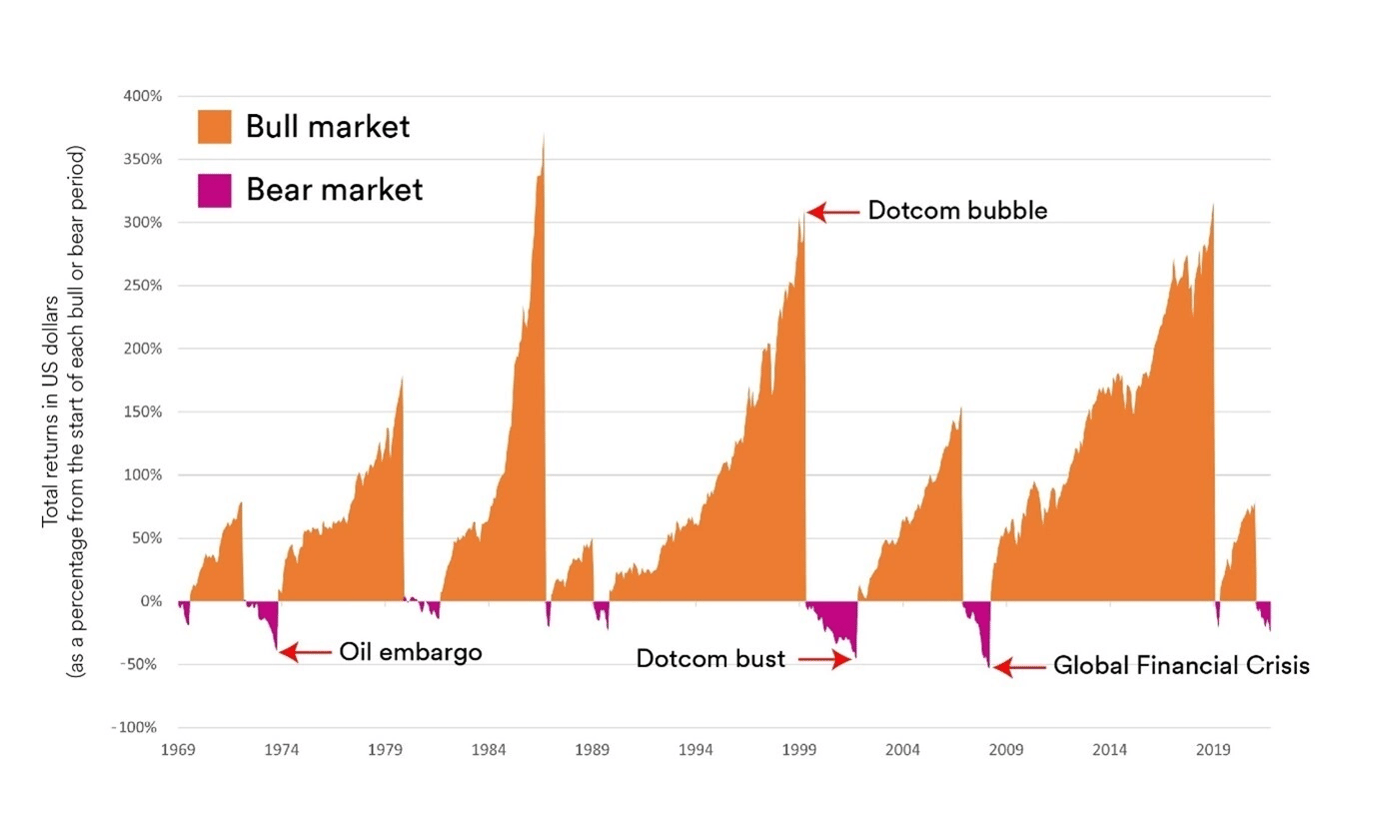
Markets that enter correction territory tend to recover and continue higher and the investors who benefit most from that recovery are the ones who stayed invested.
The information in this article is for educational purposes only and does not constitute financial advice. Past market performance is not indicative of future results.











submit your comment