You’ve probably heard of the wheel income strategy and want to discover how options traders use the wheel strategy to earn an income. A cash wheel strategy is basically a repeating income options strategy cycle built out of two common options strategies you may have heard of: selling cash-secured puts and selling covered calls. Together, both selling of a put and selling of a call forms a loop that keeps generating premiums, month after month.
Key Points
|
If you are just starting out in Options Trading, check out our Complete Beginner Guide to Stock Options Trading.
This guide breaks down how the wheel works, walks you through a full example with real numbers, and what should a beginner look out for when trading the wheel strategy..
What Is the Wheel Strategy?
The wheel strategy (sometimes called the "income wheel" or the "triple income strategy") is a systematic approach to generating options income that cycles through two phases.
In Phase 1, you sell a cash-secured put on a stock you want to own. You collect a premium upfront and wait.
In Phase 2, if the stock falls to your strike price and you're assigned, you now own 100 shares. You then sell a covered call against those shares and collect another premium while you wait for the stock to recover or be called away.
Once your shares are called away, you return to Phase 1 and start again. Every turn of the wheel generates income. The goal is not to predict where the stock goes next. The goal is to collect payment at every stage while holding a position you're already comfortable with.
Phase 1: Selling the Cash-Secured Put
You start selling the cash secured put by choosing a stock you genuinely want to own in the long run. You then sell a put option at a strike price below the current stock price, at a level where you'd be comfortable buying the shares. In return, you collect a premium upfront.
To make this a cash-secured put, you set aside enough cash to buy 100 shares per contract at your strike price. That cash is reserved as collateral and sits in your account until expiration.
Now you wait. If the stock stays above your strike price, the put expires worthless and you keep the full premium. You sell another put and the income continues. If the stock falls below your strike price, you are assigned: you buy 100 shares at the strike price.
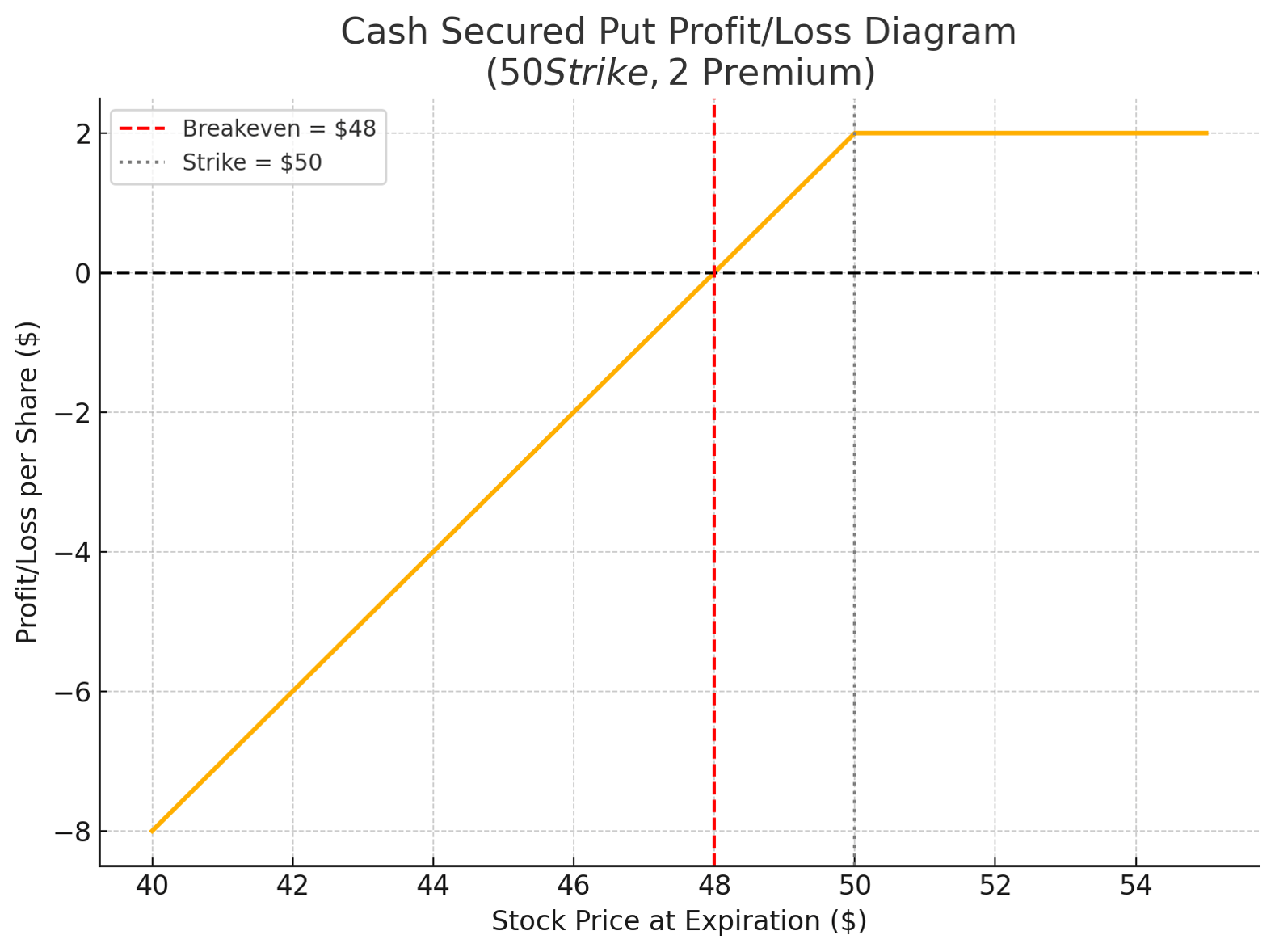
Profit and Loss Diagram of a Cash Secured Put - To find out more about Cash Secured Puts Refer to our beginner CSP guide.
Your effective cost basis is the strike price minus the premium you already collected. From here, you move to Phase 2.
Phase 2: Selling the Covered Call
Once you own 100 shares, you sell a covered call against them. You choose a call strike price above your cost basis, collect another premium, and wait again.
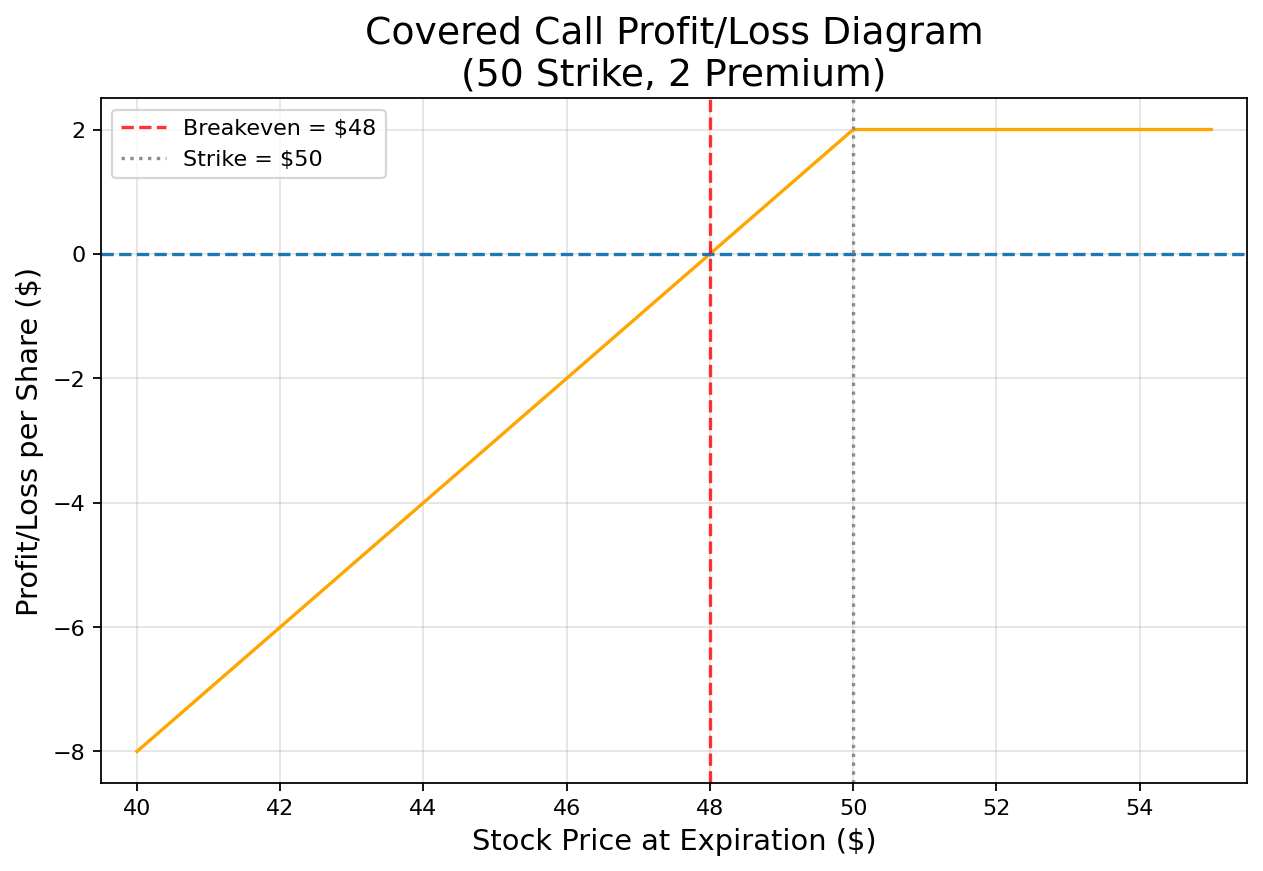
Profit and Loss Diagram of a Covered Call - To find out more about Covered Call Refer to our beginner CC guide.
If the stock stays below your call strike at expiration, the call expires worthless. You keep the premium and sell another covered call slowly reducing your cost basis with each cycle.
If the stock rises above your call strike, your shares are called away at the strike price. You keep the premium, pocket any capital gain on the difference between your cost basis and the strike, and return to Phase 1 with the cash received.
Phase 3: The Wheel Repeats
When your shares are called away, you return to holding cash. At this point, you sell another put option to restart the cycle. Each complete turn of this "wheel" generates premium income.
Additionally, some cycles may result in a capital gain if the shares are called away at a price above your original cost basis.
This is where a crucial decision comes into play: if the stock's valuation or business model is no longer appealing, option traders can choose to apply the wheel strategy to a different underlying stock.
This flexibility is important, as the fundamental principle remains: when selling a cash-secured put, you must be prepared and willing to own the shares should an assignment occur.
Now, before you start running the wheel strategy, there are three primary risks you'll need to watch out for. They are:
- What happens if the stock price drops after you're assigned? That's a potential loss.
- Capital gets tied up.
- The upside is limited.
These risks will be further dived into later in the guide.
The following is an example of a Cash Wheel Cycle, designed to clarify the concept explained above.
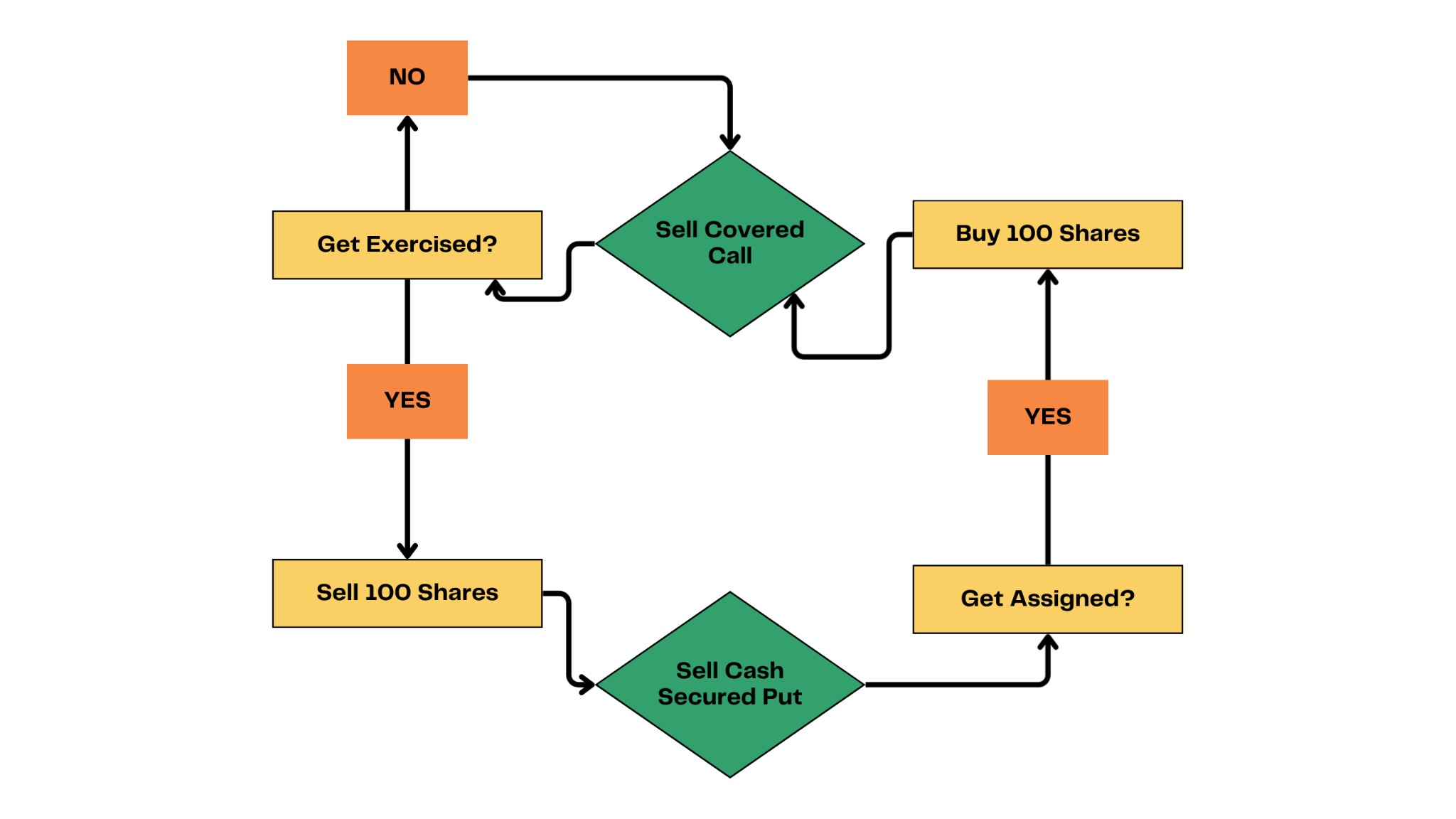
A Concrete Example: One Full Wheel Cycle
Let's walk through a complete wheel cycle using a fictional stock, XYZ Corp, currently trading at $50 per share.
You have studied the company financials and would be happy to own it at $48 within a 35 days period.
Most options sellers target the 30–45 DTE window because this range captures the steepest part of the theta decay curve. Striking a balance between premium collected and time available to manage the trade. This is not trading advice and is for educational purposes only.
Phase 1: Selling the Put
You sell one XYZ put option with a $48 strike price and 35 days to expiration. The premium is $1.50 per share, or $150 total for one contract (100 shares).
You set aside $4,800 in cash to secure the put.
Scenario A: Stock stays above $48
XYZ closes at $51 at expiration. Your put expires worthless. You keep the $150 premium. Your $4,800 cash is released. You sell another put and collect again.
Scenario B: Stock falls below $48 (you are assigned)
XYZ drops to $44 at expiration. You are assigned and buy 100 shares at the $48 strike, spending $4,800. But the $150 premium you collected earlier reduces your effective cost.
Your real cost basis is $48.00 minus $1.50 = $46.50 per share ($4,650 total).
Phase 2: Selling the Covered Call
You now own 100 XYZ shares with a cost basis of $46.50. The stock is trading around $44. You sell one XYZ covered call with a $48 strike price and 35 days to expiration. The premium is $1.20 per share, or $120 total.
Scenario A: Stock stays below $48
XYZ closes at $46 at expiration. Your call expires worthless. You keep the $120 premium and still own your 100 shares. Your cumulative premiums received: $150 plus $120 = $270, lowering your effective cost basis to $44.30 per share. You sell another covered call next month.
Scenario B: Stock rallies above $48 (shares called away)
XYZ rallies to $52. Your shares are called away at $48.
Here is the full cycle result:
CSP premium collected (Phase 1) +$150
Covered call premium collected (Phase 2) +$120
Capital gain on shares: ($48.00 - $46.50) x 100 +$150
Total Cash Wheel cycle returns :
+$420 on $4,650 outlay (~9%)
For educational purposes only — this is what the wheel strategy looks like under the assumed conditions.
What Many Beginner Options Trader Realise Only After running the Wheel Strategy
Two things catch beginners off guard once they start running the wheel in a live account.

The first is tracking. The wheel is a continuous options strategy with multiple positions, rolling decisions, and overlapping expiration cycles. Tracking your realised premiums, your cost basis adjustments, and your overall account performance is harder than it looks.
When you buy to close a position early (to lock in profits or manage risk), calculating your actual realised premium requires careful bookkeeping.
Our Covered Call Spreadsheet Guide can help you set up a tracking system from the start.
The second is stock valuation. When you sell puts and covered calls, there is a real chance you will end up holding the underlying stock for an extended period. Knowing whether that stock is fairly valued, overpriced, or a genuine bargain matters far more than most beginners expect.
Buying and holding a great company at a reasonable price gives you a margin of safety that premium chasers do not have. Traders who bring fundamental analysis to the wheel carry a real edge over those who are simply chasing the highest available premiums.
The Risks You Need to Understand
The wheel is not a free lunch. Here is what can go wrong.
Risk 1: Significant Stock Decline After Assignment
If XYZ drops from $50 to $28 after you are assigned, you are holding 100 shares with a $46.50 cost basis that are now worth $28. That is an $1,850 unrealised loss.
The premiums you collected ($150 from the put, $120 from the call) soften the blow but do not come close to offsetting it.
Risk 2: Capital Tied Up
Selling a cash-secured put on a $50 stock ties up around $5,000. During that time, your capital is committed. If a better opportunity appears elsewhere, you cannot act on it. Spending the capital converts your put into a naked one instead of cash secured which exposes you to a higher risk profile.
By being intentional with the selection of the stocks for the wheel and managing your portfolio allocation, you can view the committed capital as a planned purchase for a stock you already desire to own, but at a more favorable price than the current market rate.
Risk 3: Capped Upside on Big Rallies
When you sell covered calls, you cap your upside. If XYZ rockets from $44 to $68, your shares are called away at $48 (strike price). You miss everything above that strike. The covered call trades your participation in a large rally for guaranteed premium income.
Traders should accept this trade-off before you enter the strategy. The wheel is an income strategy, not a capital appreciation strategy.
How to Start Trading the Wheel Strategy as a Beginner
If you are new to the wheel, start by learning cash-secured puts as a standalone strategy first. Running Phase 1 alone for a few months builds your confidence with assignment, strike selection, and expiration management before you add the complexity of covered calls.
Once comfortable, explore covered calls on stocks you already own. Many traders run covered calls on existing long positions and generate consistent monthly income without ever entering the full wheel cycle. Understanding both strategies independently makes you a stronger and more flexible wheel trader.
Also Avoid speculative tickers and illiquid options chains. Many wheel traders also avoid stocks with earnings announcements close to their expiration date, since those events can cause sharp moves that are difficult to manage within the wheel framework.
Final Thoughts
The wheel strategy is not magic, and it is not passive. It requires you to choose the right stocks, manage your positions thoughtfully, and stay emotionally steady when the market moves against you in the short term.
What the wheel offers in return is a structured, repeatable income process that does not depend on predicting the market.
Simply explained, you collect a premium while you wait to buy. You collect premium while you wait for shares to recover.
Note: This information is educational and should not be considered financial advice. Options trading involves significant risk and is not suitable for all investors.









submit your comment