Every time someone mentions "options," the conversation shifts into what feels like a foreign language. Calls, puts, strike prices, Greeks. You nod along, but inside you are wondering: where do I even start?
Most beginners hit the same wall. Options terminology feels overwhelming, and the fear of getting it wrong keeps investors on the sidelines far longer than necessary.
The reality is that options are not as complicated as they sound.
At their core, they are contracts that give you a right (not an obligation) to buy or sell a stock at a specific price before a specific date. Everything else builds on top of that one idea.
By the end of this guide, you will understand the basics of options trading, the key basic option terminology every trader needs to start, and how to classify options by moneyness. We will keep this guide brief and insightful to only the basics. If you are interested in a further in-depth article, view our full stock option beginners guide 2026 here.
The Basic Concept: What Are Options?
Let’s start with a real-world analogy so it’s easier to understand.
Imagine you find a house listed at $400,000. You are interested but not ready to buy for whatever reasons. So you pay the seller $5,000 for the right to buy at $400,000 any time in the next 90 days.
If the house’s value jumps to $450,000, you exercise your right and buy at $400,000, saving $50,000 minus the $5,000 you paid.
If the house price drops, you simply walk away, losing the $5,000. You were never obligated to buy.
That $5,000 is the premium. The $400,000 locked-in price is the strike price. The 90-day window is your expiration date or DTE(days to expiration). The contract itself is an option.
Now.. lets use the same idea but on stocks.
Let’s assume Apple (AAPL) is trading at $200 per share. You believe the price will rise but do not want to commit $20,000 to buy 100 shares outright.
You buy a call option with a $200 strike price, expiring in 30 days, for a $5.00 premium per share ($500 total for one contract of 100 shares).
Apple rises to $220. You exercise your option: buy 100 shares at $200. That is $2,000 in gains, minus your $500 premium you paid earlier = $1,500 net profit. You essentially spent $20,500, to get shares that are now worth $22,000. Simple isn’t it?
If Apple dropped to $180 instead? You let the option expire. You lose the $500 premium, nothing more. Your maximum loss has been defined from the start.
You now have an understanding of how an option contract functions and the buyer's role. We will dive deeper into both the buyer and the seller of options later in this guide.
Core Basic Options Trading Terminology That will Get You Started
To trade options, knowing the basics of calls and puts is essential, but it's only the starting point. You must also understand the other choices that come with buying or selling an options contract. Before making your first trade, it's crucial to familiarize yourself with at least these eight key terms.
Here is the quick reference of the options basic terminology:
|
Term |
Quick Definition |
|
Call Option |
A contract giving you the right to buy a stock at a set price |
|
Put Option |
A contract giving you the right to sell a stock at a set price |
|
Strike Price |
The fixed price at which you can buy or sell the underlying stock |
|
Premium |
The upfront cost you pay (or collect) for the options contract |
|
Underlying Asset |
The stock or ETF the option contract is based on |
|
Expiration Date |
The deadline by which you must exercise or let the option expire also commonly used with DTE (Dates to expiration) |
|
Moneyness |
Whether the option is currently profitable (ITM), breakeven (ATM), or not (OTM) |
|
Options Style |
Whether you can exercise any time (American) or only at expiration (European) |
Basic Options Trading Term Breakdown
Call Option
Definition: A contract giving you the right to buy 100 shares at a fixed price before a specific date. Commonly also known as a Long Call Option.
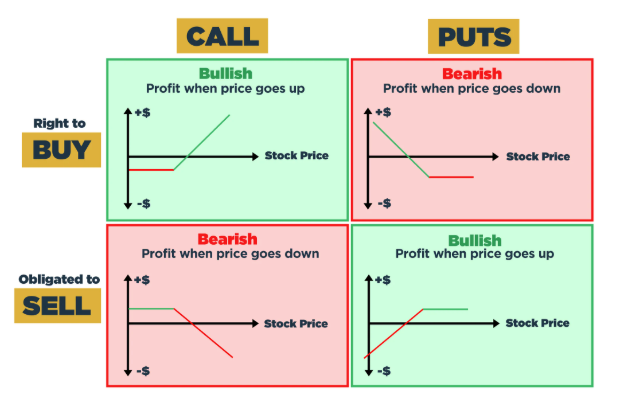
Explanation: When you buy a call, you are expressing a view that the stock will go up. If it does, your right to buy at the lower strike price becomes valuable. You profit when the stock rises above your strike price plus the premium you paid.
When it matters: You buy a call when you are bullish but want your downside capped at the premium. Instead of $20,000 in shares, you spend $500 on a call and control the same upside.
Put Option
Definition: A contract giving you the right to sell 100 shares at a fixed price before a specific date. Commonly also known as a Long Put Option.
Explanation: A put is the mirror image of a call. You profit if the stock falls. It gives you the right to sell at the strike price even if the market drops well below that level. Think of it as insurance on shares you own.
When it matters: You buy a put if you expect a stock to decline, or if you own shares and want downside protection without selling them.
To save you some time, this image guide tells you exactly what calls and puts are and when a trader profits from it.
Strike Price
Definition: The fixed price at which you can buy (call) or sell (put) the underlying stock.
Explanation: This is your locked-in price. If you buy a call with an $80 strike on Apple and Apple rises to $100, your right to buy at $80 is worth $20 per share. The strike is set before you enter the trade and does not change.
Moneyness (ITM / ATM / OTM)
Definition: A classification of whether an option currently has intrinsic value based on the stock price relative to the strike.
When it matters: Moneyness is how traders quickly assess risk and reward. We will break this down in the next section.
Premium
Definition: The upfront cost you pay to buy an option, or the payment you receive when you sell one.
Explanation: The premium is the price of the contract. As a buyer, this is your maximum risk: if the trade does not work, you lose the premium and nothing more. Premiums are quoted per share, so a $3.00 premium costs $300 per contract (100 shares).
When it matters: The premium determines your breakeven. For a call, you break even when the stock reaches the strike price plus the premium paid.
Underlying Asset
Definition: The stock, ETF, or index the option contract is based on.
Explanation: Every option is tied to a specific asset. When you buy a call on Apple, Apple stock is the underlying. The option's value moves in relation to how the underlying price changes.
When it matters: You always start here. Before looking at options chains or premiums, decide which stock or ETF you want exposure to.
Expiration Date
Definition: The deadline by which you must exercise the option or let it expire worthless.
Explanation: Every option has a countdown. After expiration, the contract ceases to exist. Options with more time cost more because there is more time for the stock to move in your favour.
When it matters: Short-term options (7 to 30 days) are cheaper but give less time. Longer-term options (365+ days, called LEAPs) cost more but give the stock more runway.
Options Style: American vs European
Definition: The rules governing when you can exercise an option.
Explanation: American-style options can be exercised any time before expiration. European-style can only be exercised on the expiration date itself. Most U.S. stock options are American-style.
What is Moneyness and how does this affect your options contract
Moneyness is a term that describes whether an option currently holds intrinsic value. It is defined by the relationship between an option's strike price and the current market price of the underlying asset.
In-the-Money (ITM)
An option is ITM when it has intrinsic value, meaning exercising it right now would be profitable (before accounting for the premium).
Call: Stock price > Strike price. Apple at $200, your call strike is $180. You could buy at $180 and sell at $200 = $20 intrinsic value.
Put: Stock price < Strike price. Apple at $170, your put strike is $200. You could sell at $200 when the stock is worth $170 = $30 intrinsic value.
Why it matters: ITM options cost more because they already have real value. Higher probability of profit, but higher upfront cost.
At-the-Money (ATM)
An option is ATM when the stock price is approximately equal to the strike price.
Call: Apple at $200, call strike at $200. No intrinsic value, but the slightest move upward puts you in profit.
Put: Apple at $200, put strike at $200. A slight move downward and you are profitable.
Why it matters: ATM options sit at maximum uncertainty. They carry the most time value (the speculative portion of the premium) relative to their price. Popular with traders expecting a big move in either direction.
Out-of-the-Money (OTM)
An option is OTM when it has no intrinsic value. Exercising right now would lose money.
Call: Stock price < Strike price. Apple at $200, call strike at $220. You would not buy at $220 when it trades at $200.
Put: Stock price > Strike price. Apple at $200, put strike at $180. You would not sell at $180 when the open market pays $200.
Why it matters: OTM options are cheap because they are purely speculative. High potential percentage returns but a lower probability of profit. If the stock does not move enough, they expire worthless.
Moneyness at a Glance for Easier Understanding
|
Category |
Call Condition |
Put Condition |
Key Trait |
|
ITM |
Stock > Strike |
Stock < Strike |
Has intrinsic value; costs more, higher probability |
|
ATM |
Stock ≈ Strike |
Stock ≈ Strike |
Maximum uncertainty; most time value |
|
OTM |
Stock < Strike |
Stock > Strike |
No intrinsic value; cheapest, lowest probability |
Options Buyer and Options Seller
Every option strategy, from the simplest to the most complex, is built from two contract types. Call options and put options. Every strategy you will ever learn (covered calls, spreads, straddles, iron condors) is just a combination of these two building blocks. Beyond understanding what call and put options are, it's also essential to know the roles played by the buyer and the seller within the options contract.
Buying vs Selling Options
This distinction matters more than most beginners realise. When you buy an option, you pay a premium and gain a right. Your risk is limited to the premium. When you sell (or "write") an option, you collect a premium and take on an obligation. Your risk can be substantially higher.
As a buyer, time works against you because your option loses value every day. As a seller, time works for you because the option you sold decays toward zero.
Basically, as you hold the position as a seller, you are slowly realising your premium received. And every day that the buyer holds their position, they are slowly losing their premium paid.
Read more about time decay in our Stock Options Trading Beginner Guide.
This dynamic is crucial to understanding why some traders prefer buying options while others build strategies around selling them. While there are no guarantees on which methods work better, starting with the basics of selling options should provide you with the confidence and room to learn more about options before diving into more complex strategies.
Final Thoughts
Knowing the basics and terminology of options trading is only the first step; proficiency emerges through dedicated practice and navigating real-world market complexities. Options are sophisticated financial derivatives, and the most successful options traders continue to leverage fundamental investment analysis to thoroughly understand the underlying assets and businesses before placing any trades.
So before trading options, you should ask if you thoroughly understand the underlying stock or ETF, as the options contract's value is intrinsically linked to the asset's price movements and health. Being aware of the company's financials, market position, industry trends, and upcoming events is crucial for informed decisions. Without this knowledge, options trading no longer becomes a calculated investment.
Note: This information is educational and should not be considered financial advice. Options trading involves significant risk and is not suitable for all investors.








submit your comment