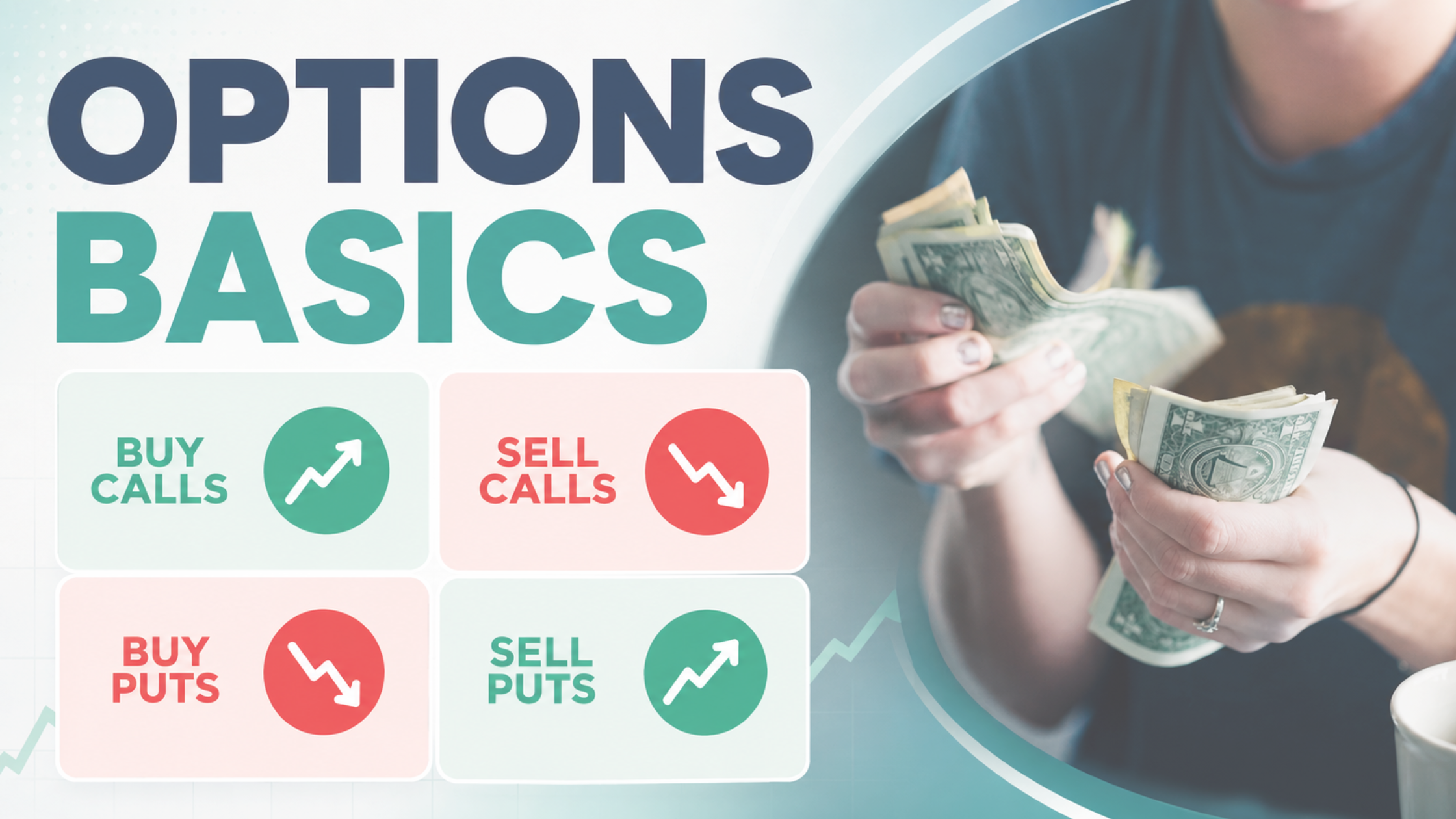
In this guide, we’ll break down calls and put options using simple, real examples you can easily understand. We’ll focus on just four basic core strategies,
You’ll also learn how to read the options chain, that “messy table” filled with numbers inside your brokerage account. More importantly, what those numbers actually mean. By the end, what once looked confusing will start to make sense, giving you the ability to navigate options.
What is Calls, Puts and the relationship between the Buyer and the Seller
Before diving into examples, you need to understand two basics: what calls and puts are, and how the buyer and seller interact in every options trade.
Call Options Buyer and Seller
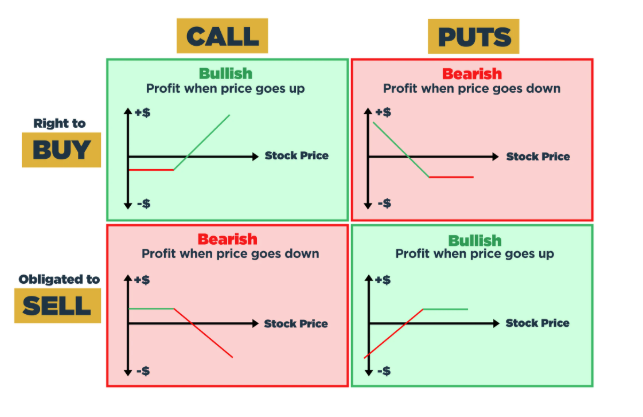
As a buyer of a call option, you’re paying for the right to buy a stock at a fixed price (strike price). Traders typically buy calls when they expect the stock to go up (bullish view).
As a seller of a call option, you’re taking on that obligation to sell your stock at the agreed price (strike price). In return, you collect a premium upfront. If the stock stays below the strike price, you keep the premium as profit. If the stock goes above the strike price you sell them your stock at the agreed price.
To find out more about calls and puts in options, check out our options trading for beginner guide here.
Put Options Buyer and Seller
As a put buyer, you’re paying for the right to sell a stock at a fixed price (strike price). This is usually done when you expect the stock to go down (bearish view).
As a put seller, you’re obligated to buy the stock at that price (strike price).
You collect a premium upfront, and if the stock stays above the strike, you keep the premium. If not you have to buy the stock at the strike price.
Here is a simple table/image for you to visualise how everything fits together:
Reading the Options Chain Table
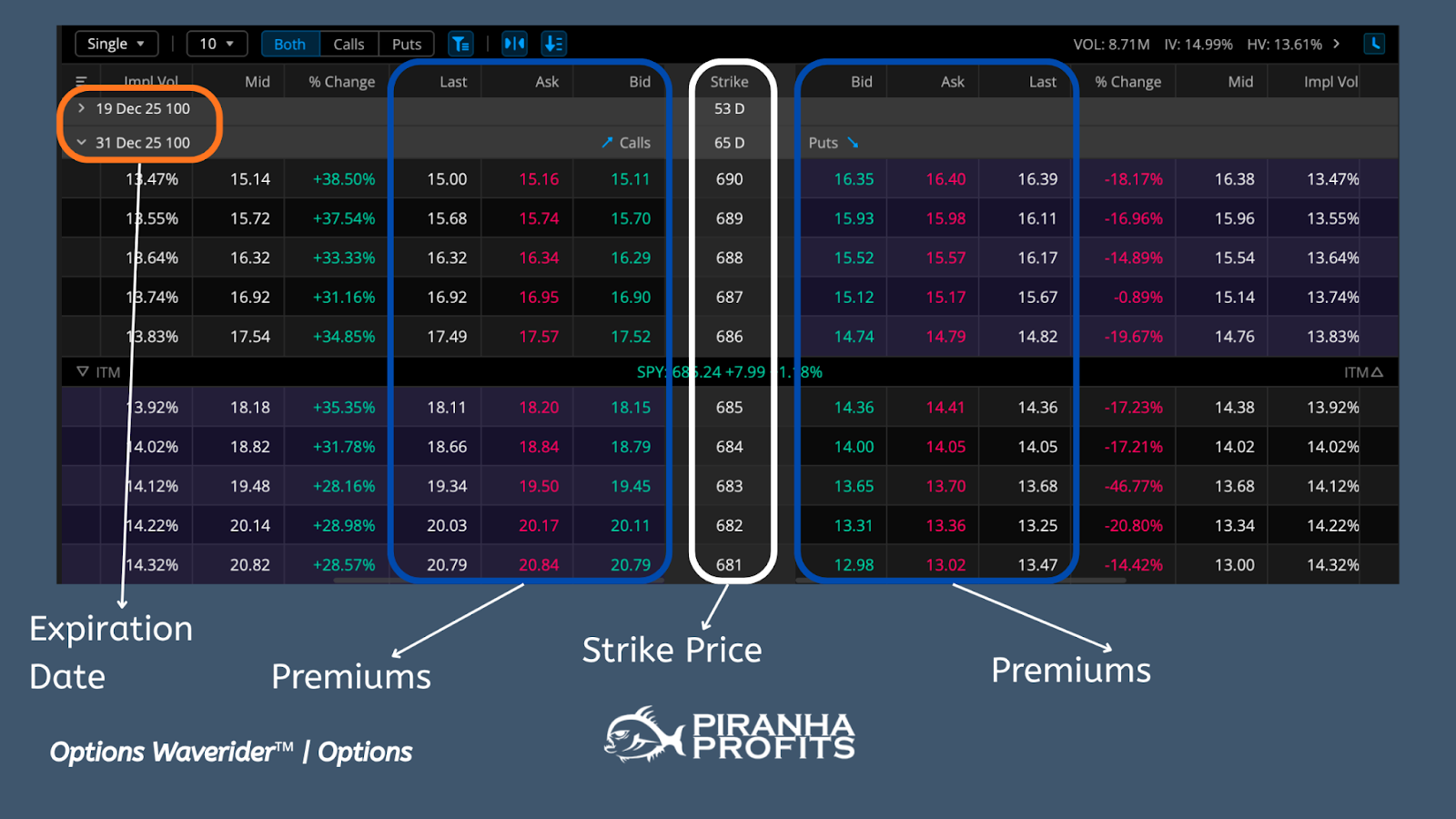
The image above shows a typical options chain table you’ll find in your broker account.
The table is split into two sides , Calls on the left and Puts on the right
If you only see one side of the table, it’s usually just a display setting you can toggle.
Next, you’ll notice a row of expiration dates. These are the different timeframes for the options. When you click on a specific date, it should expand into the full table showing all available contracts for that expiry.
Inside, you’ll see key columns like:
- Strike Price
- Last Price
- Bid
- Ask
Here’s what those prices actually mean:
- Bid: The highest price a buyer is willing to pay
- Ask: The lowest price a seller is willing to accept
- Last: The price of the most recent trade
All of these represent the option’s premium, the price of the contract.
If you’re buying, you usually pay near the ask. And if you’re selling, you usually receive near the bid
That small gap between bid and ask? That’s called the spread and yes, that’s where some of your money quietly disappears if you’re not paying attention.
Selecting the bid or ask will typically prompt an order form to pop up.
Additionally you might also see things like :
IV - This reflects how much the market expects the stock to move. Higher IV means higher premiums and Lower IV means cheaper options
Think of it like insurance pricing. More uncertainty = higher cost.
Open Interest - This shows how many option contracts are currently active. Higher open interest means more liquidity and lower open interest usually means it’s harder to trade, wider spreads
In simple terms, it tells you whether people are actually trading that contract or if you’re alone in the desert. If you are trading the SPY, usually open interest is high due to high liquidity. However in lesser known stocks or ETF, open interest might be low.
SPY is an exchange-traded fund (ETF) that tracks the S&P 500 index, giving investors exposure to 500 of the largest publicly listed companies in the United States in a single trade.
Read more about Options in our full Options Guide for Beginners.
Long Call (Buying a Call) with Example

The examples and tables shared are for educational use exclusively and do not constitute financial advice.
For simplicity, the example above only shows the call side of the options chain.
Let’s walk through a Long Call With Example.
Assume SPY is currently at $650, and you decide to buy a $652 call because you are very bullish about the S&P500 near term performance.
From the options chain:
- The bid price is 11.91
When you click on that the bid price, your broker will open an order ticket where you will choose:
- Number of contracts
- Your entry price
Say you buy 1 contract, which in this case means 100 shares. If you buy at 11.91, your total cost will be :
11.91 × 100 = $1,191
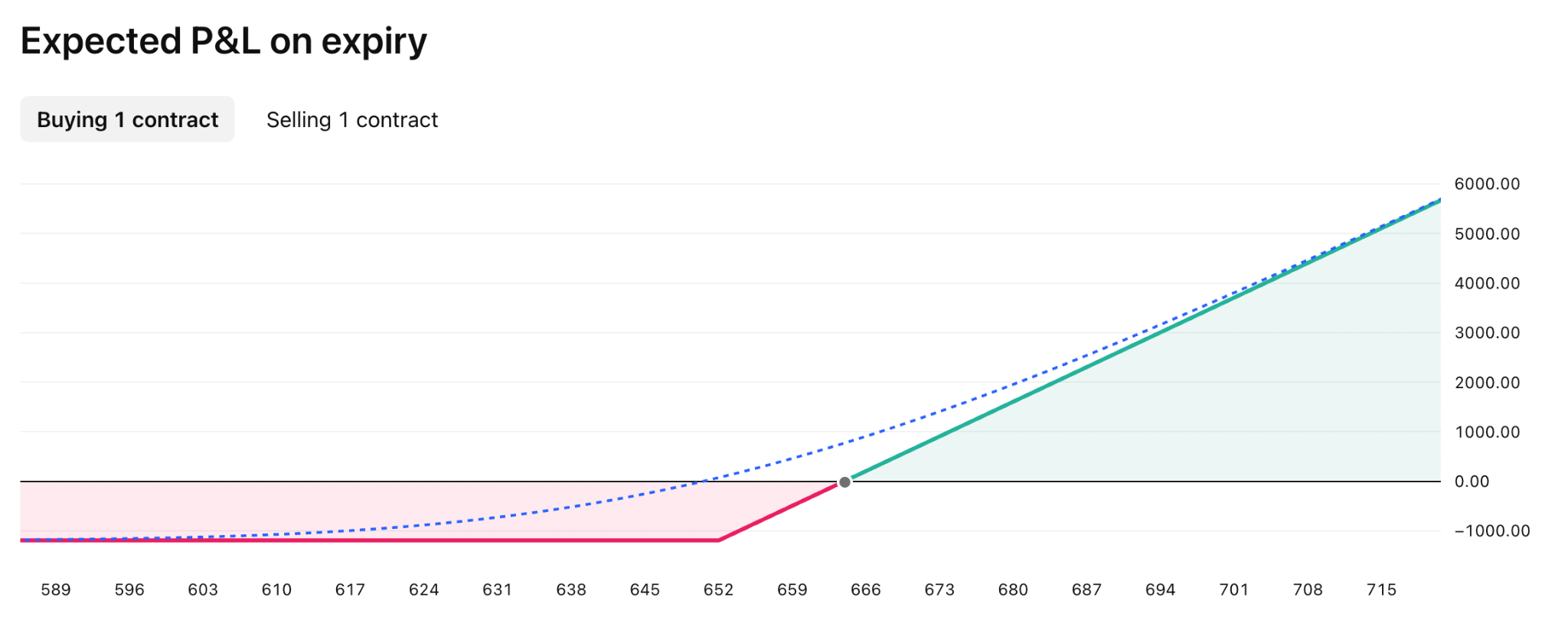
Before you enter the trade, the P&L chart will tell you how your position behaves over time. The solid line represents your profit or loss if you hold the option all the way to expiry. If SPY moves higher, your call becomes more valuable and your profit increases. If SPY stays below the strike price, the option gradually loses value and can expire worthless. But your losses is capped at your premium paid ($1191).
The dotted line shows your current P&L based on today’s conditions. Since options have a time component, their value is affected not just by price movement, but also by time decay. As expiration approaches, this dotted line will gradually shift and move closer to the solid line.
Short Call with Example

The examples and tables shared are for educational use exclusively and do not constitute financial advice.
The example above only shows the call side of the options chain for easier reference.
Now let's walk through a Short Call With Example.
Let’s again assume SPY is currently at $650, and you decide to sell a $652 call.
From the options chain:
- The Ask price is 11.98
When you click on the ask price, your broker will open an order ticket where you choose:
- Number of contracts
- Your entry price
If you sell at 11.98, your total premium received will be :
11.98 × 100 = $1,198
(Each option contract controls 100 shares)
Before you get excited over the premium earned just from selling calls, find out more about short calls and covered calls.
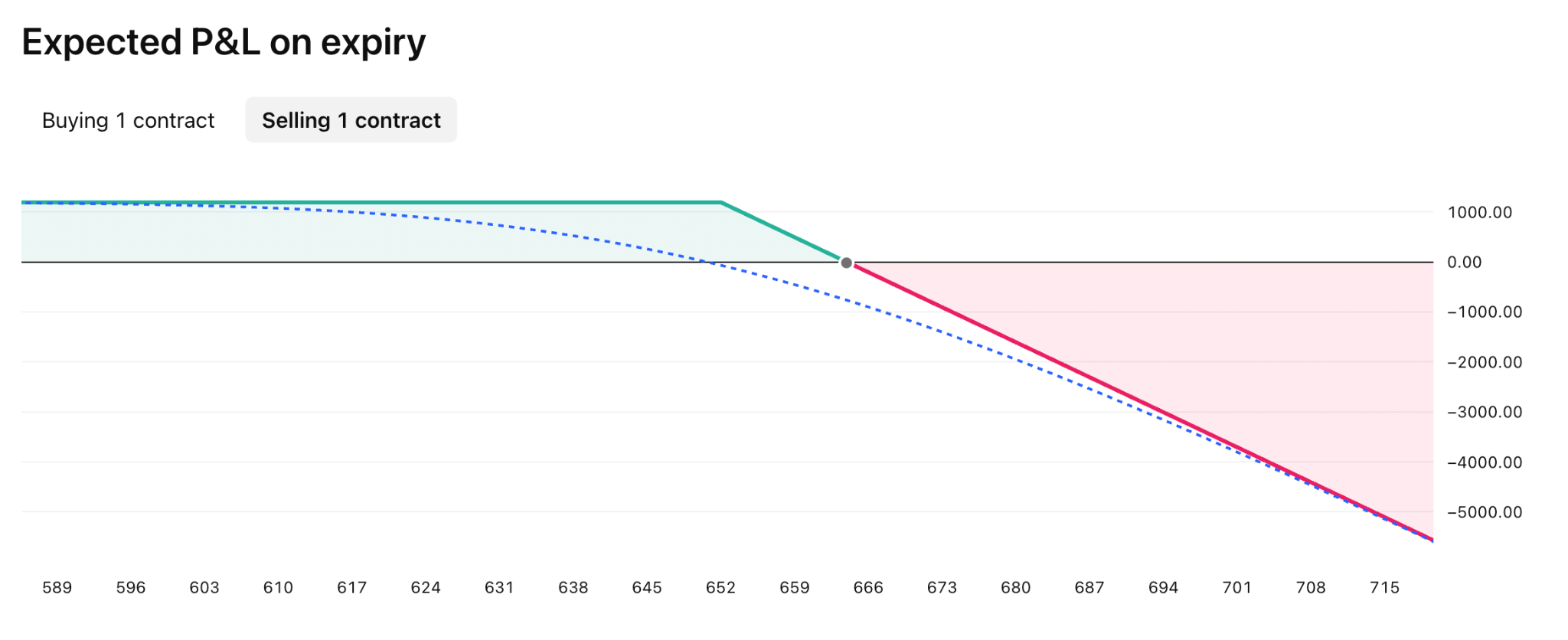
Now let’s look at the P&L chart of a short call.
Your maximum profit is capped at the premium received ($1,198), shown in green. This is the best-case scenario where the option expires worthless and you keep the full premium. This means that SPY stayed below your strike price all the way till expiration.
However, your risk is where things get a little uncomfortable. If SPY continues to rally, your losses can keep increasing, and the premium you collected won’t be enough to offset those losses. As shown in red in the P&L graph.
In other words, the downside is theoretically unlimited if you don’t own the unlying stock.
This is why selling calls can be dangerous when done naked. A naked call means you’re selling a call option without owning the underlying stock. If the buyer exercises the option, you’re obligated to deliver the shares but since you don’t own them, you’ll have to buy them from the market at whatever price it’s trading at.
If the stock has surged significantly, you’re essentially forced to buy high just to sell lower, locking in a loss.
Long Put with Example
The examples and tables shared are for educational use exclusively and do not constitute financial advice.
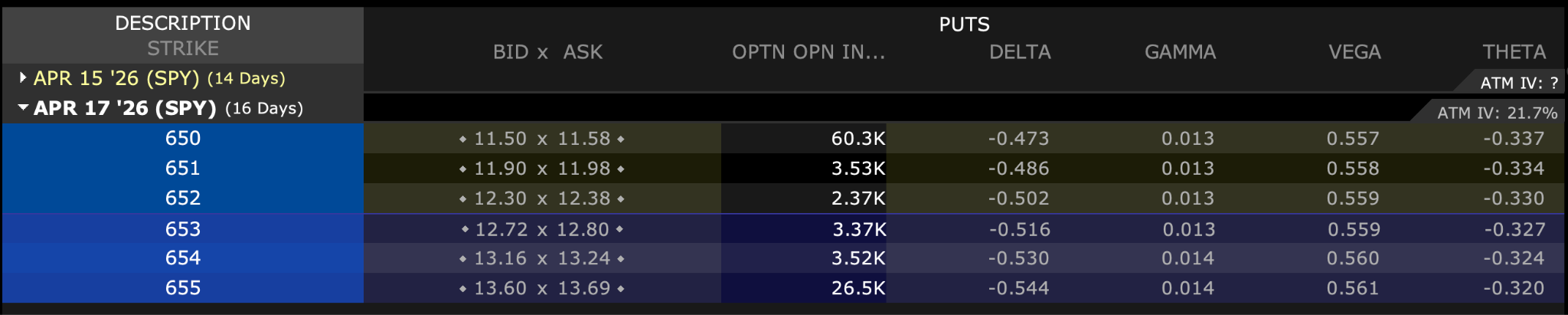
Now, let’s move on to the put side of options. Again for simplicity, the example above only shows the put side of the options chain table.
Let’s walk through a Long Put With Example.
Say SPY is currently at $650, and you decide to buy a $650 put because you have a very bearish view of the S&P500 in the near term.
From the options chain:
- The Bid price is 11.50
When you click on that price, your broker will open an order ticket where you choose:
- Number of contracts
- Your entry price
If you buy at 11.50, your total cost will be :
11.50 × 100 = $1,150
(Each option contract controls 100 shares)
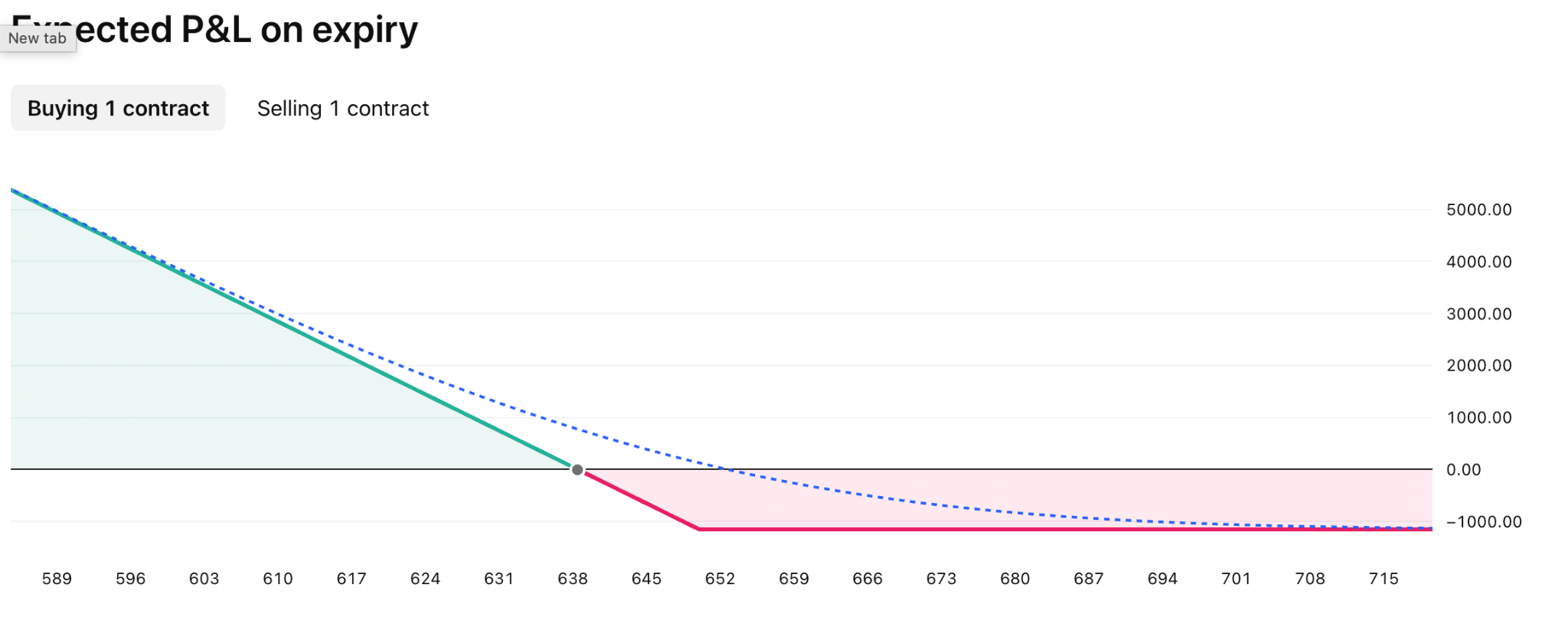
The P&L of a long put is essentially the mirror image of a long call. The solid line shows your profit or loss if you hold the option all the way to expiration. If SPY drops significantly past your breakeven point, the green area reflects your potential profit as the option increases in value.
At the same time, your downside is limited. The most you can lose is the premium you paid for the contract ($1,158) . Even if SPY doesn’t move as expected, or only drops slightly, your loss is capped at that upfront cost.
One important thing you might have noticed is the breakeven point as buyers(long position holders). As a buyer of calls or puts, you’re paying a premium to enter the trade, which means the stock has to move enough to cover that cost before you actually become profitable.
In this example, SPY doesn’t just need to drop, it needs to drop far enough. A small move down won’t suffice, because your breakeven sits lower, somewhere around $640. Until price crosses that level, you’re still not in the profit zone.
Short Put with Example
The examples and tables shared are for educational use exclusively and do not constitute financial advice.
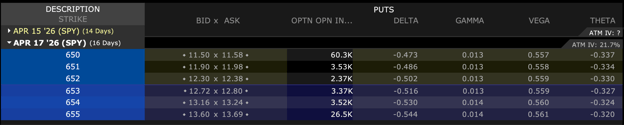
Now let's walk through a Short Put With Example.
Let’s again assume SPY is currently at $650, and you decide to sell a $650 put.
From the options chain:
- The Ask price is 11.58
When you click on that price, your broker will open an order ticket where you choose:
- Number of contracts
- Your entry price
If you sell at 11.58, your total premium received will be :
11.98 × 100 = $1,158
(Each option contract controls 100 shares)
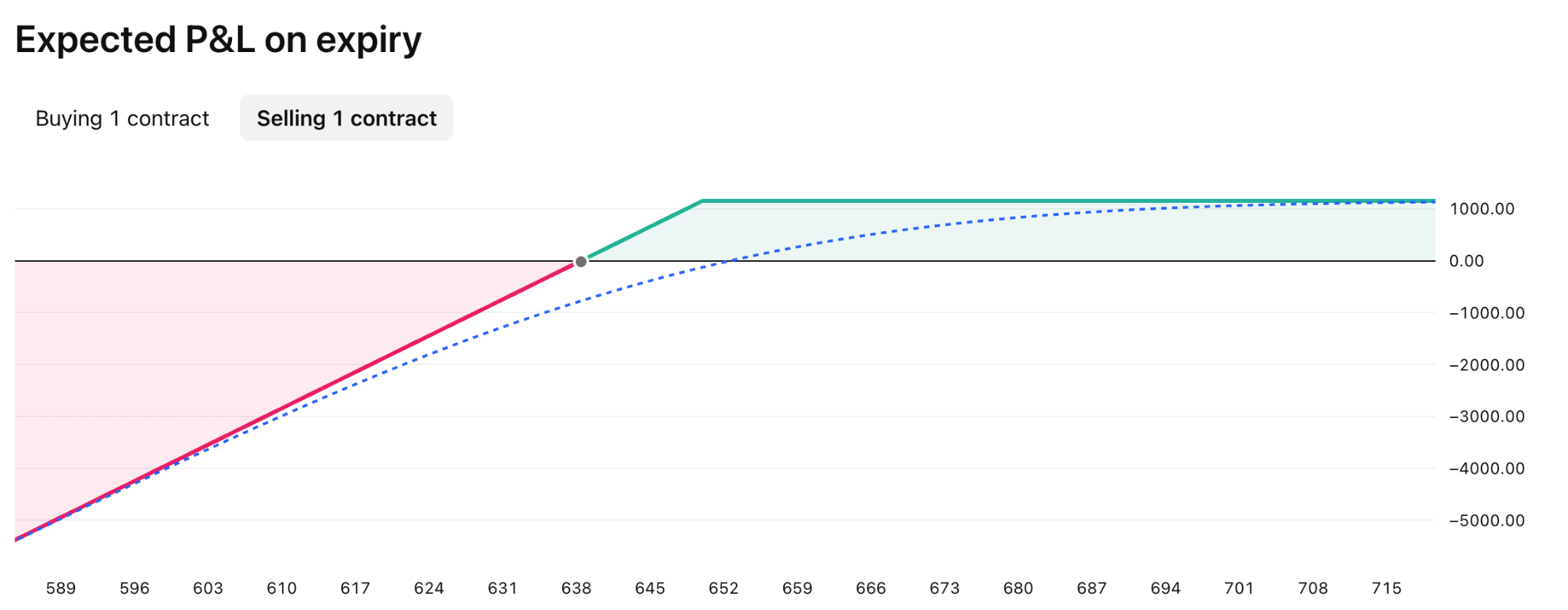
Your maximum profit is capped at the premium received ($1,158), shown in green. This is the best-case scenario where the option expires worthless and you keep the full premium, meaning SPY stays above your strike price throughout the contract.
The risk comes in if SPY starts to drop, as shown in red. As the price falls below your strike, your losses begin to increase because you’re obligated to buy the stock at that higher price (strike price at $650).
While the loss isn’t technically unlimited (since a stock can only fall to $0), it can still be substantial, especially if the stock drops sharply.
Selling options naked means taking on obligations without having the capital to back them up. In the case of a naked put, you’re selling a put without enough cash to buy the shares if assigned. If the trade moves against you, you could be forced to liquidate positions or face a margin call.
This is why many traders prefer cash-secured puts. By setting aside the full amount needed to buy the stock, you define your risk upfront while still collecting premium income. It’s a controlled approach, especially crucial when you’re starting out.
Final Thoughts
When it comes to options, the same rule as investing applies: do your homework before entering any trade. The worst situation you can put yourself in is being stuck in a position you don’t understand or don’t want to hold. For example, selling a naked call because you think the stock won’t move any higher, only for it to rally hard due to a catalyst event. Suddenly, you’re in a position where losses can keep growing.
Options provide leverage, and that leverage cuts both ways. It can amplify gains, but it can just as easily magnify losses. Understanding what you’re doing is the first step to managing risk.








submit your comment