Many investors use the S&P 500 index, specifically ETFs like SPY or VOO, as a benchmark to evaluate their portfolio's performance. However, when examining the Year-to-Date (YTD) performance for 2026, the data currently shows an unremarkable picture, appearing broadly flat or slightly down for the year. This lack of movement might lead most people to quickly assume the market is stagnant.
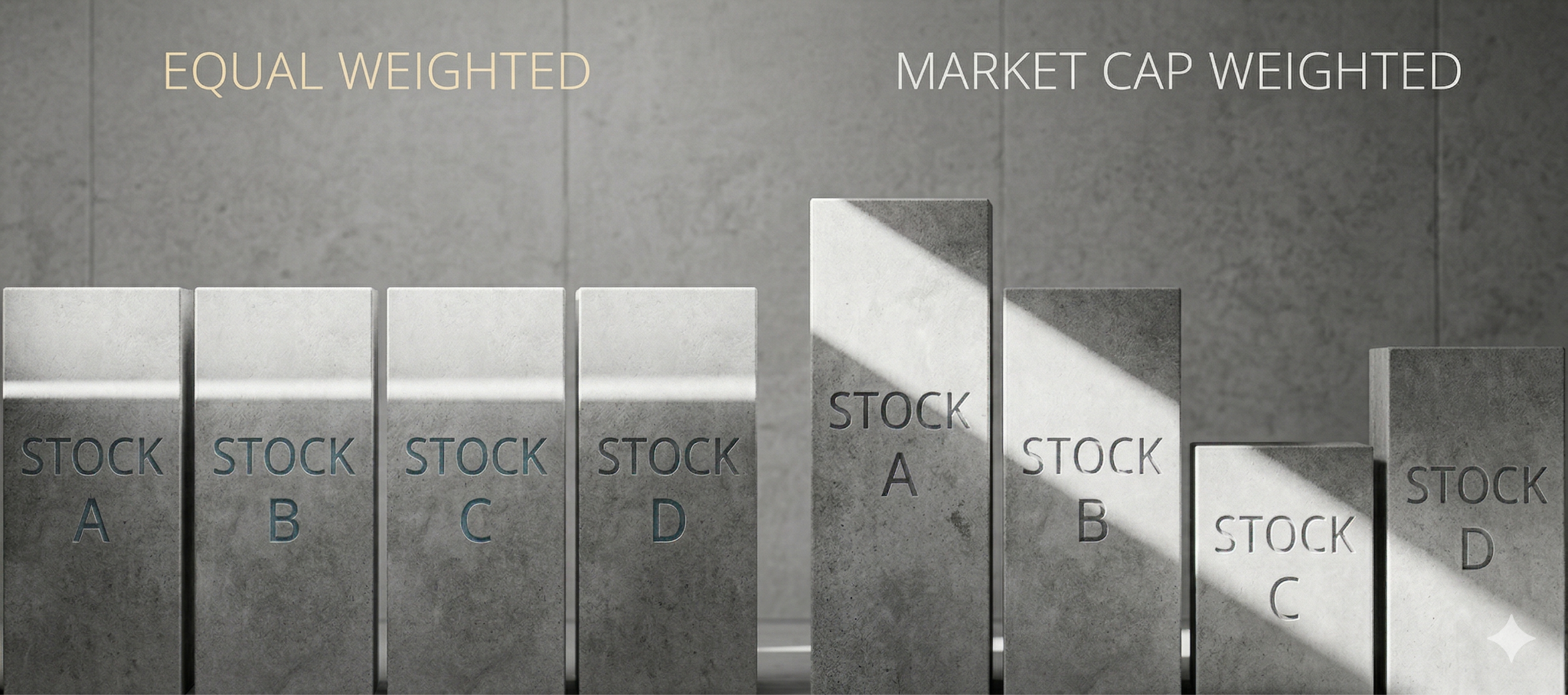
Here’s what most people don’t realize: there’s another ETF tracking the exact same 500 companies, and it’s actually up roughly 4% in the past 6 months as compared to 0.45% for SPY and VOO.
Same companies, same index, different returns. The ETF is RSP, the Invesco S&P 500 Equal Weight ETF and the divergence between it and SPY tells a story that the headline number alone cannot.
The key difference comes down to one thing: how each fund is constructed. And understanding that construction is key to making sense of what’s really happening beneath the surface of the S&P 500 this year.
Cap-Weighted vs Equal-Weighted: Two Versions of the Same Index
In a cap-weighted index like SPY/VOO, each company’s influence on the overall performance is proportional to its market value. The bigger the company, the more it moves the index.
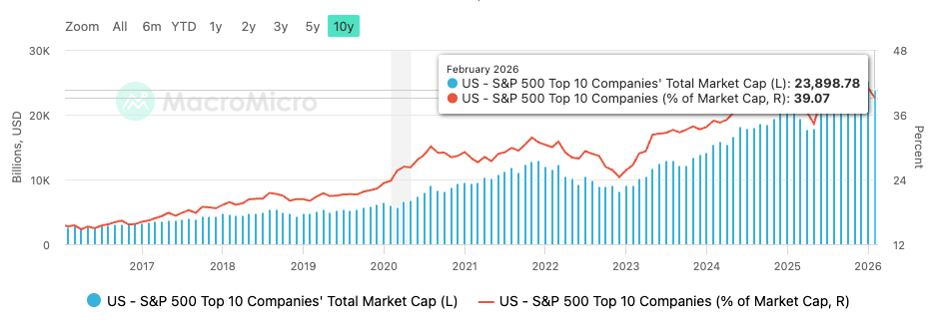
As of February 2026, 39% of the market cap is dominated by the top 10 market cap companies in the US.
This means that a handful of mega-cap stocks like Apple, Microsoft, Nvidia, Amazon, Alphabet, Meta, and Tesla make up a huge chunk of the entire index. Just 2% of the companies in the S&P 500 can determine over a third of SPY/VOO direction. When those 10 stocks rally, SPY and VOO surge. When they stumble, the index appears to stall, even if the other 493 companies are doing well.
RSP takes an entirely different approach. Instead of weighting by market cap, it gives each of the 500 companies an equal allocation of roughly 0.2%, rebalancing back to that equal split every quarter. This means that a mid-cap industrial company has the same influence on RSP’s performance as Apple or Nvidia. With RSP, you’re exposed to all 500 U.S. companies in a balanced way, rather than riding on the coattails of a handful of mega-cap tech names.
SPY vs VOO vs RSP: A Side-by-Side Comparison
Before diving deeper into the dynamics at play, let’s lay out the key metrics across all three ETFs that as investors we need to consider.
|
SPY |
VOO |
RSP |
|
|
Weighting Method |
Market-Cap |
Market-Cap |
Equal Weightage |
|
Expense Ratio |
0.09% |
0.03% |
0.2% |
|
AUM (Approx) |
$570 billion |
$1.5 trillion |
$89 billion |
|
Top 10 Concentration |
~35% (Fluctuates based on market-cap) |
~35% (Fluctuates based on market-cap) |
~2.8% |
|
Dividend Yield |
~1.12% |
~1.09% |
~1.65% |
|
Rebalancing |
Continuous |
Continuous |
Quarterly |
|
Inception |
1993 |
2010 |
2003 |
A few things stand out immediately. VOO is the cheapest at 0.03%, making it the go-to for cost-conscious long-term investors. SPY, while slightly more expensive at 0.09%, offers the deepest liquidity, particularly important for options traders.
RSP’s 0.20% expense ratio is higher, but the structural difference it offers is the real story here.
The most striking figure in the table is the top 10 concentration. In SPY and VOO, approximately 35% of your investment is determined by just 10 companies. In RSP, that figure drops to roughly 2.8%.
SPY vs VOO vs RSP: Performance Comparison
Powered by TradingView
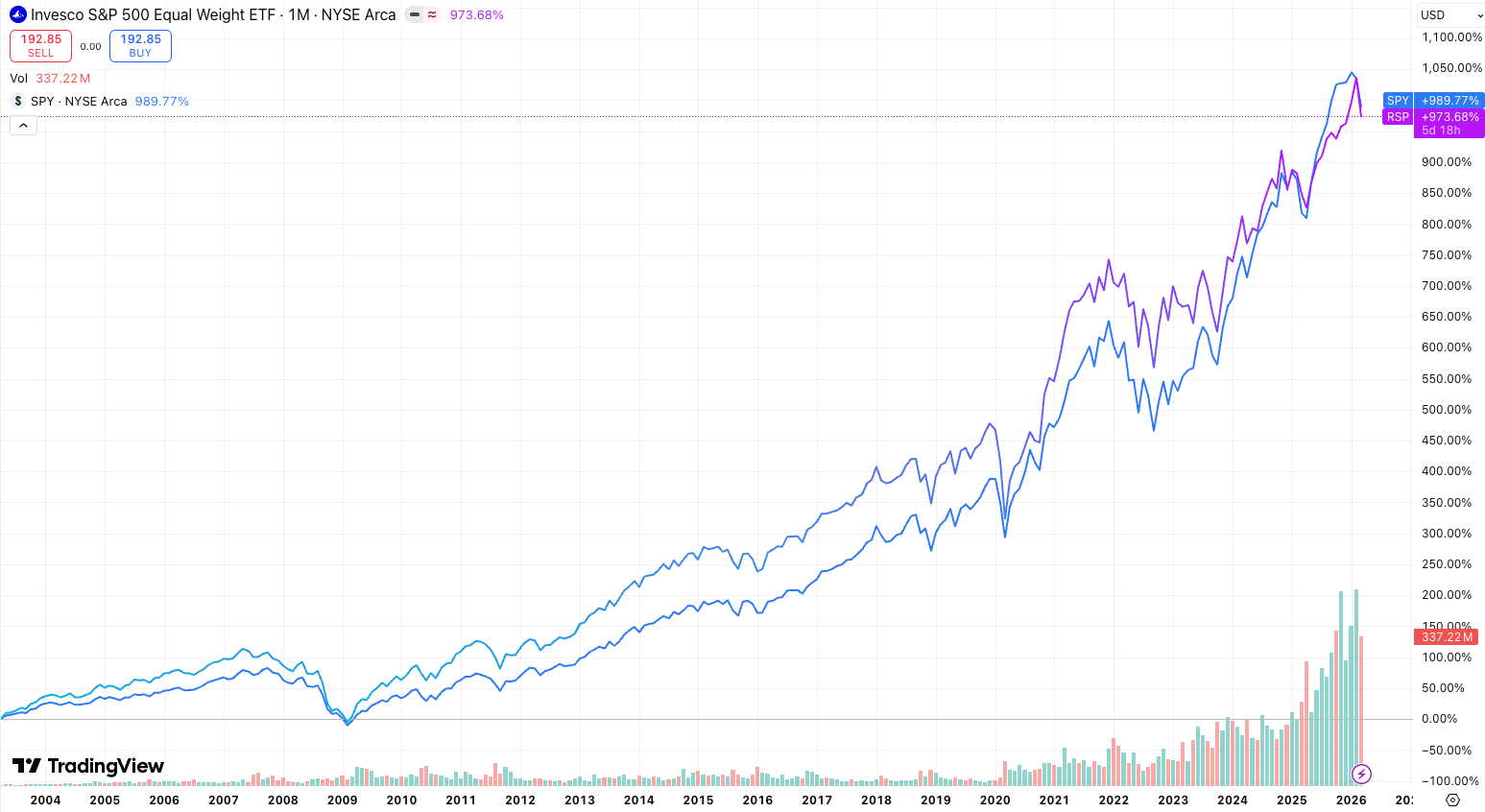
Neither cap-weighting nor equal-weighting is inherently superior. That’s one of the most important things to understand. In the long run, they achieved very similar results. They are simply different views on how the market is structured and historically, their relative performance moves in clear, identifiable cycles that map onto broader market regimes. Let us dive in deeper.
2003–2014: RSP’s Decade of Outperformance
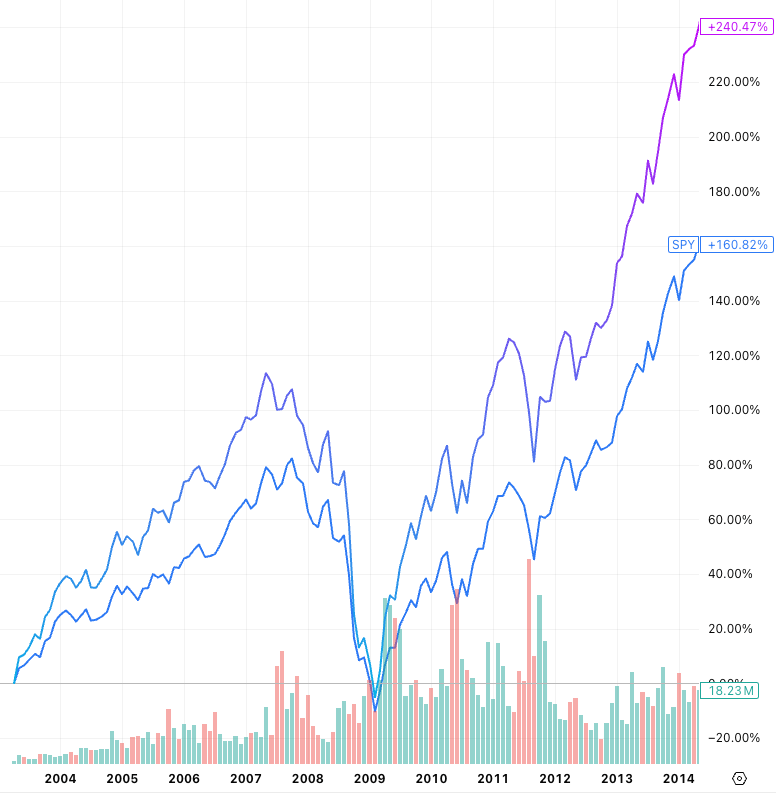
For the first decade of RSP’s existence, equal-weighting was the better bet in most years. Coming out of the dot-com wreckage, broader market participation drove returns. The market wasn’t being carried by a handful of names. Recovery was widespread, and equal-weighting captured that breadth perfectly.
Powered by TradingView RSP outperformance 2023 - 2014
The pattern repeated after the Global Financial Crisis. In 2009, RSP returned approximately 44%, compared to SPY’s 28%. And it wasn’t just that single year. In almost every subsequent year through to around 2014, RSP continued to outperform. When the market recovers broadly from a steep selloff, the smaller and mid-cap names that RSP gives equal voice to, tend to bounce back more aggressively than the mega-caps that tend to dominate SPY.
Any past performance mentioned is not indicative of future results.
2015–2024: The Mega-Cap Dominance Era
Then the tide shifted. From around 2015 onward, the rise of mega-cap technology companies changed the dynamics entirely. As companies like Apple, Amazon, Microsoft, Alphabet, and later Nvidia grew to enormous market capitalizations, their outsized performance pulled cap-weighted indices like SPY and VOO sharply ahead. Concentration risk, which can be considered a vulnerability, was actually being rewarded.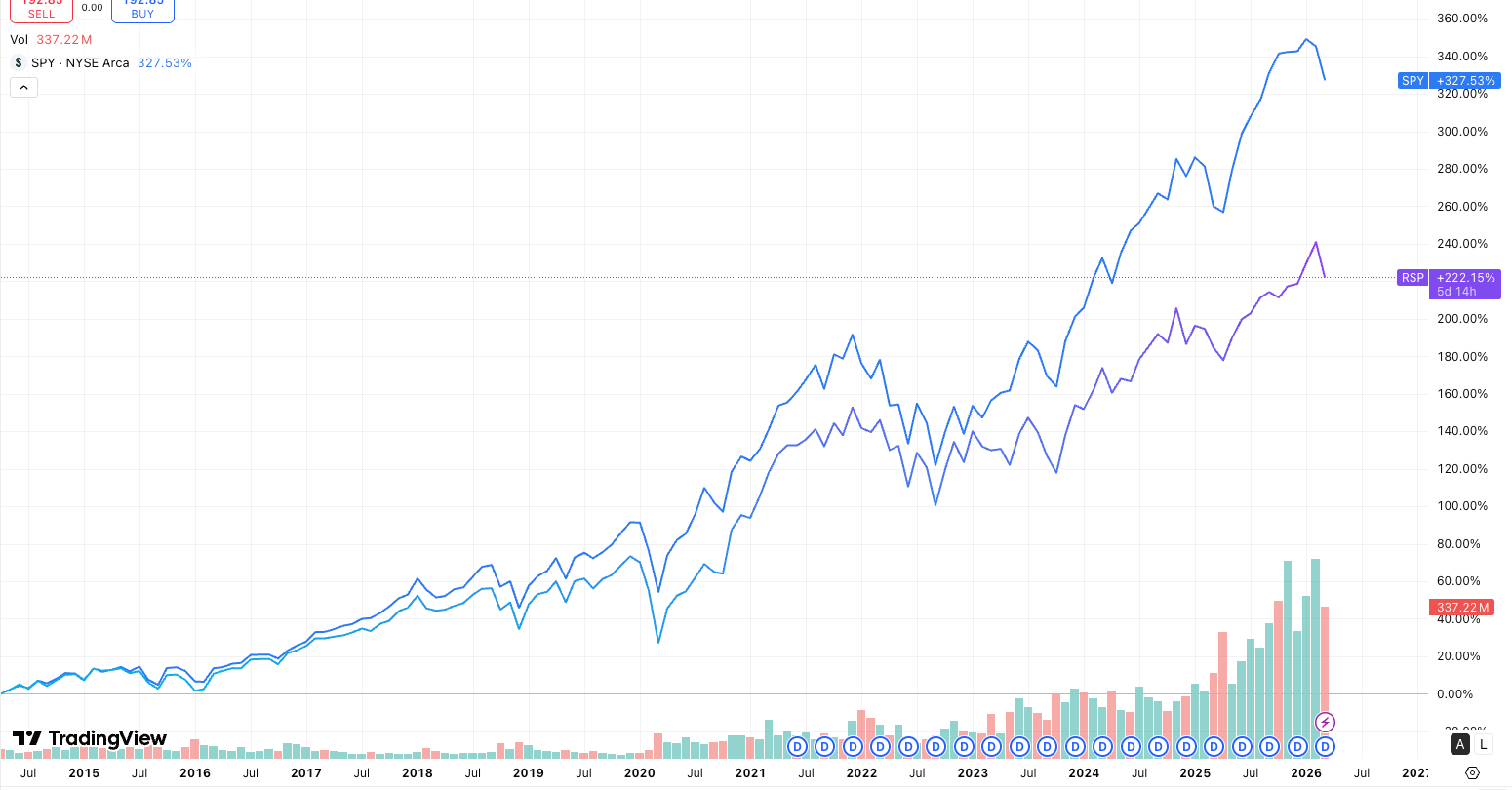
Powered by TradingView SPY outperformance 2014 - 2025
During this period, the Magnificent Seven drove an increasingly large share of the S&P 500’s total returns. RSP, by design, couldn’t participate in that concentration. For investors in cap-weighted funds, this was a golden decade. For RSP holders, it was a period of relative underperformance, not because the broader market was weak, but because a small group of stocks was exceptionally strong.
2025–2026: The Inflection Point
And now we arrive in 2026. The Magnificent Seven’s earnings growth is slowing. Profits for these seven companies are projected to grow approximately 18% this year. While still impressive, it’s the slowest pace since 2022. Meanwhile, the remaining 493 companies in the S&P 500 are projected to deliver around 13% earnings growth.
The key here is the gap itself. When the earnings growth differential between the top-heavy names and the broader market narrows, the valuation premium those mega-caps command becomes harder to justify. This is what we’re seeing play out: a rotation out of concentrated mega-cap positions and into the broader market. The index looks flat because these two forces are offsetting each other, the Magnificent Seven slowing down while the other 493 accelerates.
For RSP, which treats every company equally, this broadening of market participation is where it thrives.
What This Means for Investors
The SPY-versus-RSP divergence isn’t just an interesting data point, it carries real implications for how investors think about their portfolio construction. The choice between cap-weighted and equal-weighted exposure comes down to a view on where market leadership is heading.
The Case for SPY / VOO (Cap-Weighted)
If you believe that mega-cap technology companies will continue to lead, and that the premium investors pay for quality and scale is justified, then SPY or VOO remains the more efficient vehicle. Cap-weighting naturally allocates more capital to the winners. And when the winners keep winning, that concentration becomes an advantage.
The Case for RSP (Equal-Weighted)
If you believe the market is broadening. The earnings growth gap between mega-caps and the rest of the index will continue to narrow, and we're entering a regime where broader participation drives returns. RSP offers a more diversified view on the entire U.S. large-cap universe.
Equal-weighting also provides a natural contrarian rebalancing mechanism: by resetting to equal weights each quarter, RSP systematically trims winners and adds to laggards, which historically creates a small but persistent rebalancing premium over time.
RSP also offers slightly higher dividend yield at approximately 1.65% versus 1.1% for SPY/VOO, given its greater exposure to traditionally higher-yielding sectors like utilities, financials, and industrials that are diluted in cap-weighted indices where the big tech dominates.
The Bigger Picture: Staying Invested Matters More Than Picking the “Right” ETF
Here’s perhaps the most important takeaway from this entire comparison. Historical data consistently shows that the investors who generate the strongest long-term returns aren’t the ones who made the smartest tactical call at every turning point. They’re the ones who stayed invested through the noise.
Whether you choose SPY, VOO, RSP, or a combination of all three, the evidence suggests that the most important decision isn’t which version of the S&P 500 you own. It’s that you own it. And that you stay in it.
This analysis is shared for educational purposes to illustrate how different index construction methodologies affect portfolio outcomes. It is not intended as financial advice or a recommendation on any investment.











submit your comment